Skip to content

Pegasus Librarian* Posts

What Writing Can Teach Us

This morning was the first of three consecutive mornings that I’ll be spending reading the sophomore writing portfolios at my college. This is my first time reading such things, and I must say that it’s kind of daunting.

You see, each year, all the sophomores turn in three to five examples of their writing from their first two years of college. Each year, some time soon after school gets out, a whole bunch of faculty and some staff (all volunteers) gather to read hundreds and hundreds of portfolios over the course of three mornings. And this year, I’m included in this bunch of readers.

Readers volunteer for a number of reasons. They want to see examples of assignments from other professors. They want to re-calibrate their own grading by reading masses and masses of writing. They want to intervene with students who need help. And the list goes on. It’s really fun to see a bunch of people taking on a task that just has to get done, but rather than just do it they reinvent it as a powerful professional development tool.

I’m there because my college is thinking of coming up with information literacy benchmarks for first- and second-year students. So another librarian and I are helping to read the portfolios not only to help make it through the boxes and boxes of papers, but also to find examples of information literacy at work and see if we can generalize our observations to help us develop an assessment matrix or a first-year info-lit initiative.

So far, after reading only a couple of portfolios, I’ve learned that:

  • underclassmen don’t understand citation, but that they can do it if guided
  • they are happy to use outside sources, but the sources control the writer rather than the other way around
  • that they think of “fact” and “interpretation” as much more distinct categories than they really are
  • and that I’m a very slow portfolio reader (I’ll really have to pick up the pace tomorrow… it’s been a long time since I was a regular writing tutor and could do this in my sleep.)

On a somewhat separate note, I’m quite happy that I can walk into a room full of faculty members and not only greet and be greeted by name, but also carry on conversations with them about everything from libraries to pedagogy to gardening and not feel out of place. I’ve worked hard this past year to build this kind of relationship, and it’s finally feeling less I’m “just staff.” In fact, all the librarians have been working at getting involved in all sorts of things across campus, and now we’re beginning to be invited to meetings as less of an afterthought. Slowly but surely…

(The Pinky and the Brain song comes to mind…) Tee hee hee.

1 Comment
Search Motivation and the Expert/Novice

I’ve been doing a lot of thinking and reading, lately, about what makes an expert and what makes a novice, especially when it comes to information seeking. There are all sorts of theories out there, but today I ran across one that really makes sense to me. There’s a discussion happening on the ngc4lib listserv at the moment called “What’s Better? Dumbed Down or Loaded with Functionality” (don’t get me started on the ideology of “either-or” that’s inherent in this question). Anyway, one responder made a comment that completely resonated with me. It’s a teeny little comment of just a couple of lines, but packed with implications. This person mentioned that even when he fails at a Google search, he continues looking and tweaking his search string because he’s “pretty darn sure” the answer’s there somewhere. This motivates him to keep looking.

And there you have it: one more piece in the expert/novice discussion. Novices have less knowledge of what’s out there to begin with, so they have less motivation to keep tweaking search strategies, so they are less likely to find what they’re looking for. This would also hinder their efforts to come up with viable research topics.

I don’t know how many students have come to me frustrated because they’re having trouble finding good stuff on depression in PsychInfo, and yet they’re unable to narrow their searches to a workable sub-topic because they don’t know what they’ll be able to find. To make matters worse, when they have spent 15 or 20 minutes not finding what they want, they ask if maybe they should change their topics, by which they do NOT mean refine… they actually mean CHANGE to a completely different topic. And then the cycle is repeated.

So file this away in the “how can I help with this” section of your brains. I don’t know how I’m going to help develop experts, yet, but I’m going to give it the old college try (just as soon as all the students get back from their summer vacations…[insert some pining for a summer vacation here]).

Leave a Comment

Flickr-ish Goodness

After spending the day playing with my new tech-toys, I’ve loaded photos into Flickr (while listening to the radio, no less). Then I ran around trying to figure out the Flickr identities of anyone I could think of and making them into contacts (still can’t find some people that I KNOW have accounts, but I’ll keep sleuthing). What fun!

I’m still a little miffed that it doesn’t let me order the photos on the main page my way, or if there is a way to do that I haven’t figured it out. But hey, I’ll live. Let the photo sharing begin!

Now my little head is buzzing with ideas for using my camera and Flickr account in the library. The possibilities are endless… though as yet un-articulated. All I know is that this could be FUN. The first things that came to mind were kind of pedestrian (things like creating illustrations for my web pages or instruction sessions). But now I’m wondering if there is any way to work this in to the idea that some co-workers and I have. We want to build social communities around research. We want communities that have an online space that allows for sharing, helping, commiserating, discussing, and generally HAVING FUN (are you catching my theme?). We have no concrete plans, but when has that ever stopped us? So anyway, I’m wondering if there’s some way to work the visual into all of this. Has anyone else tried this sort of thing? What did you do? What worked? What didn’t work? Are you still sane?

Well, after a long day of doing absolutely nothing, it’s time for P and me to wind down.

1 Comment

Rocketing into the Late-20th Century

I finally caved to a deep, dark desire. I finally bought a digital camera! Now that I’ve got my brand new Flickr account and this oh-so-cool camera, I can start sharing pictures like never before.

Oh, and I’m currently enjoying another essential of modern-day life that I bought today: my new tuner/DVD/CD player and speakers. They not only work well, but they look so very stylish (photos coming soon). Finally I have a sound system in my very own home, and the sounds is amazing. 🙂

[Update: You can see a picture of my new sound system, taken using my new camera, here.]

2 Comments

Google Spreadsheet Sharing

I haven’t played very much with Google Spreadsheets, yet, but I did share a test sheet with my co-workers, and it seems that I’ve given them automatic access to the beta test. So if anyone wants to have a peek, email me or leave me a comment (only gmail accounts work, though, so be sure you have one of those first [Update: I can get you one of those gmail accounts, too, if you need one. Just drop me a line or a comment]).

Leave a Comment

Audience Level Information

When I was at Computers in Libraries this year I saw Lorcan Dempsey’s presentation on “Exploiting the Value of Structured Metadata” (ppt slideshow) in which he showed a Greasemonkey script that inserts audience level information into Amazon records. At the time I just filed it way in the “huh, that’s interesting” part of my brain, but today it’s consumed more time than I’d prefer.

The backstory: At MPOW the Reference & Instruction librarians are responsible for collecting for the reference collection. Faculty members do most of our collecting for the main collection (with help from both an automated system and our collection development department), but the R&I librarians select the reference books. Well, it’s coming up on the end of the fiscal year and it seems that we’ve all been too busy to think much about this part of our jobs. I can’t speak for my colleagues’ organizational and piling skills, but I had a hanging file full of “unprocessed” (by which I mean “I haven’t looked at these at all”) Choice cards, Blackwell slips, and promotional postcards. Then I had a stack about 6 inches deep of catalogs and the larger promotional mailings. Most of you don’t know me and my office, but I don’t tend to let things pile up. I’m one of those who deals with things and then either files or throws them away.

So this was really starting to get on my nerves, but it just wasn’t very high on my priority list compared to all the other things I’ve been doing lately. Not only that, but I don’t consider this the most enjoyable part of being a librarian. I just don’t have enough of a sense of how to select the “good” stuff sight-unseen, and I don’t yet have a feel for the reference “gaps” for my liaison areas to go out and look for stuff (except that I know I want more encyclopedias and dictionaries for Asian literature, and specialized dictionaries in a couple of languages, but they’re pretty hard to come by).

To make a long ramble shorter, it turns out that we all need to concentrate on this task and spend our budget before next Tuesday afternoon or else the money disappears, so we’re all sitting in front of Amazon and sorting through catalogs and review cards and looking distinctly annoyed. I’m not sure if unsuspecting patrons would get better reference help today because we all want to do anything other than what we have to do, or if they’d get worse service because we’re all in such disgruntled moods. (On the up-side, I found a 272-page monograph on the history and development of the ellipsis… who knew?)

Anyway, I thought that this Greasemonkey script would really help me as I sorted through specialized dictionaries. I needed some clue, any clue, about how comprehensive and scholarly the works were. So I installed the Greasemonkey Firefox extension, installed the Amazon script, and restarted Firefox. All anticipation, I clicked over to Amazon, salivating over the wonderful new descriptive information on what types of libraries collect each book, opened a book record, and… nothing. What did I do wrong? None of the records have the promised “Audience Level” indicator. I’m so disappointed. [Update: Jeremy from OCLC research pointed out that the OCLC test server was down that day. Now everything works PERFECTLY. Yippee!!!]

Does anyone have any idea what I have to do other than have the extension and script installed?

6 Comments

All the Pretty Pictures

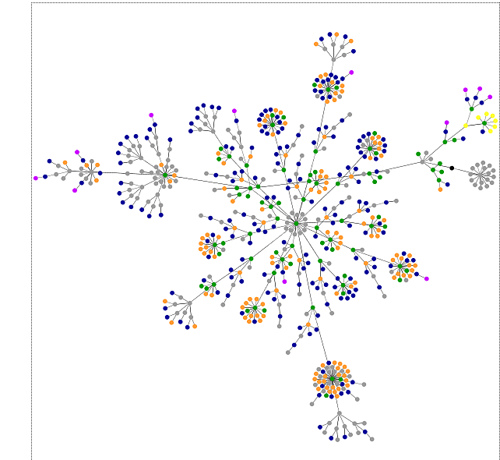
Ever wonder what your blog looks like as a graph (or a flower, depending on how you look at it)? This is mine.


Here’s what the colors mean.

  • blue: for links (the A tag)
  • red: for tables (TABLE, TR and TD tags)
  • green: for the DIV tag
  • violet: for images (the IMG tag)
  • yellow: for forms (FORM, INPUT, TEXTAREA, SELECT and OPTION tags)
  • orange: for linebreaks and blockquotes (BR, P, and BLOCKQUOTE tags)
  • black: the HTML tag, the root node
  • gray: all other tags

You can get your own graph/flower here, and see lots more graph/flowers here.

p.s. Blogger’s going haywire at the moment, so if you don’t hear from me for a bit, it’s not for lack of trying on my part.

Leave a Comment

Google Takes Over the World… With My Help

I did it. I signed up for Google Spreadsheets, and I just got my acceptance letter.

I don’t know why I feel a little sheepish about adding to the Google mania, but I can’t really justify not playing with something simply because the company comes out with a new product every two or three weeks. I always was a stubborn one, though. If everybody says I have to see a movie, I don’t see the movie… One of my less-admirable traits, I suppose.

Ah well. It’s only a little feeling of sheepishness, easily ignored, easily dismissed. Let the playing begin!

2 Comments

NextGen Catalog Listserv Debut

Yesterday Eric Morgan wrote to the Web4lib listserv wondering about starting up a new listserv exploring the catalog of the future (a topic that is becoming one of my de facto research areas because, well, I’m interested). Today it’s up and running and I’ve subscribed. You can join, too, by going here.

One of the interesting discussions that came up while deciding on the name of the list (ngo4lib for “next gen opac” was nixed because it sounds like a government agency… but I’m glad it’s gone because I HATE the acronym “OPAC.” It just smacks of everything that’s wrong with our current discovery system. It’s incomprehensible to non-librarians. It specifies that this system is online, which only makes sense if you’re differentiating between this and the card version. And by specifying “public access” it makes it sound like there’s a whole bunch of other good stuff out there that we just don’t let the riff raff see. But I digress… a lot.) Anyway, the question came up whether a listserv was really the best format for this discussion, and the answer was very quickly and decisively “yes.” Hmmm. Really? Someone pointed out that email is integrated into our lives while checking blogs isn’t. But my aggregator is now a part of my day, from beginning to end, just like my email.

Oh well, I don’t really care that it’s email. I was just interested in the speed with which other formats were dismissed. And I guess this way it’s more apparent that anyone can post, so that should help foster interaction.

Anyway, I’m signed up and look forward to a lively discussion. I wonder if any of the major vendors will sign on. Innovative Interfaces? SirsiDynix? Listening in could be not only a great source of ideas, but also a great PR move.

6 Comments

Laptopping in Style

After reading Rachel’s post over at the Liminal Librarian, I got bag lust. I admit it. It’s the most impulsive impulse buy I’ve ever made, but I bought that beautiful, sleek, and – ahem – utterly useful bag in Olive Brown. My rational, developed while ferreting out my credit card, is that I’ll be doing a lot of traveling soon and it’ll be nice to have while I’m at Information Literacy Immersion this summer. It’s a good story, and I’m sticking to it.

Leave a Comment
css.php