Skip to content

Pegasus Librarian* Posts

Of Socks and Writing

For the past three days I’ve been attending one of the many December workshops offered by faculty for faculty on our campus. This particular workshop was put on by our Writing Across the Curriculum program and was a fabulous opportunity to learn more about what good pedagogy looks like, think carefully about what we want our students to get out of their college experience, and get to know faculty from all over the curriculum. I don’t directly teach writing, but I do support those who do, and I almost never get three days in which to talk over the underlying goals of writing assignments with my faculty. What fun!

But everyone always looks forward to the last day of the workshop because on that day the Dean of the College presides over the annual outrageous sock contest. And this year… I WON! Last year I was deemed “almost tasteful” and was therefore disqualified. This year my fur-lined santa socks earned me a Sock Monkey grand prize.

Leave a Comment

Brrrrrrr

Today it was too cold to snow. Seriously. We got UP to to 10 degrees (-12 for those of you who think in Centigrade), but it was so windy that when I went to work this morning they were warning of “dangerous” temperatures with windchills close to -30 (or -34C).

On such a day, how could I refrain from naming the class I taught “Warming Up to Library Research”? I couldn’t. But I don’t think any of the students noticed.

Today was also the first day in months that union protesters weren’t holding up their signs outside of the construction site that is apparently not using union labor. They’ve been there rain or shine, snow or fog since late summer, but they appear to draw the line at bone-cracking, life-threatening cold. I’ve grown so accustomed to driving past them several times a day that the vacuum of their absence almost palpable, and it took distinct concentration to keep my eyes on the road rather than on the spot where they should have been.

Then I felt silly for looking and looking at a spot where there was nothing to see.

Leave a Comment

Link Resolvers and Education

Looking back over the last two weeks, I can’t believe I’ve only posted twice! That’s got to be some kind of record for me. But I had car issues, and then vacation (which was WONDERFUL and long), and then I spent all day yesterday trying to catch up from being away. I didn’t succeed, of course, but I made a healthy dent.

Anyway, I’ve become curious about link resolvers and how academic institutions set theirs up. We use SFX, and so far I’m absolutely thrilled with it. I think of it in terms of eras: I graduated from library school in 1B.SFX (one year Before SFX), and it is now the year 2A.SFX (two After SFX). My library implemented it the first term that I was working here, so I never had to teach the tedious methods of hunting through databases, using Ulrich’s, interlibrary loaning, having the loan request rejected because we have the article (somewhere), looking again, searching Google, and then resorting to cursing and pulling out hair when trying to find the full text of an article. Instead, all I had to teach was “click on this handy little button and it will search all our databases for you.” Who wouldn’t be thrilled?

But there were all sorts of decisions that went into setting up our instance of SFX, decisions I wasn’t a part of, but that I need to think about now as we go through the endless cycle of evaluating our service, tweaking it, and evaluating it again. At issue right now is the question of whether or not we made the correct decision when we chose to have an SFX menu pop up every time a user clicks on the Find It button, or whether we should switch to having it deliver full text (if available) from a preferred database.

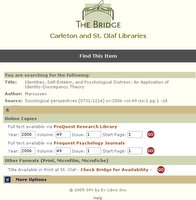
For those of you who don’t have SFX, or who have it configured differently, here’s what I mean. Let’s say I search and find a citation for an article from the journal Sociological Perspectives. Click “Find It” and I’ll discover that we have two subscriptions from two different databases, and St. Olaf also has the print. Click on either of the database options and I’ll get the full text; click on the print option and you’ll be taken to the catalog record for location and holdings information.

This system has three distinct advantages. First, it helps students figure out which databases they should be searching other than the database they’re currently searching. I teach my students to keep notes on databases that come up often when they’re looking for full text because those databases obviously have a collection of journals on your topic. This technique is especially useful for upper class students when they’re beginning to do research for their comprehensive projects. But it can also work the other way. I’ve mentioned before that unlike my co-workers, I mainly teach freshmen. And consequently, I also teach the less specific databases more often than my co-workers do (my co-workers rarely have to deal with students who just have to write “a research paper” on any topic). So I tell my students to watch the Find It menu to see if there’s a more specific database on their topic.

Another reason for providing choice, beyond simply my love of letting people choose what works best for them, is that over time students develop familiarity with the databases they use most often, so they may prefer to click on a link to their favorite CSA database, Ebsco database, or ProQuest database when it appears in the list of choices. I know I default to certain databases over others because I know that I can manipulate some vendors’ databases more easily than others.

And finally, some poor, young students dealing with requirements for “print” sources handed down from professors who haven’t explained that you can get “print” sources online from these databases, would really just prefer to click on that “available in print” link and go photocopy the article for themselves.

On the other hand… there’s value in immediate delivery whenever possible. I’m torn. Is delivery more important than education and discovery? Possibly. But I’d hate to give up the information I’m given when I’m presented with choices.

Carleton and St. Olaf will be deliberating on this issue soon, and I’m comforted that we can’t make a “bad” decision. I just wish I knew which was the better decision.

Technorati tags: , ,

10 Comments

Freakishly Personalized

We talk a lot about personalization, and about how personalization improves the user’s experiences, and about how personalization makes the user feel appreciated. Well, I’ve just found out that you can take personalization too far. My dad got a birthday card from the dealer that sold him his car several years ago. This is freaky.

It’s funny because we give dealers all sorts of information about ourselves when we apply for loans, but there’s a level of politeness which assumes that the dealer will a) only use the information for the purpose we intended when we handed over that information, and b) pretend not to know the information when they’re in situations outside of that originally intended information exchange.

I remember learning this lesson when working at a small, independent bookstore for several years. We were expected to watch what our regulars bought so that we could recommend books to them that they would like, but we had to pretend not to know that one regular was reading up on divorce after having spent a year or so buying “fix my relationship” books. And we were certainly never to know why that same person later bought the books on managing finances after divorce…

We also collected phone numbers of the customers who signed up for our charity program (buy a book and 1% of the sale goes to a charity of your choice). But we weren’t supposed to “know” their phone numbers even when, after years of ringing up purchases and entering the phone number which served as their account numbers, we could rattle off the names and numbers of several dozen of our regular customers.

There is decency in asking our patrons to provide us directly with information we use for their accounts, or let them know what information we collect about them. But I think there is even greater decency in “forgetting” even readily remembered personal information when we’re interacting with our patrons in contexts outside of the personalized services we provide.

Technorati tags: , ,

3 Comments

Terrible Horrible No Good Very Bad Day

Last night my car stopped shifting gears. It’s very hard to go places when you’re stuck in first or second gear. If I had a manual shift car, I’d think this was a slipping clutch. But I don’t have a clutch, just a mysterious box where gears float around in viscous fluid.

So this morning, bright and early, I got out my owners manual and figured out how to check the transmission fluid only to find that the fluid is fine. So I called my car guy only to hear that he thinks it’s electrical (which he doesn’t do) and he’s full anyway. But he gave me the name of another guy nearby whom he trusts and who will be able to do this type of thing. So I called the second guy and was able to drop off my car. Unfortunately, I was so stressed out and generally disheartened by this time that an hour long walk beside a highway seemed far preferable to asking for a ride. I’m not quite sure why that was… but there was no way I could force myself to ask for a ride.

So I set off on my highway adventure, thankful I’d worn comfy shoes. It’s funny what you notice about the outskirts of your own town when you take it at 4 miles per hour rather than 55. It forces you to stop and smell the roses that would be there if a highway weren’t belching exhaust fumes. I saw little shops that I’ve never noticed before, and I particularly noticed that the roofing and siding shops looked like they’re doing pretty well after the summer hail storm that tore up the town. I’ve never seen little shops look quite that well groomed before.

I also found a roll of art paper that must have flown out of a passing car and landed among the crushed beer cans, soda bottles, and cigarettes. Inside was printed with a reproduction of coastal scene originally done in pastels or colored pencils.

Trudging along, carrying my work bag, purse, and now a large roll of art paper, I also passed the veterans’ memorial that I’ve never walked through before. It was completed last year, but it’s in an out-of-the-way part of town. No sidewalks lead to it, and only the bike trail passes nearby.

Just before arriving at work I stopped in at the local coffee shop and got a large hot chocolate. Mmmmm.

So, it was actually a fairly pleasant morning, supremely peaceful and quiet. Now, if I can just hold on to the feeling of peace right through the moment where they tell me that my transmission is shot, it’ll cost a bazillion dollars to fix.

[Update: They called. It’s shot. It costs a bazillion dollars. And they can’t get it fixed for a week. No more peace is left.]

6 Comments

Reading and Vulnerability

I used to read a lot. I lived for library trips when I was growing up and would read almost anything I could get my hands on. I was lucky in that my mom was also an avid reader and had a good sense of what I would enjoy, so she would stretch me to read books I wouldn’t otherwise have picked up on my own. Then I went to college, and reading “good” books became a chore that it had never been before. I still enjoyed it immensely, but didn’t often do it on my own (at least, not during the school year). I was majoring in literature, though, so it’s not like I was starved for reading material. This continued through grad school, but there, again, I was studying literature, so I didn’t really notice. But I did notice that after I graduated, I had to train myself to enjoy unassigned reading again.

Unfortunately, I had just finished my re-training when I moved here and suddenly found that I couldn’t sit down and read. I was too stressed, lonely, and generally unsettled to concentrate on the flow of language, to let my mind wander into the prose and see the scenes presented to me, or to open myself up to feel what the characters were feeling. Reducing my strict control over my imagination made me vulnerable to too much that I wished not to think and feel in my daily life.

But now I look back over the last year and a half and realize that I’ve only made it through a handful of books since I moved. 11, to be exact, 6 of which were required by my participation in campus activities. I don’t think I’ve ever read so little in my life, and I’ve never read so little fiction (my preferred pleasure reading). I’ve heard many more books than that because I listen to books on tape whenever I’m in the car, which is a lot. But this is an entirely different kind of reading experience. I have to listen to books that don’t require complex thought because, well, I’m supposed be concentrating on the road, and I also have to stop listening whenever I arrive at my destination.

But now that I’m more stable, I’m trying to retrain myself. I’ve started playing with Library Thing (which I’ve been avoiding because I’d heard it was addictive…. which it is), and in doing so I’ve come across all the books I’ve read and loved, and all the books I expect to love when I get around to reading them. I’ve reacquainted myself with the smell of books, the feel of their paper, and the taste of the air around me when they are open in my lap. Now I just have to convince myself that I won’t fall apart if I let go and let my imagination play over intricate scenes and in and out of people’s lives.

I’ll probably have to start easy, with a fast-paced thriller or mystery. No sense in making this hard. And I’ll definitely have to persuade my cat that he really doesn’t have to continue with his habit of putting one fang neatly through the upper right-hand corner of each page as I read.

3 Comments

Tagging

Have you ever noticed that librarians often tag things using plurals for countable nouns, just as if we’re creating subject headings? I’ve noticed this in my own tagging, in other librarians’ Flickr tagging, and on Technorati. I smile every time I see other people who have the same habit I have. It’s so … cute. 🙂

Technorati tags:

Leave a Comment

Catalog Enhancement: The Struggle Continues

I’m a member of the Public Access Working Group (PAWG, which rhymes with frog, tee hee hee) comprised of members from both Carleton and St. Olaf. We’re in charge of making decisions about our shared catalog, and among other things, PAWG has been working on two decisions this year: whether or not to upgrade to Innovative’s WebPac Pro catalog interface, and whether or not to include “record enhancement” in the form of book cover images from Amazon.

The WebPac Pro decision proved to be easier than we thought. Turns out, the ranking algorithm for it’s much-touted relevance ranking stinks. If any of you are making this decision right now, try searching for the keywords Global Warming. You should notice that even though there are some books that have this exact phrase as a subject heading, they get buried pages and pages down your result list unless the exact phrase “global warming” appears in the title. No kidding. Effectively, the default search is a keyword in title search. Now, you can get around this if you put quotation marks around each word (i.e. “global” “warming”), which deactivates the relevance ranking altogether, but there’s no way I’m going to start teaching that in my instruction sessions. So we’re not “upgrading.”

But the more interesting decision is yet to come. Will we include book cover images from Amazon in our catalog? I’ve heard a lot recently about the benefits of allowing one-click access to book reviews, and I’ve heard that our students are used to seeing images on web pages, and I’ve heard that we should do our best to make the experience of searching the catalog as enjoyable and visually interesting as we can. I agree with all of these arguments. Absolutely. After all, as librarians we’re supposed to aid in locating, collocating, and making decisions, right? And book reviews and book covers both move us in the direction of making decisions much more effectively than, say, the height of the book’s spine in centimeters.

But I think our students are used to much more than pretty pictures. They’re used to everything on a screen being clickable, and everything doing something meaningful and more or less useful. Imagine what you would think if you saw an image to the left of a title in a result list. You’d click on the image, right? I would. And I’d get sucked to Amazon. Talk about mixed signals.

Now, I would realize that this wasn’t what I wanted or what was expected of me, and I’d hit the nice little “back” button in the browser and click on titles from then on. But my co-workers and I have noticed a distinct trend among our students. Instead of using our A to Z list to see if we subscribe to a journal or magazine, they find the publisher’s web site. Then they come to us and ask, in all seriousness, if the library has a fund that will help them buy this article online. They’re usually very happy when we point out the A to Z list. But last week one poor kid came back to me after he’d verified that we did not, in fact, subscribe to his journal and wondered if now I’d help him pay for it from the publisher’s site. That lucky kid learned about the A to Z list and interlibrary loan all in one evening.

These students who expect to be able to do whatever it is that site they land on tells them to do. What’s more, they expect that we expect them to do these things. The web isn’t just about seeing things; it’s about doing things. And if we put something in front of our students that implies they should do something that we don’t actually want them to do, that’s a problem.

Of course, we could by images from places like Syndetic Solutions, but that’s expensive. Still, this would be a way to make our records look pretty without threatening mass confusion.

So the upshot of all of this is that I’m willing to be convinced, but I have grave reservations about the amazon solution to our boring catalog. If we’re really interested in providing what users are used to, we’d have to redesign everything, not just slap on some pretty pictures. And that “everything” would have to include all sorts of clickable and interactable options.

But in the spirit of being convinced, is anyone willing to share their experience with the amazon lipstick option? I’m particularly interested if you have any statistics to show how often those images get clicked on. Do your ILL stats change?

Just as a side note, we’re also pondering how best to configure our link resolver… To offer choices of electronic options or not to offer choices, that is the question. Whether ’tis nobler to privilege one-click access to beauteous PDF full text or to deepen the understanding of young minds as they develop access preferences from among the panoply of database options. To learn, perchance to dream. To dream of other uses to which they can put databases that appear often in their list of options….

Sorry Will. You’re writing was a lot better, and certainly more moving.

Technorati tags: ,

5 Comments

Bundled Collections

A question was implied during my library’s recent exploration of the functions and implications of a catalog that actually works as a discovery system. It came up during the hour-long question and answer period with Roy Tennant (have I mentioned what a good idea it was to set aside that much time for questions?!?) when he made the comment that we should build the search skills of reference librarians into the catalog interface. That’s great, but then what will reference librarians do?

I’ll tell you what we’ll do. We’ll have time to coach students in more than keyword searching, we’ll be able to explore the exploding realm of quality, authoritative information available online, and we’ll be able to develop ways of feeding this rich content to our users when they need it. “Googling” things is great, but as more and more information gets uploaded for public consumption, the relevant hits will become increasingly diluted in a sea of irrelevant hits. This means that we’ll have to teach better search strategies for web search engines, and we’ll have to develop tools that will help our users get to the information they need. We’ll also have to spend more and more time teaching students to distinguish between the useful and the bogus in their result lists.

People are already creating tools to aid in the quest for authoritative information. The first one that springs to mind is, of course, the Librarian’s Internet Index. But on a much smaller scale, librarians are beginning to create rich troves of web-based sources using del.icio.us, Furl, and now Google Custom Search Engine.

I adopted del.icio.us earlier this year and have decided to make mine first and foremost a curricular collection that will be useful to students in my liaison areas as well as to students on our campus in general (you can see my account here). It’s still a growing collection, but it’s a great place for me to “remember” the image repositories I find while helping one student with her research, the web sites I choose for students in a class on globalization, and so on.

But I have high hopes for tools like the Google Custom Search Engine. This is what reference librarians could do with all the “free” time gained from not helping students navigate the catalog. (And I’ll believe in the theory that we’d have free time when I see evidence of it… but that’s another whole topic.) A few other bloggers have noted some of the bundled searches that are being developed already. And now there’s a budding directory of GoogleCSE forms here. I’m also keeping track of any custom search forms that look particularly useful to the library world and adding them to my del.icio.us account. So far, here’s what I’ve found:

I still haven’t ventured into the water myself, but I think it’s only a matter of time before I start creating custom search portals that I know will return authoritative information to my students. I think one of our directives in the coming years will be “go forth and bundle” because without it our poor users will stumble around in an increasingly expansive conglomeration of more-or-less random information.

Technorati tags: , , , , ,

2 Comments

The Reference Desk Under Fire

Every so often, I hear variations on the theme of “Why sit behind a reference desk? What are you — scared of the students?” I’ve heard everything from wearing uniforms so that we’d be recognizable while we were “out doing our work in the stacks,” to carrying a cell phone, to simply “walking around” and being available. I’ve heard eloquent deconstructions of the barriers we put between ourselves and the students when we sit at a reference desk. And I’ve sensed unspoken assumptions that if we’re “just sitting there” we aren’t actually busy or working.

Now, I completely agree that desks can pose barriers, especially when they’re the podium type that raises the librarian on high and requires timid students to crane their necks just to see us. I am also a huge proponent of making myself not only be available and approachable, but also seem available and approachable. Not only that, but I’ve seen wonderful and creative examples from other institutions who have abandoned their desks altogether.


Why, then, do I steadfastly argue for my desk shift? Because I can’t think of any way to make myself be or seem more available and approachable to my user population. Of course, our particular desk configuration helps. We sit at a very low desk that is no more substantial than any of the work tables in the reference area (and it’s on wheels, though we haven’t moved it in a while). We also have a chair next to us for students to sit in while we work with them. We’re also directly across from both of the public printers for the main floor of the library and right next to the main floor’s computer area (which is in this room and just off the upper right side of my picture).

But simply having a non-scary desk in the highest-traffic area of the busiest building on campus isn’t enough (though it helps). That simply means that we’re visible, not that we’re approachable. Rather, having a predictable place where we can be found at predictable times, making the most efficient use of space in our somewhat unwieldy library, and playing off of the culture of our campus all contribute to my sense that our desk, or something like it, is necessary.

The physical library space needs little elaboration. There is simply very little space for anything other than books on the lower three floors of the library (remember, people enter our library on the fourth floor and work their way down). Not only that, but there’s no predictable traffic pattern on the lower floors, and the discussions that happen at the desk would disrupt the quiet levels on the lower floors. Of course the argument could made (and has, in fact, been made) that we would simply walking around down there, so traffic patterns and, to some extent, noise levels needn’t be an issue. But the fact is that the other librarians and I are rarely called upon to do work that would involve wandering in and out of the stacks. We go there to collect books in preparation for our classes, or with students when we’re in the midst of an appointment or reference interaction. But that’s about it. Then there’s the problem of the computer. Most questions need at least some computer interaction, and the computers in the library are usually all in use by students. It’s far easier to know that while librarians may be wandering around, there’s also one who’s scheduled to be either at the desk or who will be returning to the desk shortly.

No, the strongest argument in favor of the desk as a physical, predictable, and intuitive space lies in customer service. There’s nothing more frustrating than wandering 4 floors without any long sight-lines, looking in and out of stacks, climbing up and down 6 stair cases, just trying to find somebody who can answer a question.

What’s more, the librarians function in an analogous way to professors when we sit at the desk. Just as students can make appointments with their professors but can just drop in during office hours, they can also make appointments with us or simply drop in on our desk hours. Culturally, this meshes well with campus culture and student expectations.

I’ve wondered for over a year now if I’m simply defensive and stuck in the mud when I baulk at challenges to our service model. But I’ve come to the conclusion that there are very good reasons for having a reference desk, as long as that desk is positioned and designed with approachability and usability in mind, and as long as the people sitting at the desk make sure to look up, take their hands away from the keyboard, and smile whenever they’re approached. After all, approachability has at least as much to do with the person as it does with the furniture.

Technorati tags: , ,

4 Comments
css.php