I just subscribed to the feed for actions on H.R. 1120 (the social networking bill before congress). You can find feeds on house and senate actions on bills over at OpenCongress.org.
2 CommentsLearning in Libraries and Loving It*
I just subscribed to the feed for actions on H.R. 1120 (the social networking bill before congress). You can find feeds on house and senate actions on bills over at OpenCongress.org.
2 CommentsI just realized that my one-year blogiversary is coming up in 3 weeks and a day. My how time has flown. How should I best celebrate such a thing? Part of me wants to go all wild and crazy-like and get myself my own domain name and a blogging platform upgrade, just for the heck of it.
The other part of me laughs aloud at that first part and wonders if there’s a way to get out of this mutual appointment to my body.
*checks contract between halves of self*
*realizes futility of separation*
*sighs and returns to work*
2 CommentsI’ve had a cold for 10 days now. Nothing horrible (except over the weekend when I developed a fever, stopped wanting to eat, and thought I might die, but didn’t, so I guess it’s all good), and I’m much better now, thank you. But through it all I’ve been craving lemon tea with honey.
What with rules about food in my library (which I’m sure apply to sticky sweetness like honey) I can have my thermos of hot water and my tea bag in my office, but when I want to make myself a cuppa I have to trundle downstairs to the staff room, find my little bottle of honey, disengage it from the plastic bag that catches all the extra stickiness, put a dollop into my travel mug of tea, and trundle back up to my office.
Normally this wouldn’t be a problem. In fact, normally I look on such things as an excuse to get up and move around a little. But from the onset of the cold until today, stairs had a curious and unpleasant effect on my heart and lungs. I’d get honey into my tea, trudge up the stairs, pant for a minute while I waited for my legs to stop shaking, and then continue on my merry way. Now, before you start feeling all sorry for me, consider whether the honey was really worth it…
Nope. I didn’t think so.
6 CommentsAnd while I’m in a musing mood… I think there are two directions you can go when faced with metadata (be it AACR2, Dublin Core, or what have you) that’s populated with a whole bunch of information.
You could say, “Hey, we’re putting more information into this record than our patrons use, so let’s not work so hard.” (Better study your patrons good and hard, though, before assuming you know this for a fact.)
Or you could say, “Hey, we’ve got all this stuff. What could we do with it that we aren’t doing yet?” (But be aware that this could range from the simple to the we’d-need-to-hire-programmers complex.)
The path you choose will depend on your circumstances, your patrons, and your ability to dream up ways to exploit metadata. But the path you choose will make all the difference.
Leave a CommentI’ve been kind of immersed in workflows recently. Our workflow consultants delivered their much-anticipated, much-talked-about, and much-feared reports yesterday. And today I’m musing about a few of their recommendations. Some I don’t think will fly at our library, or at least not to the extent they propose, but that’s a topic for another day or another lifetime. Tonight I’m mostly interested in the question of the relative workload of a print collection vs. an electronic collection. (Notice, I’m not talking access, relative value, or any of that. Just workflow and time commitment.)
I’m all for e-access. I love love love e-access to journals. Nothing makes me happier than to click our link resolver button and find that I don’t have to walk the 100 feet or so to our print journal collection. And I’m cautiously in favor or transitioning to e-access where ever that is warranted.
But… when I hear that we should consider reducing our print periodical holdings at every opportunity, I worry a little bit that only one part of our workflow would see a benefit while other areas might see increased time commitment. Granted, print periodicals take up a lot of space, a lot of packing and unpacking, a lot of binding, and countless other processes. But what might the process be in an e-only or e-mostly environment?
I don’t know if these increased time commitments would or wouldn’t be worth the savings in the periodicals department of technical services, but these and other repercussions should be taken into account if efficiency is the name of the game.
And I haven’t mentioned archiving. It goes without saying that this is an important issue that has to be considered every time we cancel print subscriptions. But everyone knows that, and it’s not up for debate at the moment.
5 CommentsYesterday my laptop started making the sound of a somewhat rattly jet engine just before take-off. I’ve heard this sound before when my dad’s computer died, and after it started that computer only had a few hours left to live before it started melting crucial components. So I immediately turned everything off so that I could save those few unmelty hours for file transfer later. But at this point I’ve heard all but the death rattle. That computer is dead. It just doesn’t know it yet.
So this morning I ordered a new computer. Looks like I’ll be getting a Vista upgrade way sooner than I’d planned… No time for letting Microsoft work out the kinks. No time for hearing about track records. No time to learn from people who’ve gone that route. On the plus side, I just had to upgrade to 2 gigs of RAM in order to kick into a really good discount and save myself about a hundred bucks. Suweet! And what I’ll do with the 120 gigs of hard disk space, I don’t know (though I’m guessing that about 100 of that will be taken up just with Vista…). Maybe now I’ll even be able to get onto Second Life and see what all the fuss is about.
Now I just hope that I can keep old blue going long enough to cough up all my files before I consign it to the recycling kit that’s coming with my new laptop.
4 Comments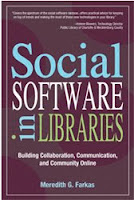
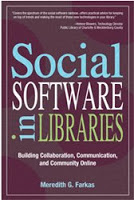
Yeah. Big ol’ “Me Too!” on this one. Cuz why? Cuz Meredith rocks, that’s why. Oh, and the book looks good, too.
There’s a section in the first chapter (a much better teaser than most introductions, btw) that I think asks the essential question: Why should librarians care about social software? Answer it for you and your library, adopt Meredith’s answers, or do whatever else it takes, but don’t leave this question on the back burner.
My answers? Well, they map very closely onto Meredith’s, and they’re constantly evolving, but here’s a sketch of their current state. I have not found that my students are very familiar with many of the social software we talk about all the time. I’ve had students ask me why I’d want to IM, diss Facebook and MySpace, give me blank stares when I mention social bookmarks, wonder what Flickr is and point out that I’ve left of the “e.” And don’t even get me started on RSS. But that doesn’t mean that social software isn’t important to me in my library with my user community.
No, social software is still important for many reasons, but foremost in my environment is that it’s a way for me to provide value-added, nimble, real-time, personalized access to online resources and research support, learn from and collaborate with colleagues near and far, and improve my own workflow and my students’ workflows. Six months from now, these reasons will have evolved again, I’m sure. But through it all Meredith’s last paragraph says it all. These things are, above all, tools. They’re tools that help libraries stop being faceless institutions and start being teams of people helping people.
Leave a CommentEarly this afternoon, MN-DOT closed parts of I-35 (which runs from the Twin Cities down to Northfield and on south toward Iowa). Mid-afternoon, the University of Minnesota closed. And then, at 4:15 in the afternoon, 45 minutes before most departments close down, our college president sent out an email that began:
Dear Carleton Staff, Faculty, and Students,
We have been notified that winter weather conditions are deteriorating rapidly. As a result, the College has decided to officially close for the remainder of the day. Essential services will be maintained.At this point, the College plans to be open tomorrow (Friday, March 2). If conditions overnight warrant a closure, announcements will be made on KYMN, DKHL, KSTP, KARE 11, and WCCO by 7:30 a.m., if possible.
This is the first time the school has closed since I started working here, but I’m kind of disappointed that they waited this long to do it. And tomorrow’s forecast calls for all of 2 inches of snow, so work will carry on as normal.

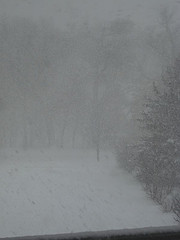
Meanwhile, the view out of my window reveals very little visibility, though the picture looks clearer than the reality because most of the visibility problems are from the blowing snow, and the picture makes all the flakes stand still. (The scale here is about 3 or 4 car-lengths of trees ending at the road that runs past the apartments, if that helps. Also, it’s supposed to be broad, afternoon daylight.)
In all fairness, it hasn’t been really and truly horrible in this town. The worst of it is swirling all around us but missing us. Still…
[Update: The campus is closing, but the library is staying open for normal operating hours, which means until 1AM. I guess we’ve just been upgraded to “essential services.”]
Leave a CommentOne of the things that makes Carleton Carleton is the nine and a half week term. Never have I heard a length of time so strenuously defended or so often blamed for any real or perceived short-fallings in teaching, learning, assignments, experimentation, or exploration.
Be that as it may, I can tell it’s 9th week because I’m sitting here tonight with over 90 students around me. There are over 20 groups of students working around piles of books, our computers, and their laptops, and the air is full of the hum of purposeful conversation. It’s definitely “Crime Scene Investigation Quiet” today. Every one of our 24 computers is in use (supplemented by at least that many laptops), every one of our tables is populated, and from where I’m sitting, I can’t see any open chairs. There are even couple of people sitting on tables. And that’s just the reference room.
I love it when the library is like this. Next week it’ll be just as full, but the noise level will drop significantly, and we’ll move carefully so as not to disturb anyone. The tension will be almost visible as everyone buckles down and studies for finals. This week is a lot happier than next week will be.
Leave a CommentYesterday I taught a class on finding book reviews. The professor had specifically asked for this topic, and I was happy to comply, but I was a little at a loss to figure out what I could do other than pointing out the “document type” limiters in different databases, and show the differences between book reviews published in scholarly journals as opposed to trade publications and newspapers. Luckily, one of my colleagues has thought more about this than I have and taught several classes on book reviews, so I shamelessly cribbed her materials and even mooched some of her examples. And although I can take very little credit, the class we built together seemed to go over very well with the students and this faculty member.
Warning: Extreme examples of my inexperience as a librarian and researcher are about to be revealed. Read on at your own risk. I cannot be held responsible for injuries to eyes that have rolled too far back into your head and can no longer be retrieved, or for bruises to heads that have been beaten against computers. Nor can I be held responsible for damage to hardware or software of said computers.
I learned a whole heck of a lot teaching this class. First of all, I’d never taught for American Studies before, so I spent quite a bit of time simply familiarizing myself with the publications in that field and where their journals get indexed (Academic Search Premier and ProQuest each index the major American Studies journals, in case you’re interested). But the real breakthrough for me came when my colleague and I were working to answer the question: so what? Why would you spend time looking for book reviews given the fact that the vast majority are positive, a good percentage are neutral, and only a tiny fraction are negative? What use could writing governed by such a ritualized style and publication process be other than to give a summary of the work?
Well, it turns, book reviews can be extraordinarily useful. So useful, in fact, that I will be incorporating them into as many classes as possible in the future.
But the fun doesn’t stop there. Book reviews are chock full of the important buzz words in the field. In my class yesterday we looked at reviews for Hope in a Jar: The Making of America’s Beauty Culture. We found one from the Journal of American Culture (Kay 1999), one from Publisher’s Weekly (“Forecasts” 1998), and one from Entertainment Weekly (Jacobs 1998). Reading from those reviews, we not only came up with lists of disciplines, related topics, and related concepts, but we also came up with a substantial list of search terms which yield really beautiful results about the social history of the beauty culture in America. What fun!
Forecasts: Nonfiction. Publishers Weekly. 245.16 (1998): 57.
Jacobs, Alexandra. “Hope In a Jar.” Entertainment Weekly. 440 (1998): 68.
Kay, Gwen. “Hope in a Jar (Book Review).” Journal of American Culture (01911813). 22.2 (1999): 106.
McKinnish, Terra G. “The New Race Question: How the Census Counts Multiracial Individuals (Book).” Journal of Economic Literature. 42.1 (2004): 201-202.
Peiss, Kathy. Hope in a jar : the making of America’s beauty culture . 1st ed., New York: Metropolitan Books, 1998.
Waters, Mary. Black identities : West Indian immigrant dreams and American realities . New York ;Cambridge Mass.: Russell Sage Foundation ;Harvard University Press, 1999.
Vickerman, Milton. “nonfiction reviews.” Black Issues Book Review. 2.4 (2000): 54.