Skip to content

Pegasus Librarian* Posts

Domestic Days

This has been my first full weekend at home in over a month, so my list of household tasks was daunting, to say the least. But partially thanks to fine weather, partially thanks to a cat who really didn’t want me to sleep in (and even decided to rouse me two hours earlier than I would have thought necessary), and partially thanks to the pleasure I get from crossing things off of lists, I made it through 23 of the 25 items on my to-do list. I also started to gather some of my flickr photo sets into a collection I’ve called “Flickr Cook Book” … because I’m creative with names.

So what were the two things I didn’t get done? Oh, just the two most important and time-consuming items on my lists, both having to do with a writing project I’m doing. I sure hope my co-author hasn’t pasted a picture of me next to the entry for “slacker” in her dictionary. It’ll get done. I promise. I’ve never not gotten something like this done before, and I don’t intend to start now.

Leave a Comment

Clammering in the Hallways

Scott McLemee, with the help of Steven Bell, declared quite some time ago that there’s too much silence in the stacks.* Apparently he couldn’t find blogs that were specifically “maintained by academic librarians” and focused specifically on issues important to academic librarianship. Hi, I’m Iris, and I’m an academic librarian.

Actually, there were a couple of statements in this article that rankled. I don’t particularly enjoy thinking of my writing here as “splenetic” (no matter how true it may be some days) or hearing that I’m “not capable” of the type of writing McLemee and Bell would prefer. But whenever people get too defensive about these types of statements, authors always come back and argue that we missed the main point of their writing.

So let me be clear. McLemee is not, apparently, saying that there aren’t blogs out there that are both maintained by academic librarians and focused on academic librarianship, no matter how clearly that message seems to leap off the screen when the few of the blogs mentioned in the article are condemned either because readers “don’t really know if the [author] is an academic librarian” or because the blog’s topic “isn’t specific to academic libraries.” Instead, he maintains that his argument centers on two points. First, he is not aware of any blogs that have stepped up and become the “voice of academic librarianship.” And second, the lack of such a voice is sapping the profession of it’s cultural capital.

These are not simple arguments. Every time I think I’ve grasped their intent, it slips away to snicker at me from behind another corner. But even though this post of mine won’t stand up to the criterion of “great (or even good) insight,” I think it’s important to unpack some of the underlying assumptions here.

First, I’ve already written that good, clear writing is essential to our profession. So on that point, I believe McLemee and I agree. Without clear and insightful writing we librarians can’t hope to excel in academic environments because these environments eat, drink, and breathe scholarly writing. Scholarly writing is the lingua franca of our environments, and if we don’t speak it, we essentially exclude ourselves from the societies in which we live and work.

I do not believe, however, that a blog – any blog – no matter how consistently insightful, would prove to our chosen culture that we are fluent in its language. In order to be seen as “full-fledged participants in contemporary intellectual life,” we would have to publish in vehicles that are understood to be prestigious by our audiences (in our profession, academia, and the wider intellectual community). Currently, these only rarely include blogs or any other self-published vehicles.

And if what McLemee wants is “public spaces devoted to thinking out loud about topics” that are important specifically to academic librarians, and yet doesn’t want “reflective and/or splenetic mini-essays,” then blogs may never be the appropriate vehicle as blog posts, by their very format, lend themselves primarily to an op-ed style, much like McLemee’s own essay.

So I would argue that yes, good and focused writing is essential to our profession. Librarians with the gift of insight and eloquence should be encouraged to pursue their talents for the good of the profession. And these writers should also contribute to the professional discussions that happen online, the visible “thinking out loud” that will in turn inform their thinking and writing. Blogging is very important, but it cannot be all things. Not yet. Not when we’ve set up our lives in the midst of academia.

And when I reference the online “discussions,” I use the plural quite deliberately. No single profession can easily sum up the issues that are important to that profession. There are myriad issues, and most can be approached in multiple ways. Because of this, no single person can become the voice of the profession. And this is not a characteristic exclusive to academic librarianship. People can usually identify a handful of voices of Dickensian criticism or the theory of Universal Grammar, but it is impossible to identify the “voice of literary criticism” or “voice of linguistic analysis.” What is more, nobody thinks of this as a lack in either of those fields. Nobody calls this a “puzzling silence.”

What we do find are journals and publishing houses that take the lead in publishing the cream of the scholarly thought in those fields. In this way, McLemee’s idea of a group blog devoted to topics in academic librarianship makes sense. I would gladly subscribe to such a blog, and there are a few out there that I think contend for the title of academic blog for academic librarians, by academic librarians.

But even these blogs might fail to meet his expectations because issues that are important to academic librarians are also important to other types of librarians. Librarians in public and special libraries are just as engaged in “questions concerning public budgets, information technology, the cost of new publications, and intellectual freedom” as academic librarians are. I would argue that the different types of libraries are usually more the same than they are different. We may prioritize our foci differently, or emphasize certain parts of our missions differently. But for the most part, we care about the same issues and deal with the same or infinitely analogous challenges. Blogs focused on issues in academic librarianship may not, then, look very much different from blogs focused on public or special librarianship.

So perhaps there is silence in the stacks. But maybe that’s because the conversation isn’t happening in the stacks. Maybe the conversations are happening in the hallways. And maybe it’s hard to pick out the conversation because there are several, and maybe they’re happening concurrently and on multiple plains.

p.s. Does this count as disagreement and discussion?

*This article was just brought to my attention today, and though the article itself is old, my response to it is based in the world of current academic librarianship. I wonder if McLemee still thinks the same way?
1 Comment

Spam 2.0

I’m having an easily-annoyed afternoon, so take this with a salt shaker of salt, but I’m just sayin…

Is it really a good idea to syndicate content from everything you do online to everything else you do online? If your photos get automatically included in your blog’s feed, and you up load a whole boatload of them, my aggreggator creaks and I get depressed. If you syndicate your linkblog and your blog to twitter, that means I either click on those TinyURLs or get browster to retrieve them for me only to find that they lead to a post that leads to a link. So… click on link to find link to click on… wash, rinse, repeat. This does not make me a happy camper.

The problem being, I really do want to keep up with the other stuff in your feed/twitter/blog/etc. But feed readers and twitter don’t have any filtering system.

I guess what I’m getting at is that there’s some value in giving me choices about what I subscribe to and not forcing me to double-sub by syndicating something I’m already subbed to to some other thing I’m subbed to.

3 Comments

The Future of Our Catalog

I spent all day today at a school two hours northwest of my school meeting with a bunch of librarians of all kinds (including library directors) who work at private colleges in Minnesota. On the agenda: contemplating the future of our catalogs.

Four groups of librarians presented their visions of what this future might look like using a combination of examples already extant (WorldCat in many paid and free forms, Koha, NCSU’s Endeca interface, Google, LibraryThing for Libraries, etc.) and “what if” ideas drawing from the world of Web 2.0 and the hope that search algorithms will continue to evolve. Then we broke into groups to discuss what we’d heard and add our thoughts. And finally we reported to the group any ideas, concerns, questions, or random thoughts our discussion groups had generated.

Even more interesting than these presentations, though were two revelations. First, only one of us indicated she liked our current catalog (which is not a smear against any particular catalog, since we all used different ILSs, but against the ILS landscape in general). And second, we learned that when it comes to thinking up feature and function lists, there was a large degree of consensus, regardless of school affiliation or job description. We wanted all the usual social web features, web 2.0 discovery aids, and recommendations based on user behavior… all of that. Plus we wanted the option to search the full-text of our books’ tables of contents, introductions, bibliographies, and indices.

One group even decided that we need to ditch the name “Catalog.” In fact, we were so busy ditching names that all we could come up with was “up-pushing thing” (based on the idea that whatever tool or system of tools we come up with should be able to push relevant/important results up from a pool of articles, books, archival material, images, recordings, web pages, and anything else the library might care to point people toward). Oh, and this tool’s uber-descriptive name is only proper if accompanied by a hand motion that would take far too long to describe, but involves moving upward…

We still aren’t quite sure about a couple of things (the role of metadata, privacy, how long some of the transitional technologies and solutions we identified might need to be kept around, etc.). But we’ve only met once…

At the end of the day, the directors of our respective libraries stood up and reported where each library stands in respect to its ILS. These ranged from “thinking about thinking about changing” to “actively exploring alternatives,” but it was nice to get that up front. It was especially nice to get that cleared up because after that they called for volunteers to work on behalf of all of these schools to explore future options. And somehow (not quite sure what possessed me…) I ended up on this Think Group with 7 or 8 other librarians from around the state.

So here I am… thinking about thinking about the future of OUR catalog. I’m a little worried that this will be a lot of work, and that it’ll turn out we don’t actually do anything. (And I DEFINITELY don’t believe what one director said: “think as if money is no object.” We tried that for another and much smaller decision and got burned. Money is always an object.) But at the very least, I can contribute my year’s worth of accumulated information on this topic, and maybe set up a wiki for us…

11 Comments

Best, Iris

As a child, I remember writing letters to grandma, having them carefully proof-read by my mom, and then copying them onto “real” paper before sending them off. Each letter was signed “Love, Iris” in that wobbly block writing of mine. In fact, that’s how I signed all of my correspondence. And it worked pretty well when I was writing to my family and friends, though not so well when I was writing to a new friend who had just fallen in love with me. (The feeling was not entirely reciprocated, so let’s just say that there was some confusion about my intentions. But it only took us about ten years to get that one cleared up…)

But then I graduated and got a job. I remember staring in some consternation at my very first out-going email as a professional librarian and wondering how in the world to sign off. “Love” just didn’t seem right when I was explaining off-campus database access to a faculty member. I’d seen “Cheers,” so I typed that one in, just to get the feel of it.

It didn’t feel like me. I wasn’t even quite sure what it meant. “Thank you” didn’t seem to work when I was providing a service rather than receiving it, and “Sincerely” was way to formal for me, though I did try it out, just to see. And closing with only my name sounded far too abrupt.

I wanted to sound professional yet also approachable, cheery, un-stuffy, and maybe even a little bit fun. That’s a lot to ask of a word or phrase followed by a comma.

After spending far too long trying various closing lines and becoming equally frustrated with the lack of options and my own obsession over getting this right, I finally typed “Best, Iris” and hit Send. “Best?” What’s that? Best what? Probably derived from something along the lines of “Best wishes to you and your family,” it’s definitely on the stuffy side. It tries to be hip by cutting off all the descriptive stuff and leaving the reader to fill in whatever he or she pleases. It’s even less descriptive than its slightly longer cousin, “All the Best,” which at least sounds more generous, though not any more enlightening.

But I was so relieved to have sent the stupid email without encumbering myself with either more or less affection than I meant, or sounding too earnest or too abrupt, that this abbreviated and incomprehensible closer has become my standard. I type it without even thinking any more, and it has graced the ends of dozens of emails a day for the last two years, varying only on those rare occasions when a more descriptive closer is absolutely necessary.

So if you get an email from me, scroll down to the signature. Your odds are pretty good that you’ll see this habitual signal of my capitulation to ethos over expression.

Best,
Iris

13 Comments

Looking Back

One of the most interesting things about going to two conferences in three weeks is that the contrasts between them become much more apparent. Take, for example, the dress codes. ACRL was definitely on the business casual side. We all looked exactly like what we were: 3200 librarians. At CIL, things were a little more casual and a little more hip all at the same time. We still looked like what we were, but there was a subtle difference.

Then there was the session envy… At ACRL, if you were sitting in a session that only you and about 10 other people decided to attend, you had a pretty good idea that everyone else at the conference knew something you didn’t and had decided to attend one of the 10 or so other sessions that would have been better. At CIL, if you attended a session that was only one third full, you knew that everyone else at the conference knew something you didn’t and had decided to attend the one REALLY hot session that period. (On the other hand, sitting in your un-full session you also had a seat and didn’t have to sit on the floor in the hall outside of the overflow room, so it wasn’t all bad.)

But no matter which conference, there are always library geeks. “Lunch 2.0,” for example, can only happen in a group of librarians. (In order to achieve Lunch 2.0, you must walk from your hotel and turn right toward many restaurants every day, lunch and dinner, until the last day. On that last day, you must turn left toward different restaurants even though “we’ve never done it that way before.”)

Looking back over these two conferences, I’ve met so many wonderful people, seen some truly cool stuff, and generally renewed my conviction that I’m in the best job ever, and I’m in it with the best companions around. It’s not without it’s frustrations (and after hearing many variations on the theme of “I could never do that at my library” I’m even more grateful for my co-workers and working environment than I was before), but it’s pretty darn amazing nonetheless.

Now, back in my “real world” of Sunday reference shifts, burgeoning to-do lists, classes, consultations, and meetings, everything seems just a little rosier than it did a few weeks ago. There’s no good reason for this. I have even more to do than I did before, and even less time in which to do it all. But at least for now, that doesn’t matter so much. I’m jealous of everyone who gets to go to Internet Librarian, but I’ll see you all at CIL next year. Just don’t have too much fun without me in Monterey, alright?

Technorati technorati tags: cil2007, acrl2007

Leave a Comment

Federated Search on Steroids – but Still Broken

Ex Libris vendors showed me Primo while I was at CIL. It workes on top of Metalib and your catalog to function as a search of everything available through the library. Shiny. Probably the flashiest thing they showed was opening a video and a text version of the same title in two side-by-side windows. If it weren’t for one small problem, I’d say I’d seen the future of library discovery systems.

The problem? After 15 or 20 minutes of talking to these vendors, I finally got them to understand the problem of searching subject and generic databases at the same time. Subject databases never index their primary subject, right? So “psychology” would return gazillions of results from catalogs, Academic Search Premier, ProQuest, etc. But it wouldn’t return anything from PsychInfo. That’s a problem.

When I’d finally gotten them to understand what I was saying, they agreed. But here are their answers: create custom views or scopes for each subject (so yes, make students chose their subjects first and then do searches, which still won’t compute if they search for “psychology”), and tell PsychInfo to include “psychology” as a subject term. What? That’s about as likely as catalog vendors moving their products to wiki platforms.

Why doesn’t Metalib or any other federated search system allow us to tag databases and then add those tags to the results that get fed from the database to the search system? That way we could customize for our communities AND get our patrons the most relevant results possible.

Leave a Comment

Catalogs that are Both Useful and Fun

[Update 4/27/2007: LibraryThing for Libraries tour available here.]

[Update 5/14/2007: The Danbury Library catalog has LTfL active in it’s catalog (sample record here).]

I went to the exhibit hall the last morning of CIL, had a great time talking to Tim Spalding about Library Thing for Libraries (demo link coming soon to his blog, he promised). I want it. I need it. Gimme gimme gimme!

I almost always come out of vendor demos feeling a little like I need a shower. Stuff always looks great but there’s always the point when I ask a question and the vendors try to pretend they didn’t hear me, or understand me, or that I’m silly to think that would be an issue. Not so with this thing. There’s no downside. It doesn’t take anything away from the current functionality of our catalogs (and it’s “platform agnostic,” according to Tim, so it should work with any type of catalog out there), but it adds a whole lot of information and fun. You can see the most relevant tags (i.e. often used and cleaned up by a poor, overworked librarian at Library Thing) that Library Thing has for a particular work (not book). You can browse tags and retrieve your catalog’s holdings that match specific LT tags. And you can see related items! What’s not to love?

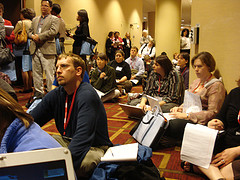
Anyway, when I’d finished drooling, I went back downstairs to sit around and wait for the next session to start: “Catalogs of the Future” starring Tim Spalding and Roy Tennant!!! (Did I have a good morning or what?) I sat down next to Jason and Michelle, who were also hoping to get good seats for that presentation, and was just about to blog about the coolness that is LTfL (I can acronymize ANYTHING) when Tim showed up and sat with us. Well, you can’t blog about somebody who’s sitting crosslegged on the floor four feet from where you’re sitting… And besides, that would have meant missing out on hearing how his colleague was speaking at the National Library of Australia that day, and how he was speaking at the Library of Congress the next day. Very cool.

This was one of those sessions that needed overflow rooms for the overflow room… but it was well worth the squeeze. Tim asserted that while we’ve been concentrated on fixing the three known problems of our catalogs (lack of usability, findability, and remixability), we haven’t paid much attention to increasing it’s funability. He argued that while the ILS may dis-integrate sometime in the future, we need to look toward making what we have NOW fun. Enter LTfL, stage left. LT increases by over 60,000 tags per day, and that’s enough to really DO stuff with. More is more when it comes to tags.

But even beyond that, our catalogs need a whole boatload of lipstick, blush, and mascara. Add pictures (and he is definitely still working on an open database of images, but he can’t say more than that just yet), allow inbound links (permalinks are essential), link out (Google, Amazon, you name it), and get your data out there.

These last two points were particularly interesting. He pointed out that we don’t want to be like big malls, were all the stairs lead to other places in the mall, and the exits are incredibly hard to find. “That’s how big corporate web sites work; the sites you want to leave immediately.” Instead, he said we’ll likely garner trust and become more useful if we are generous with our patrons’ attention.

Not only that, but if we’re generous with our data all the “bored programmers” out there who haven’t yet discovered library data would love to sink their teeth into our data and figure out ways of manipulating it. But they won’t struggle through MARC. We need mark, and our catalogs need MARC, but programmers don’t. So we need to figure out some way of opening our catalogs up and feeding our information out there in something other than MARC.

Then Roy spoke. His main theme? “Future? What Future? Catalogs ain’t got no stinkin’ future.” That’s not to say that we need to start over or throw out what we’ve got. We still need the ILS to do our work well. And contrary to what some people say, we still need good, detailed cataloging. But we don’t need to show this thing we use to the public. They need something different. They need a discovery system that manipulates our data for their benefit.

He also had a more is more theme. Maybe WorldCat is our future, and we should all sign on for WorldCat Local especially now that Open WorldCat has article-level records. (This would privilege the large libraries that actually submit their holdings information to OCLC.) This isn’t because they are the be all and end all of catalogs, but because they have enough aggregated information that they’re starting to be able to do really interesting things with all that data. (Things like WorldCat Identities, which I hadn’t played with before but which could be very useful.)

So I’m officially a Tim and Roy groupie. Can we start a fan club? I know a guy who can hook us up with T-shirts.

It was too bad that Tim was working on his presentation for LOC that night. We were all hanging out for our last evening together, and he worked. Too bad.

(This is a really bad picture of Tim working while we play.)

p.s. Did I mention that Meredith signed my copy of her book with Tim’s pen?!? I’ll allow visits to the book by appointment only, so call ahead if you want to see it. 🙂

Technorati technorati tags: cil2007

4 Comments

Blogging about Conference Blogging

I’m so bad at napping that I nearly always give up the struggle, even when I’m completely exhausted. So here I am blogging rather than napping. And speaking of blogging, I was sitting there at Steven Cohen’s presentation (or rather, on the stairs outside of the overflowing overflow room), taking notes and using my wireless connection to show people around me the stuff Steven was showing but that none of us could see (thank goodness for Google). Oh, and it was a good set of tools, even if Fleck does kick CiteBite’s butt, no matter what Steven says. 😛

In fact, it was probably the intimacy of sitting on the floor together, hovering over a couple of laptop monitors, and getting all jazzed up over fun technology that led one of the other women near me to come up afterwards and ask how I manage to blog sessions. She said she’d seen me typing away at an earlier session, and she sounded more than a little skeptical that anyone could possibly type and listen all at the same time. So I showed her my raw notes (especially URLs for slides or other interesting sites), how I highlight in bold any portion of those notes that I think will make good inclusions in a blog post, and how I add parenthetical comments to remind me what questions or ideas the sessions sparked. Then I showed her how I take the notes and create posts around them whenever I get a minute (and some working wireless, which got pretty rare as the conference progressed).

“But you’re still typing,” she protested, “which seems like it’d make it harder for you to listen to what’s being said.” Thinking back, I only gave her one third of the whole answer to that issue. I explained that I can type a lot faster than I can write long-hand, so I actually hear more of the session than I would if I were writing on paper. But I didn’t explain that typing with an eye to synthesizing for a blog post helps me stay on task when I’m listening to presentations (as Nichole just blogged… it’s another inadvertent-blog-topic-convergence day). It forces me to look for the themes and primary points in the presentations. I don’t end up blogging every session, but I do end up taking blog-ready notes for almost every session.

And of course there’s the final third of the puzzle. When presenters end up explaining something I already understand, I can compose the actual blog posts while I keep an ear out for when the presentation moves on to topics or perspectives that are newer to me. The fact that I only posted a couple of times a day during this conference speaks to the general lack of such down-times for me, which is a good thing. But it did happen occasionally.

In the end, the skeptical woman walked away looking relieved that I wasn’t wasting my conference registration fee (or hotel costs, which was significantly more expensive). Maybe next year she’ll have a blogger banner on her name tag. 🙂

Technorati technorati tags: cil2007

2 Comments

CIL Aftermath

Sitting here in the airport, waiting to go home after a morning spent with such last-minute things as figuring out how much to tip hotel maids, everything seems suspended out of time. I’m exhilarated and exhausted all at the same time. Happy to go home, sorry to leave. It’s been four wonderful days full of ideas, inspirations, fun, and the best company imaginable.

In the absence of an internet connection (when did this become such an life necessity?), I took the time to draft this post and transfer my pictures from my camera to my laptop. Tagging them as I went, I had to giggle when I remembered the librarian next to me in one of the session when, asked to write down a tag for a picture the presenter projected, wrote her tag in perfect LCSH (including double dashes). You’ve gotta love librarians. And I must admit, I have librarianish tagging tendencies, too. I use plurals to describe countable nouns and singulars to describe uncountable nouns, I don’t often tag pictures of me “me,” and I rarely attach more than a couple tags for any picture. But I draw the lines at double dashes and qualifiers.

And you’d have to be a librarian to get a kick out of the jokes that were flying a couple nights ago at the Irish pub in town. The CIL snowball effect had taken hold and we’d gathered well over 20 librarians by the time we left the hotel. One of them (our personal jester, as it turned out) looked up as we sat in the pub, noticed a bunch of books lined up and tilting into the spaces where some had been removed, and asked “Does anyone have the compulsion to go straighten those books?” We giggled. That was only the beginning. That was before our jester (Eric Sizemore) nearly killed Steven Cohen by suggesting that we twitter in DDC… “How are you feeling?” … “745.5944” … and then we started twittering requests for DDC translations of concepts … and then some librarians started twittering us the answers. Yeah. We completely geeked out. You probably had to be there, but for those of us who were, it’ll live on in CIL lore for generations.

But now my plane is getting ready to board. I’m not a nervous flier, but I always get a little nervous about my seat neighbor. Two equal horrors may await me: it might be a nervous (or worse, an air-sick) flier, or it might be a talker. My duo combo of audio book on iPod AND magazine (which I pretend to read) should take care of the later, but there’s no help for the former. Luckily the former is very, very rare.

There are a couple more sessions I’ll blog about later. But for now, wish me happy travels.

Technorati technorati tags: cil2007

4 Comments
css.php