Skip to content

Pegasus Librarian* Posts

MLA

I hereby declare a moratorium on thinking up names for library/librarian associations that begin with an M-word. I mean, seriously… how many MLAs does one profession need?!? I realize that this will be difficult for states and areas of study beginning with M, but consider the benefits of having an acronym that actually conveys meaning, that actually names your association.

For those of you who’s heads spin whenever somebody mentions “MLA,” consider adopting my fool-proof solution: choose one meaning and cram all mentions of that acronym into that particular meaning. For example, since I’m the librarian for languages and literature, the Modern Language Association dominates my life. So from now on, to make things easier, I’ll just assume that all mentions of “MLA” refer to that organization. I can’t see that this would cause any problems…

Leave a Comment

Working with our Writing Center

I’ve written before about working with writing centers. About a year and a half ago the director of our writing center invited me to a joint meeting of writing center professionals and librarians. As is usual with such things, the meeting was great, but the conversations that our campus’ writing center professionals and I had on the way to and from the meeting was even better. In fact, it resulted in my being invited to make a 10 minute appearance in the writing consultant orientation the next fall, and for our two services to exchange publicity materials and generally start talking to each other in a new way.

Well, this fall things progressed much further. Rather than repeat my 10-minute appearance at the tutor orientation, the WC director generously handed over a full week of their fall mentor group sessions. (Writing consultants here don’t take a course prior to working in our writing center. Instead, they gather for one Saturday early in the term, and then for the rest of the term they meet in small “mentor groups” each week for an hour, during which time they discuss a reading with their writing center mentor. One week may be “Working with ESL students,” and another may take on plagiarism. This year, one of the weeks was library week.)

Preparing for these sessions proved to be challenging for several reasons. First, there were logistics. 5 sections of a class in the space of a week puts quite a dent in my calendar, and this year there were some scheduling snafus which will hopefully be ironed out next time we do this. Then there was the challenge of finding a reading that would be appropriate for students, that would give them some touchstone issues to discuss that would be relevant to their work, and that would encapsulated the practical and epistemological worth of the library on an academic campus. Turns out, our profession doesn’t really write such thought-pieces in a way that is appropriate for students. Either that or I just couldn’t find what was out there. So I assigned a piece James Elmborg had written about writing centers and libraries and how we’re a good match.* And finally, I realized that I’ve become completely dependent on preparing library sessions with an assignment in mind. Not having an assignment stymied my efforts to put this thing together for quite some time. I hadn’t realized how dependent I am on using the assignment as a way to prioritize what gets included in a session.

Anyway, at the advice of a co-worker, I finally decided to build the session around a theme of “how we are similar.” I hoped that this would give them something to latch onto (since they lacked the grounding force of an assignment, too), and that it would give me a way to work out my own uncertainties about turf.

Yes, I said “turf.” Here I am, going around believing that if we librarians feel the need to “own” Information Literacy, we lock ourselves into an unsustainable, less-than-perfectly effective, and ultimately untenable position. Not only are we insufficiently staffed to be the sole purveyors of Information Literacy to our population of undergraduates, but our students need to learn these skills in the context of their other learning if they’re to develop any kind of facility or nuanced understanding of the research process. What’s more, how can we make the claim that IL is an essential part of a liberal arts education, that it is inherently intertwined with learning on many levels, and then sequester it in the safe confines of the library? And yet, here was I, worried about turning these writing consultants into mini-librarians.

Luckily, my co-workers have wise heads on their shoulders and pointed out that I was worrying for very little reason. The best outcome possible would be to equip these consultants to help their peers think through research problems at point of need, and that they would know enough about what we do to feel comfortable making the decision to refer writers to us when needed.

So these sessions stressed our similarities. Just as consultants “work with to develop writers, not writings,” so librarians work to develop good researchers rather than hand over the perfect research. We both deal with citation, so we talked about resources for that and when consultants could, perhaps, want to steer students our way. We both deal with “it’s due tomorrow” issues, so we talked through strategies for dealing with these students. Of course, we also covered a few library basics, the “how do I know if this counts as a print source” conundrum (they loved the idea of Ulrich’s as a giant cheat sheet of “print” resources), and where to find the research guides that we create for most classes we support.

All of this seemed to go over well, so next term we’re stepping it up a notch. The writing center director and I are coordinating support for the “writing rich” courses on campus so that each librarian can know if classes they’ve been asked to support also have a dedicated writing assistant. If there is a WA, we’ll invite them to the course’s instruction session so that the WA will have the same understanding of the research involved as do the students we’ll all be serving.

Meanwhile, I’m going to try my own little pilot project. I’m going to arm one of my WAs with a reverse sign-up sheet. This way, the WA can identify students would could benefit from an individual session with me, provide me with the students’ names, and I can follow up and schedule one-on-one appointments. We’ll see how that goes.

*Elmborg, James K. “Locating the Center: Libraries, Writing Centers, and Information Literacy.” Writing Lab Newsletter. March, 2006. (Available Online)
1 Comment

Mental Energy

It takes a certain amount of mental energy to read a book, even a fun book, and recently that mental energy has been prioritized away from such things as reading for pleasure. When I had a minute to myself, I could muster just about enough energy to stare at a wall or watch silly TV shows. But this morning I woke up, rolled over, picked up my book, and read for 2 hours straight. Pippin came and slept like a baby in my arms for a full hour of that time, sighing and pressing his paw gently against my chin whenever I turned a page, before moving down to his tent at the other end of the couch.

It’s too bad this feels a little like the calm before the storm. This next week is the dreaded 10th week of our term. Half the week is filled with classes, followed by two reading days, followed by exams. During this time panicky students scramble for last minute research appointments, the tension on campus is suffocating, and we have several days full of candidate interviews. Consequently, while much of the U.S. takes time to honor veterans for their service to our country, my schedule is back-to-back jam packed from 8:15 to 5 on Monday.

But you know? The crazy part of me kind of looks forward to the week ahead. I couldn’t tell you why. I just wish I had a week off between now and Monday to sit here with my snoring cat and my book.

Leave a Comment

Making Connections on Our Campuses: MnObe Ref Fall Round Robin

Yesterday 20 or so reference librarians from the 5 Minnesota Oberlin libraries got together for one of our 3-ish annual meetings. This one was our informal “round robin” gathering where each school reports on what they’ve been doing recently, generally revolving around a theme. This time’s theme was that of connecting with people, organizations, and services on campus. These discussions are always fascinating. In fact, I tend to prefer them to the more formal presentations we do at the other meetings. Throughout this meeting I sat there taking notes on all the cool things the other libraries are doing to connect with their campuses while thinking to myself how lucky I am to have such fascinating, engaged, and imaginative colleagues.

One school has a set of faculty representatives whose job it is to act as a conduit between their fellow faculty members and the librarians. This school is also getting involved in the orientation for study abroad students, setting up library orientation for parents during new student week, and has created an online game (much like Clue) for new students to do before classes start. And that’s just one school! Another one gets 25% of their reference questions via a brand new chat reference service.  Here at Carleton we’ve been involved with campus curricular initiatives, the Writing Center, an ethnographic study on student and faculty use of visual materials, and our re-accreditation process. Several of us talked about ways in which we’re integrating library services into course management systems.

I could probably write a book on the cool things these MnObe schools are trying.  We’re all building or borrowing online tools, and we’re all thinking of ways to simultaneously get our content (and ourselves) out of the library and get our communities to come to the library (physically or otherwise).

But at least as interesting as the topics we covered was the feeling of the conversation. When I first started attending these meetings 3 years ago, even the round robin meeting was pretty formal. Each school had an alloted time period and most people brought handouts or powerpoint slides. Now we’ve gotten to know each other so much better that we happily sit around a table and spend a couple of hours in informal but productive discussion.

p.s. I’m publishing this from Flock, so we’ll see what how it looks.

Blogged with Flock

Leave a Comment

Getting Back into Meebo Rooms

For those of you who haven’t yet gotten back into Meebo rooms after they went kerplunk last week, here’s what you’ve gotta do.

If the room is still in your buddy list, you get to do the short version.

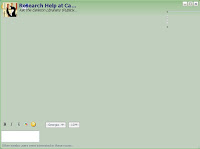
  • Open the room. It will probably look like the screenshot to the right.
  • Click the little bar which, among all the nothingness, looks like it would open the media player (kinda up, kinda right). The room should now look like it’s taking on more structure, with spaces for typing and viewing. The problem is, it will still be completely blank. Fear not!
  • Close the room with the media area open.
  • Open the room. You should be well and truly in the room, and it should even function! You can now keep the media area closed while you’re in the room, but be absolutely sure you open it before you leave or you’ll have to repeat this whole process. (This is a bug Meebo is working to fix.)

If the room is not on your buddy list any more, you have to do the long version (by which I mean “may take longer and be more annoying” rather than “has more steps”).

  • Send your Meebo login name to a helpful friend who has access to the room. (If you send the name to an unhelpful friend, I cannot guarantee results.)
  • That friend must now add you as a buddy under the Meebo network (not AIM or Google Talk, or any of those other networks).
  • Then the friend can enter the room, click “invite,” and invite you’re Meebo name to the room. The friend may have to “re-invite” you a couple of times (by right-clicking on your grayed out name in the room and selecting “re-invite.”)
  • When you receive the invitation, be sure to “Join and Add.” Soon, the room should appear in your “recent rooms” area on the buddy list. Remember to make sure the media area is open before you close the room, though, or you’ll have to do the steps above.

And there you have it! Meebo says they’re working on the two bugs that require the media area to be open and that have disabled the “Become a Member” button in the rooms.

Oh, and may I just say that Meebo people are awesome! I sent them an email explaining the problems we were seeing. They wrote back and forth with me for a couple of days getting all sorts of additional information. Then they even sent MeeboTester3 into our room to hang out for part of an afternoon and do some mysterious tests. A few of us spent time explaining to the tester what we were seeing and the work-arounds we’d figured out. In the end, Dorothea was the one who figured out the media area trick and told the Meebo Tester. Woohoo for beating things with rocks!

3 Comments

On Appearances and Legitimacy

For quite a while, now, I’ve been simultaneously intrigued and disheartened by how much we have to wade through assumptions in order to be taken seriously.

That’s a very vague sentence, partially because it has to be. Here’s an example of what I mean. Another librarian was telling me about her feeling that people who approach her for help must assume she won’t be expert in database searching because that involves interacting with computers, and surely she can’t be comfortable working with computers at her age, right? She commented that it’s probably a lot easier for me to gain trust simply because someone my age is assumed to be highly computer proficient. I, on the other hand, had just been feeling like being 20 or so years older would help people trust me because, after all, how could anyone my age have the experience necessary to be an expert at anything?

In my experience and that of other librarians I’ve talked to, administrators, consultants, the occasional professor, and even other librarians can take a rather indulgent attitude toward young-uns like me. “You’re so young” becomes a complicated statement. Is this a problem? Are you surprised that I’m young because I did a good job? Are you surprised that I did a good job because I’m young? Or is it an explanation for a less-than-perfect interaction?

Because of this, on the days when I’m in important meetings, interacting with new professors, or doing anything else where I need to be taken seriously, I feel like I have to work harder to make the pace and pitch of my speech function on a professional level, and my clothes have to be just so (not too business-ish, because that’s just not me, but no too casual either). This is especially important during the beginning of Fall Term when there are lots of new staff and faculty on campus whom I need to condition into interacting with me as a professional. Basically, I engage in an elaborate process of appearing legitimate.

This plays out in ways I hadn’t anticipated. I had never considered, for example, that there would be people who might use relative amounts of busy-ness as a measure of legitimacy (this was especially true at one job I had in grad school). Once, a long time ago, a researcher “thanked” me for spending so much time on his research question while pointedly implying that having this kind of time to help him must mean that I was probably being paid too much for the amount of work I contributed to the library. At various other times, people have “complemented” me on things like this blog or an updated research guide or a report delivered on time and backed up with evidence, but they’ve left me feeling terrible rather than bolstered. I’m sure you’ve heard it: the “you’re so lucky you have time to do this kind of thing.” Complements like this can sap the energy right out of me because the implication is that I’m not busy “enough” to be a legitimate member of my department. (Note that simply complementing me on something that takes time is not a bad thing. Anything but. It’s the “you must not be as busy as everyone else if you have time to do that” kind of thing that I’m talking about here.)

Whether people actually perceive me as too young or not busy enough I don’t know. Just as I had never thought to question my friend’s computer competence, maybe people don’t actually question my experience or time management skills. But I’ve heard many librarians express the need to fight these real or imagined assumptions, so in the end it doesn’t matter so much if they’re true or not. What matters is that we’re think they’re true, and so we work against them. In fact, whether consciously or unconsciously, we work against them so continuously that when we hear comments about age or expertise or… whatever it is each of us worries about, we are left to wonder if we’re hearing complements, insults, or simple statements of fact.

I wish I could say with confidence that I’ll just decide not to think about this anymore, but I don’t think it’s that simple. And I don’t think it’s just me. I think this plagues a lot of people. It’s not like we go around second guessing everything anybody says to us. Context and tone are really important, as always. But I’ve been wondering for the past year or so if this is connected with something inherent to our profession (and other similar professions) or if it’s just part of human nature and our constant quest to be useful and respected. What I do know is that there are better things by which to measure legitimacy than relative appearance of busy-ness, age, or any other appearance. I just don’t know how to completely divorce appearance from reality.

6 Comments

Reflections

It’s been kind of a rough Fall Term for me. Beginning a month before classes started, I’ve been swamped. Then classes actually started…. Not pretty. For a few weeks there I came as close to being truly overwhelmed as I ever have. And according to the normal order of things, that’s precisely when more deadlines appeared and my support systems crumbled. But I survived. I’m out of shape, I’ve had a lingering cold for a month now, and I feel like I could sleep for a week, but I survived.

The term (which ends in two weeks) wasn’t all bad, though. There were exhilarating moments, happy moments, and moments of clarity where isolated incidents gelled into identifiable trends. I also started to feel, for the first time, that I might be on the verge of understanding where I fit into the constellation of people and functions and services on my campus. By necessity, my skin is thicker than it was 8 weeks ago; I’ve learned to bury certain fears deep inside of me in order to get things done, only freeing them once I lie in bed and stare at the ceiling, replaying my day for analysis, critique, and release. All in all, the prospect of upcoming classes on unfamiliar research topics, or that late-night email from a student in desperate need of help with some impossible research question, or even the task of telling a professor to trust me that students can’t possibly learn everything there is to know about library research in 20 minutes… these things used to paralyze me. Now they cause some anxiety, but nothing to bowl me over.

At this point, I think I’m finally almost qualified to hold the job that I have. And I mean that in all seriousness. My first year here, my amazing co-workers held my hand through everything from class-planning to composing emails. My second year I was able to teach and meet with students and sit at the reference desk with more ease, but I still felt a little like I was pretending to be a librarian and that at any point a student might stand up in the middle of the room and accuse me of being the impostor that I was. And how would I deny it? By showing my diploma? This year, I’ve finally begun to feel that I contribute to the team I work with. I no longer feel like it’s evidence against me if I can’t answer a question; it’s just part of life and reason to thank my lucky stars that I have amazing co-workers to whom I can refer the question.

I can’t wait until qualification blooms into expertise. It’ll happen, but it’ll take time. I’m schooling myself to patience.

2 Comments
css.php