Skip to content

Pegasus Librarian* Posts

Exploding an Article

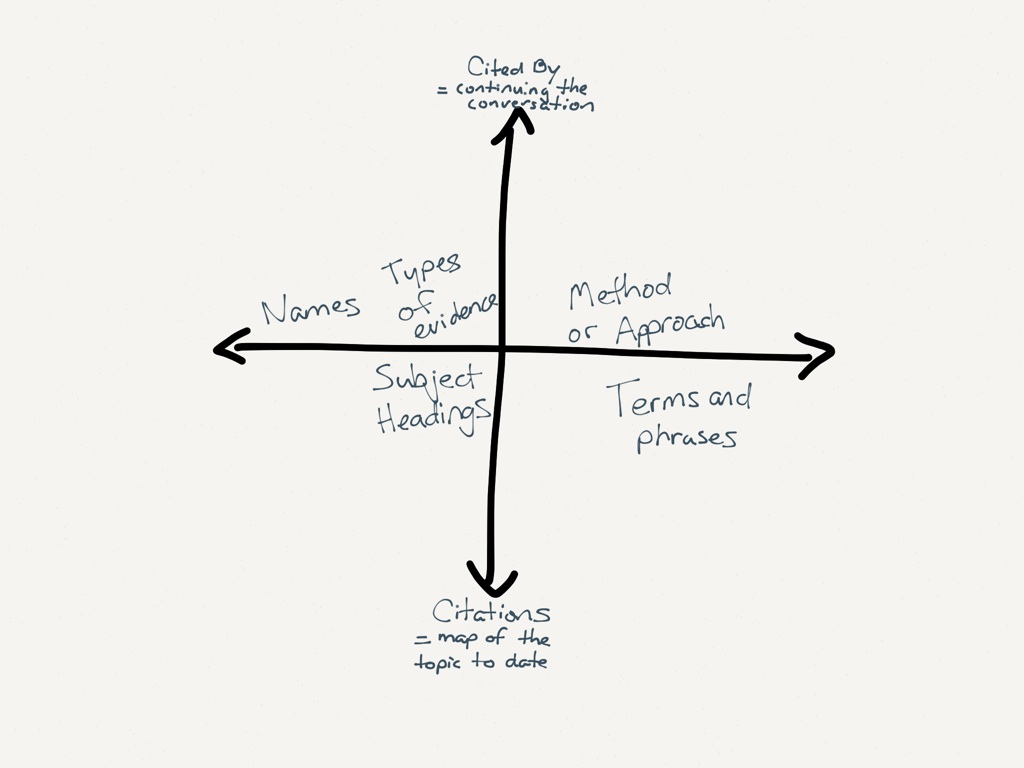
I don’t know why I hadn’t thought of it in these terms, before, but this morning just before a lightning-speed class I suddenly realized that if you have a good article in hand, you can look in four “directions” for more articles like it. (I use “article” because that’s what I was working with this morning, but it works for anything with citations, I guess.)

You can move backward by mining it’s bibliography. You can move forward by using Web of Knowledge to do a cited reference search. And you can move side to side (sort of) by reading it with an eye both for content and for vocabulary that you can use when constructing future searches.

exploding article
By Iris

8 Comments

Maintaining Research Guides, the Never Ending Struggle

I spent a good part of today trying to wrap my brain around a new subject area so that I could a) figure out which resources might be important for the assignment, b) figure out if we had access to those resources, c) figure out what to substitute for the stuff we didn’t have, d) create an online research guide for that assignment, and ultimately e) stand up in front of that class on Wednesday and say coherent and useful things rather than idiotic and generally boring things.

As I was experimenting with new sources and concocting tips for the students who will soon be using them, copying and pasting relevant chunks from other guides, and then deleting about a third of the information after realizing I’d needed it to wrap my head around the project, but my students probably didn’t need it… as my guide emerged little by little throughout the day, I mused on the changing role these guides are having in my professional life, and on their convoluted lifespan.

Before going further, a word of explanation. At our library we have three kinds of guides: subject guides, course guides, and general guides. General guides are those things that aren’t specific to a discipline at all (like “Using the Library from Off Campus“). Subject guides serve as portals for research within a major, and there’s at least one for every major on campus. Each liaison maintains the subject guides for his or her liaison departments, and we each have the option to create a course guide for any course we think needs one.

Recently, I’ve begun rethinking my guides. It started last year when I changed almost all of them over from being organized around types of sources (finding articles, finding books, etc.) to being organized around topics or tasks (finding primary sources, finding social/historical context, finding authoritative scores etc.). Now this year, I’m using the subject guides more and more while I’m at the reference desk, both to organize my own thoughts about a new topic and, more importantly, to model this behavior for students. After all, it’s probably much more useful to send students the extra click through a subject guide than to force them to sink or swim in a list of 200 or more research databases! This also keeps me honest, because I actually use the guides all the time, so their faults scream out at me until I finally get time to remedy them.

And in my life, I do my most careful thinking when creating course guides. These grow out of a specific research task and force me to really come to grips with the research challenges inherent to that task. Then, at the end of each term, I retire the term’s course guides but copy and paste the best bits into the subject guide for the appropriate major. Next term, as I create new guides, some chunks can be copied straight out of the subject guide, but there’s always something new, or some sections that just aren’t appropriate for the larger guide, so those get built from scratch almost every time.

And so this circular evolution of course guide to subject guide and back again keeps me writing and updating guides pretty much every week of the year.

p.s. For the curious, today I was working on a guide to Medieval and Renaissance Music (link will be live through March 2008, after which point it’ll be archived offline).

Leave a Comment

Musings on Periodicals

We’re in the midst of our biennial print periodicals review at the moment, and it’s gotten me thinking about how to be a good steward of our periodicals collection. Personally, I love electronic journals better than print journals in most cases. There’s just so much more you can do with them, none of which involve photocopying. (Photocopying is a sore topic with me, right now, for completely separate reasons, none of them interesting.) So faced with a list of journals and the choice to continue with the print subscription, flag them as candidates for e-access only, or cancel them entirely, I’d go with the electronic version in a heartbeat for many, many titles.

However (you knew there was a “however” coming), there are a couple of categories of things that I will not give up in print if I have anything to say about it. (And remember, I’m the librarian for Languages and Literature, so my views are biased in that direction.)

  • Periodicals that include ads or images that aren’t indexed or included in the electronic version. I spend enough time with my American Studies students (and my colleague spends even more time with her History students) finding ads and images that being forced to give up basically our only accessible copies of these ephemera makes me weep for the students of 20-years-from-now who will be basically prevented from pursuing whole swaths of research topics.
  • Periodicals that include or are primarily composed of fiction, poetry, or art. These genres are used in many ways, some of which is enhanced by electronic access, and some of which are decidedly NOT. I want to leave the door open for the later cases.
  • Periodicals that are routed and that a) don’t have good alerts built into the electronic version or b) are routed to people who don’t care for alerts because they and their workflows are set up to need the thing itself sitting and staring at them before they’ll be reminded that they actually did want to sit down and read for a while. I’m that way, myself, with somethings. Not with my professional journals, but with somethings, so I can entirely sympathize.

Assuming I’m looking at a periodical that doesn’t fall into one of these categories, the next things I’d want to know before jumping for the e-access-only option are:

  • Does the e-access include PDF full text? This is especially important if foreign characters (such as Greek, Russian, or Asian characters) are important, or graphs, or images, or really anything other than the text itself. It’s also easier for students to cite exact and original page numbers.
  • Do we get to retain perpetual access to the issues we’ve paid for? (This is a biggie, and possible from some vendors.)
  • Is the eJournal’s interface easily usable? Are the result lists for searches understandable?
  • Are there RSS and email alert options for searches and new issues?
  • It sure would be nice if we could still send articles to other libraries via Interlibrary Loan. (I still worry about the world’s libraries going e-only and cutting each other off from sharing their collections with each other and with smaller libraries.)

These are the things that run through my head as I page through the periodicals on my list. What other criteria should I be thinking about?

1 Comment

Learning Japanese

Some people have expressed an interest in looking over my shoulder while I learn Japanese via Rosetta Stone. With that in mind (and because I really didn’t have enough blogs yet, it seems), I’ve started a new blog just for that. That way, those of you who find it amusing or interesting can follow along, but the rest of you can stay here with my more library-centric musings.

Here’s the first post from the new blog, and the last one that will be posted here.

On Sunday, I cracked open my brand new goody box of Rosetta Stone materials and got ready to learn Japanese. Of course, first I had to figure out which of the two CDs needed installing first, and how not to blow my ear drums out with the headphone volume, and how to make Vista play nice with the Rosetta Stone application. I also thought I might read the user manual, since I want to do this right, but I realized that I’m just not a manual reader at heart and gave up after flipping past most of the first 10 pages.

Finally, everything was in tip top shape, I’d regained my hearing after an initial misunderstanding with my volume controls, and it was time to begin. Only I didn’t. I cleaned up my kitchen instead, wondering all the while why I was nervous about this. That done I… no, I didn’t get started. I called home and caught up with family news for a while instead. But by this time the sun had set and I was in serious danger of not meeting my own goal of getting started over the weekend, so I screwed up my courage, sat down at the computer, and began lesson one.

I quickly realized I’d have to get over my analytical “must know why things work” mentality. Presented with “Teeburu no shita ni ira otokonoko” there were just so many questions! Why is the “boy” at the end of the sentence, when I’m pretty sure the picture meant that the boy is under the table (and no, the boy was not drunk, he was playing under the table)? Are there cases in this language like there are in French? What if he “was” under the table? Is “to be” irregular in Japanese just like it is in other languages? Do nouns decline? If “to be” is irregular, how am I ever going to learn it based on these pictures? What if I forget these vocabulary words?

Clearly I’m having trouble sitting back and trusting Rosetta Stone to do it’s thing. I will work on trusting it. When it gets to be too much, I’ll reach for my dictionary and look up a couple of the words to see what they mean in a dictionary-type way, but every once in a while I’ll try to just let things flow. After all, this program has a pretty good reputation. Maybe I shouldn’t second-guess it too much.

Leave a Comment

Reason #2974 that I’m glad I’m a librarian and not an IT professional…

When I schedule a library session with a class, spend time preparing a coherent and useful session, and then head into the classroom, my audience generally shows up. (They may not want to, but they do, which is something.)

When the IT department schedules training workshops, they may or may not put hours and hours of work into preparing a coherent and useful training session only to have four walls and a bunch of computers stare back at them while they wait and wait for a participant, any participant, to show up. Talk about your thankless efforts.

Leave a Comment

Why I’m a Librarian

Rudy answered Barbara Fister’s call and then tagged me to be the next explain why I am a librarian. I’ve been putting off responding for a few of reasons. First, I was preoccupied this weekend with the beginnings of my Adventures in Japanese. (I now know how to say several random phrases that will never be useful in real life, but that thrill me to no end.) But even when I popped out the language CD and took up my laptop to think about this, I still couldn’t quite compose anything coherent. But I’ve come to realize that this is because I don’t have a coherent answer. So, setting coherence aside, here are some of the bits and pieces of my answer that form the framework on which my professional life hangs.

I stumbled into librarianship rather accidentally, and made it through to graduation by virtue of my rather entrenched stubbornness. I’d been working my way through a Ph.D in Literary Studies and even passed that crucial step of passing my masters thesis defense and being accepted as a full-fledged Ph.D student. What a point to reach only to find out you’re not very excited about the prospect entering the over-full ranks of semi-talented lit professors, and not talented enough to join the illustrious ranks of truly engaging and inspired lit professors.

Unfortunately, after casting about for a new calling for a while, I began to worry that I wasn’t cut out for anything else. That’s when my mom suggested librarianship. I remember the moment she suggested it. She was doing dishes in the kitchen, and I was lying on the family room floor with one hand buried deep in the family dog’s neck fur. I remember asking, “What? It takes a masters degree to be a librarian? Really?” And I remember thinking that this might be the perfect job to give me plenty of free time to pursue my other interests (this memory makes me giggle, now). What I don’t remember is how that suggestion blossomed into a grad school application, especially since I’d never worked in a library and never even asked a librarian a question. But it did.

So that’s the “why I became a librarian” part of the story. The next chapter, “Why I am still a librarian,” is almost as grounded in sheer luck. It started when my current director called me to offer me a job, and when I was introduced to a set of librarians that taught and continue to teach me what this job can become. And while there are all sorts of joys in my job (my friend, Boolean… the thrill of the hunt… thesauri… the way that everything from LC to citation styles grows out of a time, a place, and an ideology… the freedom I have to try almost anything I think might be beneficial to the library or my students… the MLA International Bibliography)… while these keep me happy in my current position, they aren’t my driving inspiration. No, what drives me to actually be a librarian is much more fundamental and much less specific. You see, I love helping students make sense of the mess that is our information universe. I love it when learning the language of research helps students think more clearly about the questions they confront, and present their ideas in a way that resonates with their audiences. That is why I’m still a librarian, and why I don’t foresee a future when I will no longer be a librarian.

Now I want to know why Steve and Rikhei are librarians.

3 Comments

Carleton is an Excellent Library!

It’s official. Carleton College is this year’s recipient of ACRL’s Excellence in Academic Libraries award in the college library division!!!!! (press release)

I’ve said it before, but I can’t say it enough: I’m so lucky to work with such a dedicated and creative bunch of co-workers, and I’m so lucky to be able to work with them in a library and on a campus like this one. Reading over the essay that my colleague, Matt, wrote for the award application, I realized yet again how much I’ve learned by working with this group and how much I value their energy, their creativity, and their friendship. They are Teh Awesome!

4 Comments

Is “Traditional Reference” Dead?

I’ve been mulling over this question for the last couple of years, but I returned to it after reading these conference notes posted at A Wandering Eyre. (I know, I know, that was months ago. But I’ve been mulling, remember?) In particular, there were a couple of lines in those notes where “Jane” paraphrased Joe Janes and then added her own commentary in brackets.

Now there is a lot of stuff and people can find it or they can find something. There are lots of ways to get help. Traditional reference is not going to work. [Mr. Janes is exceptionally humorous, but he is right. Traditional reference is not going to serve the needs of our users.]

I wasn’t at that conference, and I’m not even directly responding to this passage. But this is a refrain I hear over and over among librarians, and every time I hear it, I think I must have missed something. I assume that “face to face” is implied by this form of reference, as well as “reference interview” and some form of question-resolving activity. And some form of these ingredients continues to make up a major portion of my work. Maybe the problem is that I’ve only been a reference librarian for almost 3 years. Maybe I never experienced this “traditional” form of my job that everyone thinks is breathing its last gasps.

But if we envision our service as one which helps students understand how to tackle questions and why tackling them in particular ways is might be important, is this “traditional” reference or something different? And if we notice growing numbers of students coming to us for this kind of help at the desk and in our offices, and if we’re hearing that students are coming to us because their professors or their roommates or their best friends suggested it, wouldn’t that mean that these services are, in fact, serving their needs?

The kinds of questions we get, and the way that students approach us leads me to believe that reference is not dead or even dying.* I think reference is alive and well just like the English language is alive and well. It isn’t bound by the same rules and expectations as it was once, and new rules have emerged over time, but that doesn’t mean that the basics have fundamentally shifted or become irrelevant. Rather than being gatekeepers of information, we’re now expert in weeding through too much information, but we’re still helping people fill their information needs. We’ve added new methods of communication over time (I imagine telephone reference was at one time regarded as new), but we’re still in the business of communicating with people to figure out what they need.

So if by “traditional reference” you mean “a service which requires people to approach a desk and ask a librarian a question, face to face, as their only method of posing a question, and a service which will respond to these questions by handing back factual answers,” then yes, I think that kind of service is has evolved and been subsumed into a much broader service. But it does not necessarily follow that desks, physical spaces, or even librarians are obsolete. These are just the tools, and only a subset of the tools available to us now; any tool can be put to good or bad use. The service that makes use of these tools is the key. And that service reinvents itself every time a new person presents us with a question, every time we work together to figure out how best to resolve the question, and every time present strategies and tips and, yes, even answers in a way that makes sense to for that question at that time in that context.

—–

* Of course, it may just be that my particular circumstances and community keep reference a vital part of what I do. As students here have grown to rely on the other two prongs of our service (instruction and individual appointments), we’ve noticed that they bring more and more “long” questions to the reference desk. They’re perfectly able to find many of the answers to fact-based questions on their own (which is why our “short” question total has diminished over time), but they come to the desk for in-depth help, research strategy development, or just plain old help getting started in an unfamiliar research territory. I’ve also already talked about why our particular library benefits from a centralized location where a librarian can be found at predictable hours and how we supplement that service with our appointment model and with a low-key IM reference service. But these are outgrowths of our particular institution and our students’ culture, so I understand that generalization is difficult in practice, however wonderful in theory.
9 Comments

Taking the Plunge

I was probably in my teens before I realized that didn’t like the fact that I don’t know Japanese. Until then, it’d just been another language that other people knew and I didn’t. My dad knew ancient Greek and ancient Hebrew (and a whole host of other long-dead languages), and I didn’t, and that wasn’t a problem. My ballet teacher and his pianist spoke Russian, and I didn’t, and that wasn’t a problem (though I did learn a few words, and the alphabet). I was learning Latin and French, but I didn’t know them as well as my dad and my mom, and that wasn’t a problem. My parents both spoke Japanese, and I didn’t, and all of a sudden, this was a source of frustration.

I realized that it wasn’t okay with me that I needed parents to mediate if I wanted to talk to one whole branch of my family. At the same time, though, it seemed like such a monumental task to learn that particular language. I knew I’d drive myself nuts by not getting the accent right. (I can’t understand many words, but because I grew up around the language, a bad accent is like nails on a chalkboard.) I was also intimidated by the challenge of learning two syllabaries and a character set. And I think there was an element of not wanting to struggle to learn something that my parents just knew. I’m also just not really great at learning languages, though I do love them.

Well… yesterday I took the plunge and ordered a course in Japanese from Rosetta Stone, and today I bought a Japanese-English/English-Japanese dictionary. I think it’s finally time to admit that I’ll never learn this language by wishing it. It’ll take work. And it’ll be worth it.

I’m so excited. Why am I also nervous?

3 Comments
css.php