Skip to content

Pegasus Librarian* Posts

Scholars Index Their Own Literature

This year I’ve been shamelessly cribbing off one of my co-workers who’s mantra is “scholars index their own literature.” At first, I didn’t know what she meant, but the more I work with the idea, the more I absolutely love it, especially for the “softer” areas of study where traditional indexing falls short (yes, I’m thinking of the MLA International Bibliography, here).

Here’s the idea, indexers can give a general sense of the primary topics of a given article. Scholars, however, make use of other scholars’ work as it relates to their own work. The web of citations that builds as each area cites relevant works is often a much richer, much more crafted set of interrelations than any result set is. (Incidentally, this is where dissertations are a great help, since part of a dissertator’s project is to map his field and place himself within that field… jackpot for those looking for a starting place in the web of interconnections.)

The problem is that tracing this web of interrelations also takes a whole lot longer than plunking keywords into a bibliographic database and clicking “Search.” Still… if there’s time, and especially if direct searching isn’t working, this is one of those other options that can, sometimes, pay off.

Now I just need to figure out how to explain this succinctly to freshmen. “Scholars index their own literature” doesn’t make much sense when “index” and “literature” are jargon within the scholarly community.

12 Comments

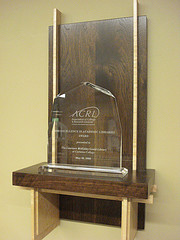
ACRL Award


ACRL Award
Originally uploaded by Pegasus Librarian.

On Friday we had the great honor of receiving the ACRL Excellence in Libraries Award in the College Library division. Our college president, while introducing the award to those present at the Honors Convocation spoke about the importance of collaboration and of intellectual curiosity on a college campus, and of how he sees these twin values in evidence in the library and across campus. And looking around at all the students, faculty, and staff, at all the representatives of various academic and computer support teams, and at the supervisor of the students who do all our public computing support in the library, I realized again how lucky I am to work in this place. I realized yet again that the whole truly is greater than the sum of its parts here, because no one of us alone could have done anything approaching award-worthy work. And I realized for the millionth time what an amazing experience it has been for me to work here as I learn to be a librarian in the midst of this type of community.

So what will we do with the award money? Well, people nominated ideas and we all voted, and kudos to whomever came up with this idea: we’re donating it to Katrina-damaged Dillard University’s library.

2 Comments

Thinking of the Future

While we all run headlong toward the end of the term, a quiet transformation is taking place on campus. The seniors with the most – er – unique styles are suddenly turning up with shaved faces, fewer piercings, more form-fitting (and less hole-decorated) clothing, and combed hair.

I sense job interviews in the offing.

Leave a Comment

LSW Has Infiltrated My Life

An odd thing has happened. For the past several months, whenever I dream of work stuff (which is more often than I’ll admit in print), certain members of LSW are just… there. I’ll be in the middle of a dream meeting with my dream department, but in addition to the people who are in my real-life department there’ll be a couple of LSW people sitting there with us. We’ll all be sitting in our regular meeting spot in the library, tossing around ideas, planning big plans, talking about recent classes, and throwing out anecdotes about the reference desk. Sometimes LSW people will pop into my dream office to ask about something or to tell me about questions they just got, just like my real-life co-workers do. And all of this seems perfectly natural in my dreams. It’s not till I wake up that I realize these people don’t actually work at my library.

4 Comments

Collection Development Choices: the Example of JSTOR

Here I am at the reference desk for one of my Sunday shifts this term.* Sitting here, trying not to think about the tornado watch we’re under, or about cook-outs, or about holidays in general, I started thinking about JSTOR and what a perfect example it is of a whole cluster of things I’m sure my students rarely think about. Namely, the role that collection development choices make on the kinds of information to which they’ll have easy access.

JSTOR, like any other collection, was developed and continues to evolve based on choices people make about what to include and what to exclude. I’m not privy to the inner workings of JSTOR, but I don’t have to know those details in order to know that decisions must have been made to exclude some journals from the collection and to seek out other journals for inclusion. There’s no way around it.

Students, though, assume that it’s comprehensive. If anything, they may know that it doesn’t have much recent content, but they often figure that if JSTOR doesn’t have what they need they’re sunk because probably what they’re looking for doesn’t exist. I’ve seen this assumption loom it’s frustrating head in classes, at the reference desk, in my office, and now again in a set of focus groups we had done. Truth be told, it’s not just the students that think of JSTOR as The access point for scholarly articles in the library… we’ve heard the same assumptions bubbling up from some faculty.

But if you only search JSTOR, how might this affect your views of the scholarly discussion on a particular topic? A PoliSci professor on campus loves to point out that the journals in JSTOR for his discipline come, by and large, from one particular theoretical framework within the world of Political Science. I’d never thought about this until a couple of years ago (when I heard him say that for the first time), so I thought I’d take a closer look at the Language and Literature journals there. And sure enough, there are a couple of interesting trends in evidence.

First of all, there’s a distinct preference for journals published in the United Kingdom or the United States. I know other English-speaking countries publish high-quality, peer reviewed journals on language and literature, but vanishingly few show up in JSTOR.

Then there’s the question of dominant theoretical frameworks. Well, after admitting in the comments on my last post that distinguishing theories of reading is difficult, I’m sure you’ll forgive me if I pain in broad strokes here. That said… all the ways of reading a text (which I define very loosely, but which is easier to type than “mode of expression”) choose some method by which expression and meaning interact and dub it the most important or interesting site of meaning to explore. Some look to the text itself and exclude other contexts while others look to the reader’s interaction with the text or to the cultural context surrounding the text’s creation. JSTOR journals tend heavily toward the cultural-context option and exclude, almost entirely, the text-by-itself option. (Interestingly, the curriculum in the English department here has historically tended toward the text-by-itself option.) So if, as many undergraduates are, you’re looking for examples of ways that scholars have interpreted a given text, JSTOR will only give you a piece of that story because it seems to have chosen to develop its strength in contextually based criticism.

Of course, none of this is meant to imply that JSTOR is trying to pull one over on its subscribers, or that it’s not valuable, or anything like that. They can’t digitize everything, and they do have many of the absolute core journals in my disciplines. My point is just that students think it’s comprehensive, but it’s not. This is why we subscribe to more than just JSTOR. Each collection, physical or virtual, has it’s strengths and weaknesses, and remembering that this is true is a key part of becoming a savvy researcher.
* Life at this college only gives passing glances to holidays as it plunges headlong through 10-week terms. In the case of Memorial Day, this glance takes the form of an email message from the college president urging us to “take a moment” to honor those who died defending our nation, a vigil in the campus chapel, and probably sidewalk art. We enjoy sidewalk art here.

2 Comments

Method as Content for Undergraduates

I wish it were possible for our bibliographic databases to index works according to the methodology or theoretical approach of the author. I know it’s not possible in many cases, but man oh man I wish it were. For a lot of undergraduates, finding examples of scholars employing a methodology or approach is high up there on the list of information needs, and it’s just not something that search can really help with.

So what do you do when a student comes and needs an example of a Marxist reading of The Wasteland or a post-structuralist reading of The Between? What about students who want to see examples of formal lab write-ups, or those formal research papers that actually use the prescribed headings Introduction… Methodology… etc? Part of the learning process is seeing accomplished researchers employing the forms that are taught in the undergraduate classroom, so for these students methodology and approach is a very real form of content to be sought, found, and analyzed.

Personally, I’ve developed some inefficient work-arounds for some of the questions I get most often. Try searching for research articles that have “study of” in the title… people likely to put “study of” in their research reports are also likely to use the traditional subheadings. And for the theoretical-approach question, I keep an anthology of the major literary theorists in my office and then do this complicated thing where I do a cited reference search in Web of Knowledge for an appropriate theorist, then I do a search for the topic or author or work we’re trying to interpret, and then I combine the two searches. Sometimes that works fabulously… sometimes it flops. But at least it’s something. (Of course, this doesn’t work very well at all if you’re trying to find an example of close reading… since close readers often only cite the work they’re reading, er, closely.)

‘Tis a puzzle. It’s one of those examples of a very common kind of research task (for my population, at least) that cannot be solved without quite a bit of prior disciplinary knowledge. Search, just by itself, will almost always fail.

7 Comments

Learning About First Year Students

The dynamics of research in our various liaison areas dictate that most of my co-workers work primarily with upperclassmen, and that I work with more freshmen and sophomores than with juniors and seniors. I used to feel a little left out of the “fun stuff” because of this split — a little jealous that my coworkers had more call to develop highly specialized knowledge and skills while I worked on basic things (like the fact that interlibrary loan exists, and that scholars publish in journals as well as books). But that only lasted as long as my naive assumptions about the complexities of working with first year students. Fall Term two years ago, those naive assumptions vanished, and ever since, I’ve been fascinated by the challenge of getting freshmen up to speed as quickly as possible. And just recently, I’ve learned a whole lot about my the target demographic of my special project.

  • Focus groups on our campus suggest that freshmen here don’t see research skills as generalizable across disciplines. Maybe our liaison model feeds this. Maybe our model just caters to it. Either way, that’s my cue to figure out how to make the skills and strategies I teach more explicitly transferable to other classes and research problems.
  • Our FYILLAA results were pretty interesting, too, showing that incoming freshmen (prior to having any classes at Carleton) *think* that tasks like citation or determining the scholarly-ness of a source are easy, but that they actually have a great deal of difficulty identifying scholarly sources or distinguishing between book, article, and essay citations.
  • And now I learn that first year students have other things on their minds, that they have to adjust to “daily life management” before being able to spend time developing their intellectual muscles.

What a range! Just the new stuff I’ve learned this term spans “transferable skills awareness,” the nitty gritty of getting your hands on stuff and navigating the scholarly literature, and the developmental project of adjusting to life on a college campus.

Leave a Comment

The More Things Change, The More They Stay the Same?

There’s been some interesting themes circulating in LibraryLand recently which have to do, I think, with the near-maturation of that collection of technologies we think of as Web 2.0 (or, at least, with the settling-in of the driving idea behind those technologies). There’s been a bit of a collective yawn in evidence when people prepare presentations or publications about “The top 10 new social tools online” or “the 100 2.0 tools every librarian should know” or anything along those lines. The time for laundry lists of new tools seems to have past. So what happens next? What do presenters and authors tell us now to continue our development as a profession?

Some have taken a step back and generalized the message to be something like “all of this is simply a byproduct of the need to implement innovative services… the tools don’t matter as long as you’re being innovative.” Or they may exhort us to “keep up with those young-uns or libraries will become irrelevant.” Maybe you’ve heard about the benefits of experimentation, or gotten deep into discussions about whether we should lead our communities to new technologies or follow them into the online spaces they already inhabit.

In my corner of LibraryLand, the question seems to be more along these lines: Does the existence of these tools, or of technology itself, fundamentally change humanities scholarship?

And of course, this question leads to a myriad of others. If technology does change humanities scholarship, what does this new scholarship look like? Is it fundamentally different or just different in its methods and appearance? If technology does not fundamentally change humanities scholarship, to what extent are humanities scholars and the librarians they work with obligated to know or care about Web 2.0? If a rose by any other name still smells sweet, does Scholarship (with a capital S) continue onward regardless of the tools that mark its methods?

I certainly don’t have answers for these questions, but as I think about them, I wanted to collect a couple examples of the places where I see this kind of discussion playing out.

  • There has been some discussion in the blog world specifically about humanities scholarship in the digital age. For example, Wayne Bivens-Tatum over at Academic Librarian has written his views on the topic. He sees the fundamentals of humanities scholarship as unchanged and unchanging, and laid out his reasoning in these two posts. Though I have some difficulties with his arguments,* they are excellent posts. Dan Cohen, on the other hand, about how humanities scholarship is shifting and will shift in the future.
  • Project Bamboo has embarked on a mission to enhance humanities scholarship by building a new suit of technological tools and by formalizing collaborations between scholars, information technologists, and libraries. Their proposal document presents a vision of the ways that these technologies and collaborations could aid in the exploration of current kinds of humanities research, but it also hints at the possibilities that new kinds of questions could be asked in the future. I’m not sure yet if these are fundamentally different kinds of questions, but I’m taken with the analogy on page 12 where they note that “for the humanist, the library is his or her laboratory.” Scientists can as questions that their methods and laboratories (formal or informal) allow them to answer. There are whole branches of science that were not possible 50 years ago because the equipment wasn’t there to support them. Will this analogy hold true for humanists? And if so, is this a fundamental change or simply new avenues built on the same foundations?
  • Conversations such as the ones that are going on now about the role of social spaces online in education. For now I’ll pick the Creepy Treehouse posts at ACRLog, See Also, and Reflections from a Small College Library. For budding humanists, will integrating research and online social interaction be as natural as breathing (or as discussing the politics of spacial representation with fellow scholars over drinks)? If not, if research would seem “creepy” in the context of online socialization, how might the assumptions about what’s askable, what’s knowable, and what’s reusable that grow out of such spaces influence these new scholars’ assumptions about their scholarship? If so, is this actually different from the kind of scholarship that happened before? I’m thinking of C. S. Lewis and his Inklings group, and of the departmental lounges in academic institutions, and of any number of times I’ve seen the scholars in my family argue points of interest.

What do you think? What counts as “fundamental” in scholarship (humanities or otherwise)? Do these fundamentals change in response to the tools available? If I can ask different questions now than I could before, could that mean the field has changed? If things don’t change fundamentally, what counts as significant change and how do all these questions play out?

*I think he’s confusing methods with fundamentals, myself, saying that some people are changing their fundamental practices when they use new tools and then arguing that humanities scholarship has not changed regardless of the fact that they do sometimes use new tools now.

8 Comments

Cover Letters

An interesting idea sprouted over at Llyfrgellydd and was taken up at Guardienne of the Tomes. Here it is:

Post a cover letter that you wrote. It can be terrible, it can be wonderful, it can be the one that got you a job. But post it with the idea that other librarians (new, old, and not-yet-to-be) can learn something from it.

Well, I debated joining in, because I don’t feel like I have a great example of a letter, and I cringe whenever I read the ones I sent out (yes, I have copies of them… all of them…). But I’ve decided I’m OK with having people point at laugh if it helps someone figure out their writing style and what to include in or exclude from a cover letter.

The letter I’ve chosen is the one that I sent in when applying for my current job, which is my first job out of library school. I didn’t have much library experience (I’d worked part time in a public library and part time in an academic library for the past year) so I was trying to make a case for myself by tying together my tutoring (read “instruction”) and other instruction experience (I’d won an award for movement instruction), my public service experience at a small, independent bookstore I’d worked at for several years (I’d done reader’s advisory, ordering, and almost everything else you could do at that bookstore) and my commitment to the disciplines I’d be serving in this new job. I also wanted to be sure they knew that I understood the idea of the liberal arts and that I knew about this particular college.

I’d been advised to have a letter of no longer than one page (which I now know isn’t necessarily true, especially for academic positions), and to close with an “I’ll call you” statement… which I agonized about for longer than I care to admit, because it seemed so incredibly cocky to me. But I dutifully followed the advice. All I can say is that I’m glad at least somebody here didn’t hold it against me.

I should also say that I wrote my resumé much more like a bulleted cover letter than many resumés I’ve seen, so I didn’t duplicate that here in my letter. I’m not sure if that was wise. All I’ll say here is that under each of my jobs listed on the resumé I placed examples or quotes from people or anything else I could think of to show that the experiences I’d had at these other (mostly non-library) jobs could translate easily to the job I hoped to obtain. I figured anyone could guess the job duties of a tutor or book seller, but what they needed from me was a direct translation into this job.

So, without further ado, here it is:

January 26, 2005

[Future supervisor’s name]
[library and address]

Dear [future supervisor],

One of [the library’s] evening supervisors, my brother [brother’s name], recently explained the exciting work you are doing to increase the library’s effectiveness and visibility as the cultural and educational center of [the college]. As he spoke, I knew I wanted to be a part of your team.

I am addicted to learning, especially at a college like [this one] where students are encouraged to explore the intersections between disciplines. My personal research explores the dynamic fusion of history, philosophy, literary theory, language, art, and social context in the literary expressions of various times and cultures.

Learning is so important to me that I work vigorously to share it. I have been a highly successful tutor and instructor for the past seven and a half years because I approach instruction with creativity, enthusiasm, and humor.

I am also adept at information marketing and have eight years of experience providing superior customer service. I am especially good at working with “challenging” customers and with customers from other cultures and linguistic backgrounds.

I think I would make an excellent addition to your team and look forward to further conversations about the ways our goals complement each other. I will call you next week to see when we can talk in more detail about how my abilities will benefit your library.

Sincerely yours,

Iris Jastram

Enclosure: Resume and References

It feels rather like letting you peek under my bed to see if I’ve swept there recently (no, I haven’t). All I can say is that I tried. I tried hard. I probably tried too hard. But it got me a phone interview, which led to an on-site interview, which led to a job.

2 Comments

Evolutions in Communication

It’s always fun when I sit in my office and get to hear students practicing their class presentations outside my door. We have a large SMART board and some comfy couches right there, so it’s a natural place for that kind of activity, but somehow I never tire of hearing these run-throughs. It’s really one of the only times I see the fruits of research activities, since we almost never see student papers.

This morning I mused on the natural progressions I see in all kinds of communication skills, and that I remember going through myself during college and graduate school. There’s an interesting phase we go through where we imitate the rhetorical structures and even the mannerisms of some idealized Smart Person. We try on jargon and clump around in it like we did our grandparents’ shoes when we were young. We start questioning our conclusions and worrying that they’re self-evident. We aren’t quite sure which evidence might be too self-evident, so some key pieces of it never make it into the final product. (Just as a side note, I love watching undergrads negotiate this phase because it’s a great way to learn what it is that they see happening when accomplished scholars perform their work.)

The next phase is one of extreme confidence. This is when we think that our readers or listeners probably pay the same amount of attention to the words, phrases, arguments, and conclusions of our work that we are learning to pay to theirs as we pour over their works in preparation for assignments and lectures. This is when formal communication becomes less of an act of dress-up and more of a game or, in the worst cases, a contest. “If my readers can hold this allusion and that metaphor and this key phrase and that piece of evidence in their minds all at the same time, they’ll understand that I’m being witty in this statement and the whole piece will be even more interesting for them to read.” This kind of writing is fun. I remember the exhilaration of weaving together fine works of analytical art and handing them in, knowing full well that my professors would enjoy a carefully and consciously crafted piece of writing. And in some cases, this is the style of writing that particular audiences did want. But little by little, I realized that not all audiences are thrilled by the prospect of performing mental gymnastics. Which brings me to the next phase…

There’s a fine art to writing in a way that clearly communicates what you want to say without forcing your audience to work at understanding you. This is the stage where writers start deliberately trying to misunderstand their own writing (knowing full well that somebody will take that beautiful sentence the wrong way) and revising their work to make misunderstandings as rare as possible. And it’s not just about misunderstandings. Remember those comments that just said “awkward” in the margins of papers you got back from professors? This is the stage where that all begins to make sense. Whereas before, respecting your audience meant trusting that they could follow you through complex writing, now respecting your audience means knowing that they probably could follow you if they wanted to, but that they’re much happier if you don’t cause them fatigue.

This is the kind of writing I aspire to, but it’s much, much harder than the complex writing I practiced in grad school.

Having said that, watch as I glibly push “Publish Post” without re-reading this lengthy piece of writing about writing….

Leave a Comment
css.php