Skip to content

Pegasus Librarian* Posts

Wrestling with Reference

In the last few weeks I’ve been part of several conversations with other librarians about reference services. And now that I’m at an academic librarian conference (Hello ACRL!), I’m having even more of these conversations. Some people talk about moving away from the reference desk model entirely, others are conflicted, or shifting the service in various ways. All have very good reasons for making the decisions they’re making.

Like so many things in life, though, I find that there are a lot of unstated assumptions and values at play in these conversations. This morning I attended a great talk about navigating change, and one of the biggest assertions in that presentation was that we have to unpack the words we use when we state our values because our working definitions and the behaviors associated with those working definitions can vary significantly. People may think they’re talking about the same thing because they both say “Openness” or “Respect,” but they’re actually not. And if people think that there are gaps between their experience of your stated values and your working, behavioral definitions of those values, that’s when trust erodes.

This connected in my connection-seeking brain with all the librarian conversations where people decide what kind of librarian you are based on your stance on staffing models for reference desks. Are you That Kind of Librarian who wants to staff the desk “just in case” there are questions, or are you That Kind Of Librarian who “doesn’t value reference?” Whole identities can be decided in a moment on this one issue.

But here’s the thing, if we start to unpack what we actually mean when we talk about “the desk” — just like we use the reference interview to unpack patron needs — I think it uncovers a much more fundamental set of values. These values may or may not be served by a reference service at any given institution, but where a reference desk is not the option, these values still need to be enacted by some other service model somehow.

So here are three of the things that have bubbled to the surface during these conversations I’ve been having in the last few weeks. None of these were true 100% of the time at desks, of course, and none of them will be true 100% of the time in any model. But they are values that I think are key to building and sustaining a research/reference service.

Visible Demonstration of Function (Especially Interest)

Even if patrons aren’t actively seeking out the service or actively learning about support options, they should be able to see you being kind and welcoming and helpful and engaged and excited about other patrons’ information needs. Maybe your patrons will walk past you a million times on the way to and from the printers, or the bathrooms, or whatever, but they become passively aware of the service and its function. And they become passively aware that librarians love the act of information seeking, love the hunt, love the puzzle, and love more than anything else the opportunity to engage with people who are curious or confused and who will have their lives made easier by access to some information or a more nuanced ability to evaluate and use what they have found.

We’re nerds at heart, and pathologically helpful, and we find our reason for existing in the ability to both help people and geek out at the same time. But our “brand” on campus is often much blander than this – much more tied to the mechanics of access. And the only way to help people see that we’re good for more than “My professor said I needed 3 peer reviewed articles…” is for people to see that we’re broadly interested in information seeking and use, information-based rhetoric, and information structures. Without this, we run the real risk of having ever fewer questions, and then cutting services back further, and then having fewer questions… in a vicious cycle to oblivion. And all this not because we’re no longer relevant or whatever, but because people can’t see what we actually do and care about.

Low Barriers to Use

Barriers come in all shapes and sizes, of course, and different people find different things to be barriers. This is one reason to have multiple methods of getting and receiving help.

At least one of these methods should allow people to somewhat randomly get drop-in help without doing a lot of information seeking to find out how to get help or to formally schedule things. Predictable drop-in hours and locations (physical or virtual) that are well matched with people’s existing habits help tremendously with this. So does shared language and modes of engagement that match existing cultures and contexts.

For the librarians: Access to a broad cross-section of questions – especially “basic” questions

We know better what’s working and what’s not, what instruction worked and what didn’t, what tools work and what tools are confusing, etc, by being exposed to as many questions as possible from as broad a cross-section of a community as possible. The questions from just the people who know you already or just the people who specialize in the same things you do are good and important and useful, but more than that is even better.

In a lot of ways, the “easy” questions are more telling than the complex ones if your goal is to keep tabs on what your population finds easy or hard. These “basic” questions may be accommodated by a variety of service models, but they are decidedly not unimportant questions. If anything, they may be the most important questions — the questions that tell us valuable things about tools or services that we haven’t set up right. It’s not the patron’s fault for asking the “wrong” questions — The User Is Not Broken. It’s on us to make it so that, wherever possible, “easy” things are easy for our users, too. Or if we make the decision to opt for a set-up that isn’t strictly the easiest option, we should have well-considered reasons for this choice. In academic libraries, for example, there are times when the better solution is one that helps our students learn things even if it means an extra click or two. But these decisions should be weighed carefully, and monitoring the tenor of these most basic questions is one way of figuring out if you’ve struck the right balance for your context.


These are some of the things that I think lurk beneath the surface for people who “value the desk.” And for people who have moved away from the desk, these are some of things that they have to recreate in their new service models.

What else is lurking? What else do we value in a reference service, no matter that service’s model? What are effective modes of enacting those values so that they are apparent and transparent to our communities? Let’s build an actually articulated definition, and then test our services against that definition.

1 Comment

Tracking down known (or known-ish) documents — some strategies

A faculty member asked if I could come to his class and teach him and his students to track down documents that they see referenced in their research. Some things they’re seeing are well cited, some things are just alluded to, and some things are decently well cited but they can’t find the text. What strategies and techniques do I use? Where do I look? Basically, what do I do every time he emails me and says “I’m looking for this publication but can’t find it” or “This person mentioned that there’s a study on x, how do I track that down.”

My initial thoughts were “This’ll be fun!” and also “I do this every day but I have no idea how to explain it in a coherent way.” It’s just something I do, and it’s never exactly the same twice in a row. But I decided to distill some of the strategies that I use most often, and then give the students a check-list of potential tools and strategies for their research area.

My Top 8 Strategies

1) Find out as soon as you can what kind of document you’re looking for.
Books and book-like-things (things that are formally published, generally all at once as a single entity) are findable in different ways than dissertations or periodicals or essays or websites or reports, etc. Different places collect information about different kinds of documents, they have different metadata associated with them, and basically if you can’t figure out this part the rest of it will be much, much harder.

2) Assume that key parts of the information you have about the document are wrong. A major early strategy is to find the best and most complete citation possible.
People misspell other people’s names all the time, or get the title wrong, or remember the wrong publication year. Similarly, scholars change their names all the time, or things get reprinted in various ways, sometimes with varying titles. Don’t even get me started on transliterations from non-Roman alphabets. (People are less likely to get the place of publication or publisher wrong because those are things you have to look up on the spot as you’re writing a citation, and they tend to have more standardized ways of being written down.) I can’t over-emphasize how useful it is to reframe your search from “I want to find this document” to “I want to find accurate publication information about this document.”

3) Use creative, “fuzzy” searching and browsing.
Pick out a few words that seem the least likely to be wrong and the most likely to be unique. Maybe choose the author’s last name (first names sometimes get truncated or left off entirely) and a key term or two from the title or topic. Maybe see if you can find everything by a particular author (maybe that author’s CV), or find everything on a topic published in a particular year by a particular publisher. Boolean operators, truncation, and nested search terms are more important in these searches than in a lot of other searching. For example, you can OR together alternate spellings or translations. Basically, figure out ways to give yourself a manageable list (tens, maybe hundreds, but not thousands) of things that could reasonably contain your thing, and then read through that list.

4) No single search tool works every time, and each tool has its strengths and weaknesses, so use multiple tools.
Google is amazing at free-text searching, and it’s HUGE, and it can do things like match up synonyms for you, or correct for spelling variations. It’s not great at letting you work with structured metadata or telling you what you actually have access to from your institution. Meanwhile, library systems don’t contain as many records (sometimes a pro, sometimes a con) and they aren’t as flexible about interpreting search terms, but they’re great at pulling together publications by discipline and/or providing access to structured metadata. And each library tool has its own advantage and disadvantage. So most of the time you’ll end up using multiple tools to track down an obscure document.

5) Always start out with the hope that you’ll find the thing in the most obvious place, but don’t get discouraged if it’s not there after all. (Or the second place, or the third… this is an iterative process)
Sometimes I second-guess myself and think “This thing is so obscure, I should start with a specialized search in a specialized place” only to find out that it would have come up immediately in a basic search of my library’s discovery tool. That said, some things only reveal themselves when you’ve worked your way through dozens of places and picked up bit of information along the way.

6) Tracking down a document is a team sport — ask your team mates and your librarian for help and ideas.
I do this every day, and I have a whole masters degree in exactly this, and I ask my colleagues for help and ideas all the time.

7) If you can’t find the thing, or can’t find it in English, or whatever
Can you find something like it that would help you accomplish your goals? Can you adjust your goals to mesh with the information you can access? Or can you use the non-English version somehow given what you know about the standard structures of most scholarship? Maybe you can find something you can use that cited the thing you can’t get/use and that built on that first thing in useful ways? In a pinch, if no other options are available, is secondary citation an option?

8) Remember to think about whether the document is actually the best document for your needs.
It’s a heady moment when you finally track down that obscure conference paper that you saw referenced as THE source for an idea in someone else’s paper. But is it actually THE source? Or is it just the source that that other scholar knew about? Don’t cite it just because you found it.

Key tools

  • For Everything
    • Google (keeping in mind its search operators – and remember you’re looking for information about the thing as much as the thing itself)
    • Wikipedia (especially for alternate spellings, related terms, citations)
    • Internet Archive (kind of like google books, but a different set of digitized things, and not just books, from institutions as well as from individual people)
    • LC Authorities (for alternate spellings/names for particular authors)
    • Any other tool that lets you search through the full text of scholarship in your area (JSTOR, Project Muse, etc), so that you can find other scholars mentioning the thing you’re looking for.
  • For Books and Book-like-things
    • Your library’s catalog
    • Google Books (especially for finding citations in scholarly works, or finding essays or reprints within compilations)
    • WorldCat (especially for searching by publisher or publisher location, or for any books or book-like-things — it’s not great at non-roman letters, though. If things get really hairy the old FirstSearch interface allows some ultra-advanced options that are helpful)
    • HathiTrust (added thanks to comments!) — especially for scans of out-of-copyright things, including really really old cool stuff.
    • The national library of whatever country seems most relevant
    • Publisher websites, researcher websites/CVs, academic department websites, etc
  • For things published in periodicals
    • Your library’s journal browse list
    • Disciplinary research databases from relevant disciplines
    • Google Scholar (especially for broad, fuzzy searching, or for cited reference searching)
    • Ulrich’s Periodicals Directory (especially to find out where a periodical gets indexed for searching/browsing) – requires subscription
  • For dissertations
  • For reports and conference papers and the like
    • Mostly Google, some disciplinary repositories or research databases… Often these aren’t actually publicly available, and when they are they can be difficult to track down.

For the topic these students were exploring, I put these tools into this long checklist of possibilities.

What about you?

Most of you are librarians — what are your go-to strategies for tracking down the documents your researchers are looking for?

5 Comments

I coded from an API for the first time, and so can you!

A couple of weeks ago, my library upped our Libguides instance to Libguides CMS, which means that a few weeks ago I came to be in charge of a system that has APIs for the first time in my life. We got the system so that we can pull more robust information from Libguides into our discovery system (so that’s our systems librarian’s domain, not mine), but there have been a couple of tiny things I’ve wanted to do that would be so much better with an API than with the built-in widgets, so I cracked my knuckles and set to learning.

Here’s the first tiny project I did, narrated so that you can do something similar if you, like me, are not an expert in web coding but have access to Libguides APIs.

Building an API-fed dropdown menu

I know, I know, there are dropdown menus of guides available in the built-in widget builder, but I don’t like how they look, and I don’t like that you need the “Go” button to make them go. So this made a perfect first toe-in-the-water project for me.

Getting data via the API

First, I needed to figure out how to make an API request. Libguides CMS “Endpoints v1.1” has a section to GET Guides, a list of “parameters,” an example request, an example return, and not much else. It took me a while to figure out that the example request didn’t work because it was asking for 2 specific guide IDs — IDs for guides that do not exist in our system. Once I deleted those two numbers I could start building requests that actually worked.

Then I figured out that you add a parameter by adding “&parameter_name=parameter_value” to that base URL. So http://lgapi-us.libapps.com/1.1/guides/?site_id=…=owner&sort_by=name would take all our guides and sort them by guide name. From there I could happily keep adding parameters, and if I wanted both “Course” and “Subject” guides but not other guides, I could put a comma between the parameter values “2” and “3” to get “&guide_types=2,3” in my request URL.

Other useful terminology I learned along the way that will help my future Googling includes:

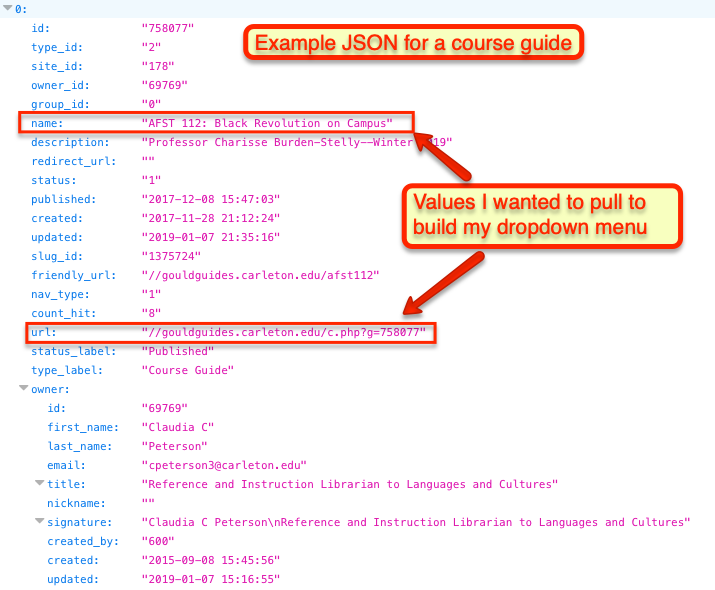
In the end, I created an API request for published guides, sorted by name, and filtered to just those having a particular tag. Here’s an example record from the JSON output I got from that request:

Using the API-generated data to feed a dropdown menu

Then came the searching around through StackOverflow for examples of code that uses a URL to point to JSON-formatted information, examples of code that use JSON fields to populate a dropdown menu, and examples of code that use javascript to add an “event sniffer” to a dropdown menu so that when a user selects an option, the menu opens a new URL without requiring anything else (like clicking a pesky “go” button). This step took me a while… In the end, I fiddled and fiddled with example code until all of a sudden, bits and pieces started to work! So exciting! And little by little I arrived at code that works for me.

Here’s an annotated version of what I built (and an html document you can download and mess with).

(And if you are someone who actually knows what they’re doing, and you see that I made dumb mistakes/choices, please let me know! I’m eager to learn.)

Leave a Comment

Information Architecture, from information about architecture

I’ve just started work with a team of people who are going to be redoing our library website’s information architecture. Maybe some design, but mostly the structure. So of course I do that thing that I do so often and try to figure out how to think about the problem at hand before actually diving into the problem at hand. And this time I seem to be doing that by reading about architecture.

I’m not the first one to do this, by any means. There’s a great talk by Dr. Molly Wright Steenson from this month’s MinneWebCon that lays out lineage of current artificial intelligence work, including the inheritance from architecture. And her talk reminded me that this is exactly what I needed to think about again in order to think about our website structure.

So I went down into the stacks and checked out Christopher Alexander’s two most famous works, A Pattern Language and The Timeless Way of Building. These are two very very large works of architectural philosophy, so there’s no way that I’ll be able to read and apply them thoroughly to my current project, but something is better than nothing, right?

And then, on page 55 of The Timeless Way of Building, the primary claim from Chapter Four jumped out at me:

We must begin by understanding that every place is given its character by certain patterns of events that keep on happening there.

This is “the user is not broken” stated a different way. Spaces are set up, and people will behave in relatively consistent ways in those spaces depending on the affordances of the environment. If they do things we think are wrong, and especially if they do them consistently, then we have clearly set up a space that invites those events. The user was not broken; our design was broken. But Alexander’s formlation works better as an aspiration to achieve rather than a resignation to past failures. If we can know these patterns that environments evoke, we can design environments that evoke patters we want. If we set up a space (physical or digital) that invites the kinds of events that our community wants and needs (actions, reactions, experiences), and invites these events consistently, then that is a space that has Alexander’s “quality that cannot be named” that animates every successful design. (He goes into detail about definitions of that quality in chapter 2, but I won’t do the same here. You can go puzzle over that chapter if you want to, but my big short-hand for it all is “it works beautifully.”)

He then usefully qualifies his thesis:

This does not mean that space creates events, or that it causes them.

For example, in a modern town, the concrete spatial pattern of a sidewalk does not ’cause’ the kinds of human behavior that happen there.

What happens in much more complex. The people on the sidewalk, being culture-bound, know that the space which they are part of is a sidewalk, and, as part of their culture, they have the pattern of a sidewalk in their minds. (72, emphasis original)

And, in the same way, the patterns of events which govern life… cannot be separated from the space where they occur. (73, emphasis original)

So what are similar structural digital elements that we could switch out for “sidewalk” here? Search box? Menu? Bullet point? We have to keep in mind that in our culture, these things call on a whole network of cultural-bound events. We cannot say “well, we know that search boxes you’re familiar with when doing research are boxes that search through the full text or at least a paragraph of text, but this particular search box searches through a list of library research tools instead.” (Incidentally, this is part of what makes the MLA International Bibliography so hard to use and teach.) People will fall into patterns and perform topic searches in that search box, and they will do so over and over again. And they will wonder why our search box is broken. These patterns are patterns that we can often predict, and good intentions won’t matter if you ignore these predictions.

That said, we can help shape the patterns that happen again and again. For example, we don’t have to blindly follow our novice patrons to their best-known patterns just because many of our patrons are novices. We have to know what they expect and their habitual patterns, and also the expectations and patterns of the experts on our campus, and we have to create systems that invite useful events for all. This may mean educational events that help the novices learn the patterns that are typical of the new culture they have entered. This may involve educational events that help experts navigate evolving systems and patterns and academic cultures. But these educational events can’t happen unless we build bridges for the inhabitants of our spaces (digital and physical) from the patterns they have known to the patterns they are developing.

Alexander, Christopher. 1977. A Pattern Language: Towns, Buildings, Construction. New York: Oxford University Press.

———. 1979. The Timeless Way of Building. New York: Oxford University Press.

Leave a Comment

The Library Society of the World: Origin Story

Eleven years ago, in a browser far, far away, a dedicated and creative public librarian named Josh Neff opened his ALA membership renewal notice and sighed as he looked at the dues he would owe. Librarians just don’t make a lot of money, and memberships are costly. Meanwhile, he and his buddy Steve Lawson, library blogger extraordinaire, were joking on Twitter (because they were awake and near computers), and out of this joking came the tweet that changed the world. Josh tweeted that he and Steve were starting the Library Society of the World, a society that would never charge any dues and where people could join simply by saying they were members. Josh’s friend from library school, your humble Pegasus Librarian, and several others heeded the call, pledged allegiance, selected association titles for themselves, and thus the LSW was born.


That same day, because this was the early 2000s, we started a wiki. One simply could not have a library organization and not have a wiki, after all. And of course we started coming up with our organization structure and policies. As you can see from our Policies page, this was a very serious effort involving much committee work and wordsmithing.

Within the first month or two we had opened up a Meebo Room where most of us spent most of our time. (For those of you who don’t remember Meebo, this was a free group chat platform.) Within the first year many of us had colonized FriendFeed, which ultimately became our main home. (For those of you who don’t remember FriendFeed, I’m still too grief-stricken over its closing to go into details.)

We introduced ourselves to the library world at large during a raucous presentation at Computers In Libraries, 2008, where the Meebo Room chat was projected live during the session so that all of us could participate simply by typing into our browsers. Then in 2010 Josh and Steve were named Movers and Shakers for their work creating this society, and in response they (and we) developed the Shovers and Makers list, nominating ourselves and writing down what we appreciated about each other. (There was a blog for that, but it has since gone dark.)

Between then and the day FriendFeed shut down in April of 2015, life continued. People got married, had babies, changed jobs, experienced loss, got divorced, struggled, triumphed, and committed daily acts of superior librarianship. Several left the profession and the group. Others stayed in the profession but stopped being active participants. Still others joined us to bring their fresh voices and perspectives from all corners of the world and librarianship.

In April 2015, FriendFeed shut down and we began nearly a year of diaspora before finally landing on Mokum.place/lsw in February of 2016. And we have lived in this peaceful place ever since, sharing ideas, asking each other for opinions and advice, and being together through the ebbs and flows of our careers and lives.

We’re a good society. You should join us. There are no application procedures and no dues. You don’t even have to be a librarian if you can put up with all the librarian-speak. Just say hi and you’re in.


1 Comment

What advanced researchers need to know about using the MLA International Bibliography

I live and breathe the MLA International Bibliography. I’m liaison to literature departments, language departments, and linguistics, so it’s pretty much home base for me. And using it is one of the reasons I’m very very grateful to have taken some cataloging/indexing courses while getting my library degree. I will never have the skills necessary to be a cataloger/indexer (those people are amazing!), but a few years into teaching the MLA-IB I realized that one of those pesky rules that I hadn’t quite grasped was completely ruling my chances of success in that database. This is still very much a librarians’ database, and it’s the only database where I find it important to explain its history to my upper level students so that they can have any chance of mining its treasures.

Three pieces of history matter a lot for this database:

  • indexing rules
  • the long legacy of the print index
  • and the almost complete lack of abstracts in the index.

Remember back in indexing class when people dozed off while the professor said something about “aboutness” and about balancing that with local policies about how many indexing terms to assign to any individual item? And remember how, back in the days of the print index, every item had to be listed under the subject headings it was assigned, resulting in increased use of paper directly proportional to the number of subjects it got? I don’t know the MLA’s internal policies on numbers of subjects, but I do know that indexers have it deeply ingrained that they are to assign the fewest number of terms that most completely describe the piece. Every term assigned should describe the full work (its “aboutness”) rather than just parts of the work, and there really shouldn’t be more than a few terms from the same term hierarchy level on any item. The reasoning being that if you need, say, 5 sub-terms from the hierarchy to describe the work, then really you should just use the next broader term because clearly that term is better at expressing the work’s aboutness. Historically, adding additional terms was a very real, practical matter of the physics and economics of publishing, and even now there’s a limit to how many terms it’s feasible to attach to any given record.

And sure, these things exist for most other indexes that have a long history, but the MLA-IB exacerbates all this by mostly not including abstracts. So people can’t kind of muddle through on keyword searching as much because there are just so many fewer words involved in the first place. Not much of a safety net. Not only that, but high end modern systems (like Google) have background thesauri so that if someone types in “heart attack” it’ll say, “Oh, that’s the same is myocardial infarction, so I’ll return those results, too, and maybe this person is confused about the exact cause of the heart attack, so let’s throw in some information about arterial sclerosis.” (They hire computational linguists for a reason! Also, sometimes I hate this “help” so very much, but that’s a rant for a different day — basically I want it to know when to do it and when not to do it.) So that’s even more safety nets. But back in the MLA-IB, lacking all these safety nets, people really have to pay attention to the indexing in a very literal way.

Here’s how you can see that playing out. Search for “Woolf, Virginia” as a subject in the MLA-IB. You’ll get several thousand results because scholars love to study her work. Now, the first thing to note is that (as we all know) works that simply mention her somewhere in the argument won’t list her as a Subject. She gets listed if the full work’s aboutness depends on her. So that’s already a caveat to note for future search strategies.

But let’s say you really want works that are really ABOUT Virginia Woolf, and you would like to explore the scope of what people have written about gender and her work. That’s pretty typical, right? She’s a cornerstone of feminist/queer literary criticism for a reason. But if you search for the Subject “Woolf, Virginia” and then AND in the keyword “gender” you get 250 results. So I tell students to use their critical thinking skills and think about this result list. Is it really likely that less than 4% of literary criticism addresses Virginia Woolf’s depictions of gender? No, it is not very likely. Not likely at all. So this is where those indexing rules kick in.

If the indexer decided that the work was about gender – nothing more specific than that – then the indexer would assign that subject heading. But scholars are usually much more specific than that. They narrow their topics. They write about Virginia Woolf’s depiction of women, men, boys, girls, masculinity, femininity, sex, sexuality, gender, misogyny, ….. So only if a work of scholarship dealt significantly with several of those narrower terms would the indexer move up the hierarchy to “gender.” Relatively rare, right? So the way to get around this is to search for narrower terms ORed together (I sometimes call this “teaching the computer what I mean by gender”). And remember to OR in some narrower terms that are the opposite of the main topic, too. So if I’m interested in the depiction of femininity, articles on masculinity can be almost equally useful, or they can point me to useful literature through their bibliographies.

One more thing to note: this applies to authors and their works as well. If you’re searching for a particular poem, you can OR together the poem and the name of the collection it was originally published with (if applicable) and the name of the poet if the previous two don’t pull in enough results, or OR together specific shakespeare tragedy play names if you’re interested in Shakespearean tragedy, or specific European country names plus “Europe.” You get the idea. The MLA-IB is not a database that functions in a post-boolean, single search box world.

Which brings us to taking notes about terms associated with your topic. This is just utterly and completely necessary if you’re going to spend time in the MLA-IB. As you’re reading and searching, keep adding to your list of words associated with your topic and play around with those in your searches. And watch bibliographies for useful new vocabulary, because unlike search (which is just matching letters-in-a-row in a very, very literal way), bibliographies are compiled by humans who know the field and can tell if a work is related by more than just pure letter-matching.

For really advanced students starting long-term research, this is where I teach them how to save searches and do advanced searches that link previous searches. So say you spent a really long time developing an extensive ORed together “definition” of what you mean by “gender.” Save that search. Then you can go into your search history and AND it together with other topics (searches for Mrs. Dalloway, maybe, or To the Lighthouse). That way you can pretty efficiently explore how your broad topic looks when applied to various literary works or genres or themes or whatever.

Three final mini-tips, especially for foreign language literature:

  1. The MLA-IB doesn’t parse accent marks well (they were entered in various encodings over the years, if entered at all), so you pretty much always get better results if you leave them out.
  2. Translated works are indexed under their translated name and their original name. Find that original name and do your subsequent searches using that original name as a subject. If things seem inconsistent, try ORing together both names.
  3. Don’t want just things that are ABOUT Virginia Woolf, but also anything that mentions her? That’s when you skip out of the MLA-IB into a full text search system like JSTOR or Project Muse. No one tool can do it all.

So there. That’s pretty much my one area of “expertise” as a librarian for literature. So now you know all my secrets.

3 Comments

Plagiarism as a construct

copypasteA student recently spent some time tearing his hair out in my office because he was really really worried about the possibility that he might inadvertently plagiarize his sources and therefore fail his course. Meanwhile, a group of faculty in a recent workshop worried that their students routinely failed to quote, summarize, synthesize, and cite in proper measure. And every year our Information Literacy in Student Writing assessment project reveals that our sophomores do a good but not great job of knowing when their readers could use some more clues about their sources.

And on the one hand, everyone kind of nods and says, “Yeah, students these days.” But I think that we’re at least as much of the problem.

Lots of academic librarians (and disciplinary faculty) deal heavily in the world of plagiarism detection and anti-plagiarism instruction, but I think long habit and acculturation has made a lot of us feel like plagiarism is an objective thing with rules that everyone agrees on. You don’t use passages in your writing that other people have already used; you don’t pass off other people’s ideas as your own. If you do these things you are either ignorant or bad, or both. Done.

While college policies make it sound like a concrete thing called plagiarism is forbidden, in real life there are a whole lot of circumstances where those rules just don’t seem to fit very well, or where they’re applied one way in one classroom and another way in another classroom. What do you do about writing that results from thoughts developed over the course of class discussion or long conversations? What about the world outside of academic writing, where sharing and re-purposing may be the rule rather than the crime? What about all the genres of writing assigned in classrooms that mimic genres outside of academia and that therefore don’t have the same norms built around them?

Similarly, librarians and faculty either “care about citation” or “don’t care about citation,” but we also tend to link plagiarism and citation as almost one-to-one topics when really citation is about so very much more than just the presence or absence of plagiarism. The complex interplay between what counts as evidence and what counts as proper community participation lead to different norms even within academia. For example, in Lit studies, individual words are the evidence, so quoting individual words is every bit like reporting the response rates on a survey in the social sciences. In other disciplines this kind of quoting is frowned on as “over-citation” and a lack of synthesis. In computer science, there’ll be different rules for your classroom work and your industry work because using other people’s code functions fundamentally differently in an individual competence environment than it does in a development team. Anthropologists tend not to cite each other very much, and historians tend to value rich tapestries of citation functioning as almost a parallel narrative to the author’s work. These rules are not self-evident or consistent, but they are vitally important in their own contexts. Is it any wonder that students are confused?

So my job as a Disciplinary Discourse Mediator is to figure out what the rules are in my departments, why they are that way, and then to help students see the norms that they will be expected to conform to. More than that, my job is to alert students to the importance of figuring out what the rules are for any community they participate in, because the community will value these norms deeply but may express them vaguely (if at all), and when they do talk about they they’ll probably do so as if these are self-evident practices or even a matter of basic human decency.

Right now my strategy has been pretty subtle for the most part, framing any conversations about citation or academic honesty in terms of community norms and (when the situation seems to call for it) explaining some aspect of the connection between the norm and its community. For the rare people who are actually interested, I point them toward the work of Ken Hyland and all the various studies he did on disciplinary practices of quotation and attribution. But I always wonder if there’s something better I could do to usefully problematize the monolithic definition of plagiarism and its strangle-hold on the topic of citation while at the same time actually improving students’ abilities to detect and mimic the practices of the communities they participate in.


Leave a Comment

Privacy and Caring: entanglements

Image licensed for reuse from Pexels.

There have been a few points lately where I’ve wished it didn’t feel like a violation of professional ethics to step out of my service character for a while and be a whole human with the person I’m helping. There are plenty of times when a research consultation turns into a something more personal, sure, but for me these have been times when the patron opens up voluntarily without me initiating that aspect of the conversation.

But I’ve also worked with people who were clearly not ok, who may have even wanted me to show that I’m not oblivious to their struggle and open that door. But I’ve felt that if I did so I’d be crossing a privacy line that’s there for a reason in libraries, and that I value deeply. Information seeking is a time of vulnerability already, and it’s drummed into us in library school that if we value intellectual freedom (and we do!) we must also value and fight for patron privacy protections — even protections from ourselves. Our professional organizations put a lot of thought into codes of professional ethics for exactly this reason. I don’t tell professors which of their students I’ve met with, I don’t share what I learn about people based on the questions they ask, I don’t pry into people’s motivations for studying what they study beyond what I need to know to help them find information, and I don’t ask “why do you come here all the time” to the guest patrons that come back over and over (even though I’m extremely curious).

Besides, what if I get it wrong and the person really doesn’t want me to say “You seem like you’re in a lot of pain right now. Are you ok?” What if stepping out of the professional and into the personal makes them wish they’d never asked for my help? What if opening that door makes the library seem less welcoming rather than more? Sometimes keeping things utterly professional is the best way to show that you care.

And maybe I’m over-thinking this. Re-reading the library Code of Ethics it says, “We protect each library user’s right to privacy and confidentiality with respect to information sought or received and resources consulted, borrowed, acquired or transmitted.” So that really doesn’t preclude me from being a whole human when my concern isn’t about the information sought or retrieved — when my concern is for the human behind the information need. So maybe outside of the actual information need, seeking, and retrieval, maybe this is just like any other interaction between two humans, where I have to figure out what you’re ok talking about, and vise versa.

‘Tis a conundrum.

Leave a Comment

Chicago Manual of Style, 17th Edition, for EndNote and Zotero

I haven’t tested it extensively yet, but Zotero has released an updated Chicago style. I see that my version of Zotero automatically updated itself to include this new style, but if yours doesn’t for whatever reason you can always load it from the Zotero Style Repository.

Meanwhile, EndNote hasn’t yet released Chicago 17, so I spent some time this week developing that. Here’s a zip folder with an EndNote style for Notes & Bibliography and another style for Author-Date. In the style description for each one, I’ve also added some help text for how to manage a couple of things that weren’t very straightforward in the EndNote style coding. Feel free to use, share, and improve upon these styles.

As always, if you notice something that can be improved or that I got wrong, please let me know!

Leave a Comment

Proving non-existence, and other impossible things

If someone knows something has been published, either a specific thing or a category of things on a topic, I’m pretty decent at pointing them toward that thing. I’ve had a whole lot of practice with this set of skills — I’ve been doing this day in and day out for twelve and a half years, now. I’ve done this more often than I’ve done nearly anything else in my life, including things like “go to bed at night” and “eat a meal.”

But for a whole category of things, all this experience simply means that I have a slightly better sense of when to give up and suggest that maybe the thing we’re looking for doesn’t exist. I’ve looked enough times for biographical information or for the personal papers of even relatively famous people to know that many, many people just don’t have much of a textual/audio/video/pictorial footprint after they die, even in relatively recent times and in pretty developed countries. Lots and lots of organizations don’t maintain extensive records/archives, especially not records we have access to. For that matter, many governments don’t share much information, or if they do it’s not guaranteed that it’ll be available online.

But this is such an uncomfortable outcome for a research question because how can I be sure that the thing doesn’t actually exist? How do I know I’m done searching? How do I know we’ve looked in the right places? It’s utterly nerve-wracking to be faced with potential non-existence, especially these days when we’ve grown so used to more and more and more being available. We’ve grown so used to living in a world where we have to deliberately keep personal information private that the world of our grandparents, let alone our great grandparents, is almost incomprehensible. Depending on particularly socially conscious family members to submit birth, wedding, and death announcements to local newspapers, or partnerships between families and archives to preserve select family papers — all of this simply doesn’t make sense to most of us in our current lives.

So I spent quality time last week trying to figure out if the blind reviewer on a faculty member’s manuscript simply mis-remembered the number of articles by a particular author in a particular publication, or if our lack of indexing for that publication was keeping some of this potential treasure trove of publications from surfacing. This week I’ve spent a few hours trying to figure out if a relatively famous Jesuit priest and Hiroshima A-bomb survivor left behind any letters or other writings before he died. In each case I found something, but nothing like the amount I had hoped for, which felt like failure, but also felt like the kind of failure I’ve experienced over and over in situations like these.

I wonder what other librarians’ criteria are for declaring a thing “likely not to exist.” I wonder how much subject knowledge vs how much knowledge of publication processes someone needs to do this well.

I know that for me there’s a weird circular logic involved in which if I can’t find the thing and I also can’t find people citing the thing, then I’m more likely to declare it non-existent. This is true even though I know that there are plenty of things that haven’t been cited but that do indeed exist. So I’ll start with the likely places (depending on the thing, this could be one or more research databases, or my good friend Google, or with a human expert). Then I’ll move to the less likely places and/or strip away anything in my searches that might have been mis-remembered or misspelled. (At this point there’s usually a whole bunch of paging through really weird result lists in hopes of finding anything that would point me in the right direction.) And I’ll search for anyone writing about whatever I’m hoping to find, hoping for clues about what they saw and where they saw it. And finally I’ll search through more context-less citations, first trying Web of Knowledge citation searching, but always also moving through Google Scholar, Google Books (you get different results if you go to Google Books rather than relying on just regular Google), and our free-text-search databases like JSTOR and Project Muse and the like. And at this point I always strip things down to just the author’s last name (if known – some citation styles don’t include first names) and other things that are less likely to be changed or abbreviated. This usually includes paging through tons of completely wonky results.

So basically, this mopping up of possible citations can take a whole ton of time, most of which is spent wondering whether you just have the wrong information about the thing, or if the thing actually doesn’t exist. And I haven’t figured out any way of speeding up this process or of predicting the outcome in less than several hours. So I guess in the absence of better strategies the only thing I can do is reframe the experience for myself. Maybe I can start thinking of the skill it takes to decide a thing isn’t findable rather than concentrating on the failure to find the thing.

What works for you, fellow searchers?

1 Comment
css.php