Skip to content

Category: Social Web

RIP FriendFeed, 2007-2015

friendfeedYou’d think I’d have a lot to say about the shuttering of FriendFeed, my online community, the place where I lived day in and day out for nearly 8 years (which matches the longest span of time I’ve lived in any physical neighborhood in my life). I’ve made and lost friends, mourned death, celebrated birth and marriage, learned to engage with opposing and complementary views, and generally grown up as a person and as a librarian on FriendFeed.

But I find I don’t have much to say as Facebook turns out the lights on us today and does whatever Facebook does with servers it no longer supports. What could anyone possibly say?

1 Comment

FriendFeed Resurrected: the Afterstory

As with most stories involving hacktivism, major corporations, insanity, and backwater social media platforms, we will probably never know exactly what happened this past weekend when FriendFeed went down for a day and a half.

Theory One

yayfriendfeed
Exhibit A

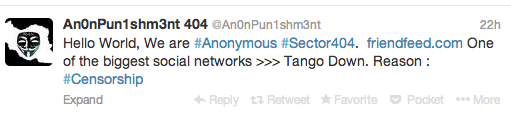
One perfectly plausible theory is that someone accidentally tripped over the FF server’s power cord down in Facebook Headquarters and nobody noticed until Sunday. Meanwhile an Anon thought this would be a good time to protest censorship, little realizing that this would make Anonymous a bit of a laughing stock.


anon
Exhibit B

Evidence for this theory includes: A) the fact that someone at FB HQ could “push the button” that made FF go again, and B) the complete laughability of any Anon thinking FF was one of the biggest social networks in the world.


Theory Two

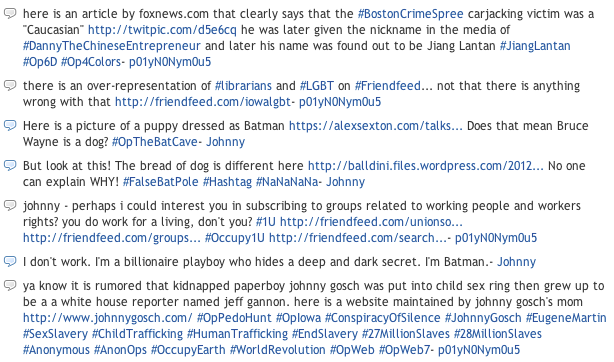
A snippet of Exhibit A (click to see the full crazy)

The other theory is that this misguided Anon really did throw an epic tantrum thinking that account deletion (and therefore content deletion) combined with buggy search equals censorship. Evidence for this theory include A) the continuing tantrum that this Anon is throwing over in FF over having had his account deleted as spam and having seen other content disappear and, somehow, images of the Boston Marathon Bombing and an over-representation of librarians on FF… (I believe the technical term is “batshit”)…


help
Exhibit B


…and B) the complete laughability of thinking “here’s a cause that nobody at FB HQ will care about — let’s claim responsibility because then they will PHEER US” when really, nobody at FB noticed until we told them.

Either way, Anonymous (or at least this Anon) didn’t do itself any favors. … And now I’ll probably be DoSed. Sigh.

Anyway…

Whatever the truth, we’ve learned a few things:

  1. Back when FF was still its own thing and they were still developing and improving its code, the data that the search function used was all housed on one machine. Since then, we’ve generated a LOT of data, so essentially old stuff isn’t indexed any more. Probably some new stuff isn’t either. There just isn’t space. So that’s good to know for all of us.
  2. Facebook let us live! And even revived us!
  3. Anonymous, or at least this Anon, doesn’t seem to understand some fundamental things about life, the universe, and everything.
  4. There is apparently an over-representation of librarians on FriendFeed.
  5. It’s a good thing Iain Baker (of Jesus Jones) has an extensive social network. We owe him and his network a whole lot of thanks.

UPDATE for the lulz: The worst insult known to humankind.

lolanon


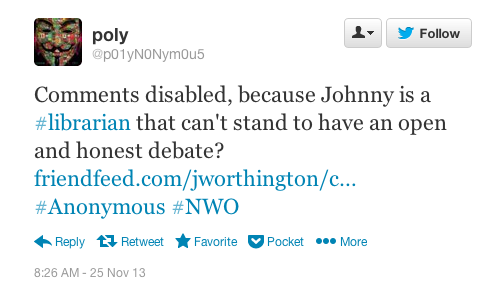
Johnny is not a librarian. It’s just that Exhibit A for Theory Two started with this post:

Johnny_-_FriendFeed

1 Comment

The day Anonymous took down … FriendFeed?


friendfeedhacker

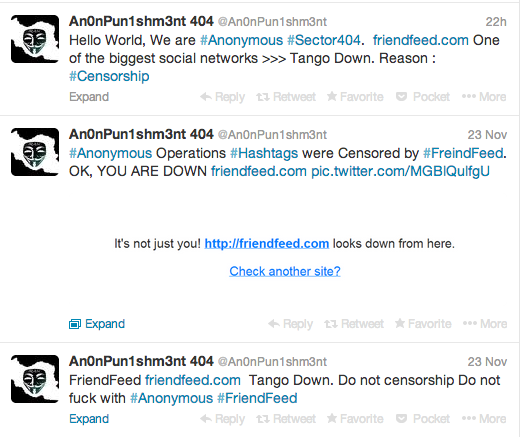
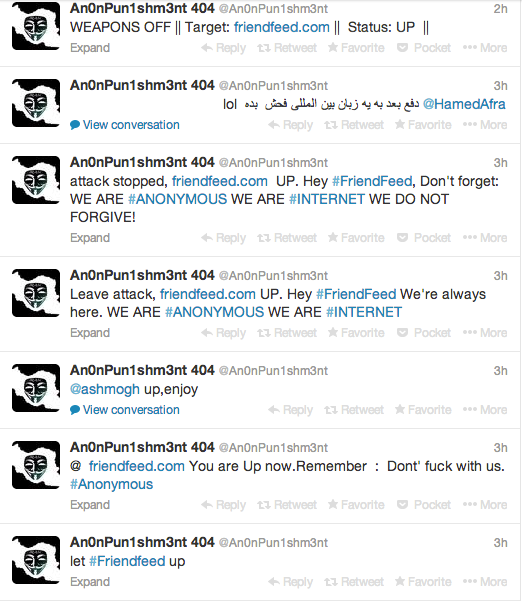
Apparently, Anonymous has mistaken FriendFeed for “One of the biggest social networks” and is therefore venting spleen in the form of a DDoS attack. Why? Because hashtag searching for something Anonymous was interested in didn’t work and therefore must have been censored. Must have! It couldn’t possibly be that FriendFeed is actually the forgotten stepchild of Facebook and the search function hasn’t worked consistently in years for any of us…

Now, for those of us active on FriendFeed, it’s a huge part of our lives and relationships. But none of us kid ourselves that we’re operating on “one of the biggest social networks.” In fact, most of us are simultaneously pleased and baffled that Facebook has let us limp along for 4 years on our preferred platform even after the whole FriendFeed team went to work for Facebook instead. TechCrunch can’t figure out why FriendFeed even still exists to be attacked. I’m mostly worried that this whole attack will remind Facebook that they forgot to pull the plug on us years ago.

So while we wait for Anonymous to realize what a backwater they’ve chosen on which to take their anti-nonexistent-censorship stand, we can speculate about a) how little they actually know about the internet, b) how bored/drunk/high they were when they launched this attack, and c) what they’ll take down next.

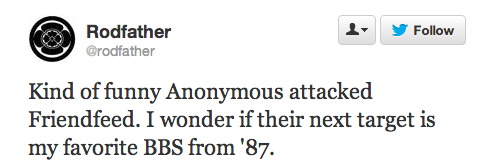
Rodfather has a guess about question C.

twitter-rodfather

UPDATE: After almost 2 full days of downtime, Facebook got FriendFeed back up and running at 2:30 this afternoon. Rejoice!!!

help

yayfriendfeed

friendfeedup

The story continues in my next post.

9 Comments

Dear Facebook: Leave Me Alone

My friends know that I have a complicated relationship with Facebook. Simply put: I hate it, but I can’t leave. The interface never made sense to me, the multiple audiences made participation hard for me, the quizzes cluttered everything up, college friends flaunted their perfect lives in my face (without meaning to, but it still hurt), and Hasbro took away Scrabulous, which was really the only redeeming feature of Facebook. So why can’t I leave? My local friends assume I’ll know what they’ve posted when we meet on the weekend.

I’d finally figured out a balance that worked for me: I put my local friends and my family members on a list of their own, dragged that list to the top of my list of lists, and now when I open Facebook, they’re all I see. But then Facebook started messing with privacy settings again. For a more full story, check this out: Facebook’s New Privacy Changes: The Good, The Bad, and The Ugly. But here are the four things I did this morning in my battle to coexist with Facebook:

  • Overwrote and then deleted some parts of the newly designated set of “publicly available information” (this includes your name, profile picture, current city, gender, networks, and the pages that you are a “fan” of). I overwrote what I could because I wanted to actually change the cached information in Facebook’s database, and then I deleted it because a) I don’t want to give that information away, and b) it was now bogus anyway.
  • Clicked “edit profile” and then the little “edit” icon next to my Friends list and unchecked the box that says “show my friends on my profile” because that seems to be the only way to keep my friends lists out of the hands of apps and random passers by.
  • Went to Facebook > Settings > Privacy Settings > Applications and Websites > What Your Friends Can Share About You and unchecked everything. I don’t like the idea that having a friend who answers quizzes on Facebook means that the quiz creators can gain access to a lot of my information.
  • For good measure, took the opportunity to go through all the other privacy settings and make sure they still reflected my wishes.

Is this overly paranoid of me? Probably. (Tinfoil hats help keep warmth in, remember, and it’s pretty incredibly cold out right now.) The thing is, I’m not invested enough in Facebook to feel like the privacy trade-off is worth it for me. I’m there so I can keep up with my local friends. Full stop. I’m already making concessions by making myself available to the students who want to friend me there and by grudgingly admitting that I like the rolodex function it plays. But I feel zero motivation to give up more than I can help to Facebook and its third party developers. They can kindly leave me alone, please.

2 Comments

Hashtag Contexts

I wouldn’t have expected a thing like a hashtag in Twitter or FriendFeed to become a rhetorical device as well as a functional one, but that’s exactly what I see happening. (For those of you that just asked “Hashtag? What now?” here’s a nice summary of how it works on Twitter.)

Looking back, I can see now that hashtags not only allowed people to gather together categories of posts, but they also gave a kind of short-hand context to those posts. A brief post like “Mediocre at best” reads differently if it’s tagged “#IL2009” or “#ProjectRunway.” The first sounds like a conference attendee who’s underwhelmed by a session. The second sounds like a critique of a fashion design on a reality TV show. Totally different contexts lead to totally different readings.

And as it turns out, short-hand contexts are pretty useful rhetorical things online, particularly in asynchronous conversations or when you’re only allowed a few words at a time. Lately the amateur anthropologist in me has been fascinated by the ways I’ve seen hashtags used not so much to allow people to gather posts together but instead to imply a category or topic that in turn supply a context for the preceding post. They let posters signal “I’m joking” or “here’s how I want you to interpret my post” without ruining the moment with a dry pronouncements of intent.

For example, I’d have had no idea what a friend was talking about if he’d just said, “Remember that part in Star Wars where the characters are running from the troopers in Mos Eisley, and they scramble on board the Millennium Falcon and then have to wait several hours for the weather to improve before they can blast off? Yeah, me neither” (from stevelawson on friendfeed). But then he added “#nasaisharshingmyfuture,” to let us know that he’s talking about the way that modern day space travel isn’t living up to the promise of science fiction. Context. There are no other posts with that hashtag, so it’s certainly not serving a gathering function, but it implies a category, implies that there could be many more examples of this particular phenomenon, and therefore builds a whole imaginary context for the original statement.

Fascinating.

Like any rhetorical device, though, it’s a skill that needs developing. Some of the people I follow seem to be really good at it. I, on the other hand, could really use some practice.

1 Comment

Low-Key Cooperative Continual Professional Development

A few years ago, my library decided to start a cooperative blog where we’d alert each other to developments in the wider world of librarianship, highlight interesting things we’d learned, and generally help each other keep up. There was enthusiasm, there was drive, there was an interesting blog… and then it died.

As far as I can tell, it died for three reasons: some people weren’t comfortable writing posts for it, people who rely on RSS to read blogs couldn’t deal with a blog that was locked down and therefore had no RSS option (one of those people was me me… no matter how useful, the site was dead to me without RSS), and everyone found they couldn’t get in the habit of clicking that bookmark and logging in to see if anything new had been posted recently.

Meanwhile, each of us continued to keep up with our own corners of the profession, some through email lists, some through professional journals, some through online social networks and blogs, and most through some combination of the three. But we all missed out on the richness that can come from hearing about things that affect our own worlds but originate in another person’s, and we all went back to been less and less aware of what interests and inspires our colleagues.

So this year we’re learning from the mistakes of our past effort and trying again, this time with more flexibility. I’ve set up a portal (still very much in progress) for those of us that really want a “home base” to check. There’s also a bookmarklet that will let people send annotated screenshots of web pages directly to my email account (using ToRead) for people who like that method of marking what they find, a Delicious tag for people who already use Delicious, and a general invitation to email me or pop in and tell me about interesting things that have come up.

So hopefully the collection piece will give people enough options that they don’t have to either conform or not participate. Hopefully there’s at least one option that will fit into each person’s existing habits, and people who are interested in experimenting with new-to-them options can do so without feeling locked into those options for all time.

Meanwhile, I’ll take whatever comes up and write a periodic blog post that glosses the things we’ve found (and behind the scenes, I’m going to see about getting password protected web-pub space on the college network so that I can link from the wide open blog to locked down documents that we aren’t comfortable sharing beyond ourselves). People can either subscribe to this newsletter via RSS or email, depending on their newsletter-reading preferences and workflow. It’ll also get fed into the portal for the “home base” folks. Just to round out our options, we’ll have low-key, face-to-face, brown bag lunch sessions once or twice a term for people who really prefer to discuss rather than read.

So hopefully the dissemination piece will also have enough options that people can work this seamlessly into their existing information-gathering processes.

The biggest challenge, then, will be striking the right balance between having a broad range of topics in each post/newsletter without overwhelming people with too many things that aren’t applicable to them. The idea is to have this be fun and interesting, not irrelevant and overwhelming. Wish me luck!

1 Comment

The Ebb and Flow of My Online Communities

Online communities, like those in the face-to-face world, are fascinating to watch. They coalesce, wrap in on themselves, fray around the edges, unwrap a little, shift, possibly acquire new members or even glom onto a new core group of members, coalesce, wrap in on themselves, fray around the edges… and on and on.

Take my own history as an example. I started this blog and started reading other people’s blogs, and in the space of a few months found myself squarely in the middle of a vibrant community of librarian bloggers. A year or so later, Twitter and the LSW Meebo room started up. Conversations started in any of those places and bled over into our blogs, but there were also new people in the group — people who didn’t have blogs at all, or didn’t blog about libraries. And slowly the LSW Meebo room group became my center. A year or so later, the librarian Twitterati started shifting to FriendFeed, so I followed them (kicking and screaming, I might add — I had a bunch of problems with FriendFeed, some of which still bother me even though that’s become my social network of choice now). FriendFeed is slightly different in that conversations can happen within or across several “rooms,” and I’ve seen communities coalesce, wrap in on themselves, and then fray about the edges in several of these spaces within FriendFeed. Meanwhile, the blogging community had frayed about the edges (Meredith also just wrote about this).

Each time I’ve found myself in the midst of a new coalescing community I’ve met new people who inspire me, question me, encourage me, and generally be good friends to me. But each time it’s meant that people who used to represent the core of my network have shifted to peripheral status. Not unimportant, just less present.

And now I find myself on the fraying edges again. Almost certainly, this means that I’m about to find a new home, or re-find an old home, but at the moment things feel a little foundationless for me. Luckily, I have a couple of really interesting projects I’m working on (which I’ll probably write about soon-ish), so that should sustain me until my new center coalesces for me.

7 Comments

Clinical Reader Train Wreck Just Keeps Going

Some day I’ll get bored of watching this train wreck in progress. But not yet. If you are, you can skip right over this post and rest in the knowledge that you’re more mature than I am.

Remember last week when Clinical Reader had only threatened a blogger, been exposed as having made up endorsements, started making up bogus Retweets, deleted incriminating tweets from their account, fired the pesky Canadians, and generally convinced thousands of people that they weren’t trustworthy? Since then, thing haven’t improved. Since then:

  • Whoever is trying to sanitize Clinical Reader’s online reputation (I assume it’s co-founder Allan Marks, but who knows) has been switching the original twitter account’s name at the speed of light. This breaks links that people had used in blog posts, but it unfortunately doesn’t erase the history from the deep dark recesses of the Internet, or delete people’s screenshots from their hard drives. Most of the good stuff is still live on the links in my previous post, and even more lives in this post on the Disruptive Library Technology Jester. (Moral of the story: Don’t be stupid online because the stupid never dies.) As of this writing the account has moved from @clinicalreader to @clinical_tweets to @amarks7 to @amarks14 to @amarks_ to @a_marks1 to @allan_marks (See below for explanation of the change in the first two names. And don’t expect @allan_marks to be valid for more than, say, an hour. As of 7pm, the name has changed 4 times since 9am today.)

  • Somebody took over the name @clinicalreader and posted a brief history of the debacle there.

  • Somebody else took over @clinical_tweets (they claim to be the fired Canadians) and started cockily claiming that they’d done the job they were hired to do because just look at how many people now know about Clinical Reader. Their claim in a nutshell: “You’ve All Been Used. Bwahahahah.” They’ve now killed the account.

  • A new twitter account went live: @clinical_reader. This had all sorts of tweets about how the real Clinical Reader wasn’t yet “officially” on Twitter but will let us all know when they are (this screencast from the Google Cache shows that if you hovered over an older version of the Clinical Reader site, it clearly linked to the original @clinicalreader twitter account). Then tweeted several rather official looking tweets about what a great service they are. Then denounced the other now-bogus accounts. And all of this while not officially tweeting! This morning, all their tweets had disappeared except for the ones saying that the tweets from @cliniclareader are not coming from the Clinical Reader service (which even whoever-it-is at @clinicalreader says, quite plainly).

  • Another new twitter account went live: @clinical_tweet. This seems to be the new, new, new official twitter account. Or something. We’ll see how long it lasts.

  • And now, the sockpuppetry really gets started. “Sally Jones” started a twitter account as @kensingtonlib in order to alternately level accusations at @lukelibrarian and laud Clinical Reader. I wonder who could possibly be using the name Sally Jones??

This is just too much fun. I’ll update this post if necessary (and add screenshots that I have on a different computer, later).

[Edit: 7pm on July 20th. I think I’m done now. If you haven’t had enough, search FriendFeed for “Clinical Reader” and see if more drama has surfaced. I’ll just add that I’ve been almost equally fascinated by the complexity of piecing together a coherent story when that story is playing out in so many social networks, by the flailing about of Clinical Reader, by the lessons this teaches about marketing online, and by the implications of this story in my own teaching. I think I’ll have to work some discussion of this parable into sessions I teach about evaluating web content.]

9 Comments

Best Bad Marketing EVER

I thought I could resist jumping into the fray on this one, but this story just keeps getting better and better.

Have you ever heard of the service called Clinical Reader? Apparently it’s a new service that acts kind of like a feed reader, only they decide which feeds you read, and it’s aimed at the medical community. The salient facts here being: 1) it’s new, and 2) nobody had heard of it. Until this week.

This week they used twitter to threaten legal action against a blogger, explain that they’d overstepped and let some unknown junior colleague too close to the keyboard, argue with the blogger and her ever-growing posse, apologize to the blogger, and now send out bogus retweets.* (See the chronology below for the gory details.)

What fascinates me is how quickly (in the space of four days) hundreds of people have gone from knowing nothing about this service to being pretty sure that everyone at Clinical Reader is completely insane. The social web can be an incredibly rich marketing arena, but it has zero patience for companies that get stuff wrong, and it rather delights in calling out this kind of behavior. This is the flip-side of crowd-sourcing, and companies and libraries hoping to harness online social networks would do well to watch this real-life parable unfold.

Chronology:

The story is way more interesting if you see it unfolding, so here are the best places to get it in kind of chronological order. This blog-version of the summary is necessary because Twitter itself is kind of difficult to reconfigure in a way that makes sense after the fact, and because Clinical Reader has started deleting tweets. Oops.

  1. Nikki noticed some less than ethical aspects of Clinical Reader’s site (which now includes edits linking to the apology she received)
  2. Steve summarized day one of the saga
  3. Nikki gathered together links to a bunch of stuff that happened after Steve’s post.
  4. The RT shenanigans begin, but these need more space, and screenshots, so here we go…

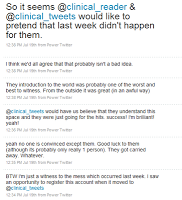
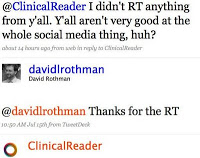
Clinical Reader went wrong in two completely wrong ways with the retweeting. (By the way, read each of the screenshots from the bottom up, because I forgot I should reverse the order and don’t feel like fixing it now.)


First, they thanked people for retweets even if the people had never retweeted them.


Then they seem to have completely made up tweets to retweet.

Amazing. Pardon me while I go pop some popcorn and settle in for the amusing ride. You can follow along on FriendFeed if you want.

P.S. The founder of Clinical Reader now says: “I have taken control of this account & parted company with former acquaintances in Canada whose behaviour I can only describe as schoolboy” (cite), and he is now apologizing to people. [The following sentence is apparently no longer true… which is ironic, since I was poking fun at Clinical Reader for misunderstanding how it works: “The problem is, he doesn’t realize that if he starts with one person’s name, there’s no guarantee that everyone else will be able to see what he writes, since Twitter only lets you see messages directed at mutual friends.” Further testing reveals that the other people would be able to see this message if they clicked on their @[username] page but not in their main Twitter feed. So, still weird, but not as egregious.]

* For those who don’t use Twitter, RT means “retweet” and is a way to redistribute something somebody else said, complete with attribution. It’s very much like a cited quote in a paper, only with links. So if I say “Something Clever” on Twitter, somebody else could say “RT @ijastram – Something Clever” which means “retweeting Iris Jastram who said ‘Something Clever,'” and the “@ijastram” part automatically turns into a link to my tweets. Quotation and citation in 140 characters or less. Pretty slick.

14 Comments

Making FriendFeed Look the Way I Want It To

[Updated with a more modular version of the steps below. First, install Stylish. Then create the following three new blank styles, and populate them with the code here:

Now you can toggle things on and off at will depending on your minute-by-minute needs.]

——————–

I interrupt your regularly scheduled library-related thinking to bring you a brief note about FriendFeed. It recently changed its look rather significantly, and a few of us felt a little claustrophobic every time we looked at it. Luckily, if you’re running Firefox you can install Stylish, which lets you modify a site’s CSS. Once you install that, you need one or more of the following:

  1. Enough knowledge of CSS to modify the site as you wish
  2. Friends who know enough CSS to do that for you
  3. The Internet, where you can find ready-made styles like this one

I know enough CSS to break things or tinker mildly with things that already exist, and I have friends who put up with my requests for help and whose code I steal mercilessly (hi Steve), and I have the Internet. So I started with this style, modified it to make it look more the way I wanted, begged for help making it look even more the way I wanted, and now have a small suite of style options (which you can copy and paste into new Stylish styles):

  1. For when I’m in friend mode, at home: this cleaned up version. (last updated 5/29/2009)
  2. For when I’m in work mode and really just want text to skim: this stripped down version that gets rid of user icons. (last updated 5/29/2009)
  3. And since I’m not a very picture-oriented person, it seems: a style that makes all posted images into teensy thumbnails that I can click on to view in their larger sizes when I want to.

I have (1) and (3) running together at home, and I have (2) and (3) running at work.

Lest you think I’m at all good at this, I should point out that my tweaks were incredibly minor. Steve Lawson did the big stuff (by which I mean shrinking images to thumbnails, highlighting direct messages, and removing user icons). You’ll also notice, if you look carefully at the code, that I just commented out portions of the original code, so you can restore that stuff and tweak it if you want.

A couple of other people really liked seeing which services were responsible for individual FriendFeed posts (like Twitter, Facebook, Flickr, etc). If you’re like them, try this Greasemonky script (after installing Greasemonkey, of course).

2 Comments
css.php