Skip to content

Category: News

GoogleNews Archive Search

Google has unveiled a new service (which they seem to be doing with amazing regularity). Now you can search 200 years of newspaper articles using the Google News Archive. The Search Engine Watch article is here, and Resource Shelf has another article on the new service here. I haven’t had much of a chance to explore this new thing today (having only had 20 minutes at my desk all day, yikes), but here are some preliminary thoughts on the features of this new search:

  • Like Google Scholar, not everything you find will be freely available online. Some libraries are contacting Google to ask about adding their link resolvers to this new service, but I don’t know yet what the answer has been so far.
  • There’s limited faceting available on the left-hand sidebar so that you can limit your search results to a specific time period or a specific publication. Yay!
  • You can elect to have your results returned chronologically by using the “Timeline” button. Cool.
  • There is no list of sources. This is terrible. That means that you’re searching blind, though you can be pretty sure the major papers will be represented. (Resource Shelf points out in their article that searching “Source:[source name]” works.)

Those are the main points that interest me about the features. But when I think of how this new service relates to my life in the library I’m left with mixed feelings. I look forward to having another “back up” search interface. (I often use Google Scholar as a last-ditch search when all normal avenues have failed. And sometimes this less specific searches return what I’ve been looking for. Now I can do the same for news sources, including advertisements, btw.)

But I’m worried that this will be yet another “easy” service that isn’t as powerful as would be useful to my students, but that will seduce them with its familiarity and immediate results. I also wish I didn’t have yet another service to add to the list of places you can search as long as you’re careful not to pay for anything because we offer the same content FOR FREE.

And finally, I’m beginning to worry about Google offering new services so regularly. My first thought when I heard about the archive search was that this new thing was sapping development time from about a million other projects that I consider only half done. The book search isn’t perfect (and isn’t done), blogger is anything but done, Google Calendar doesn’t do everything it could or should, and the list goes on. I wish they’d spend some time completing a few of their other useful services rather than pushing out something new every month. But that’s just me. I could never operate if I just kept adding projects to my cue rather than finishing a few here and there.

Of course, these niggling worries didn’t stop me from checking the new service out in between editing a Writely document, blogging, adding appointments to my Google Calendar, and generally relying heavily on all things Google.

2 Comments
The First Public Internet Library

It’s not news anymore. It’s been blogged to death. But I just wanted to point out that OCLC’s free, public search interface is now available to all. This interface is still a baby interface with lots of upgrades planned in the next months, but once you’ve done a search you can see most of the things we’ve been calling for in catalogs, including faceted search (in the form of “Refine Your Search” on the right sidebar), FRBRized records (click on “editions” when you’ve clicked into a book’s record), user reviews, and more. You can also get a browser search box if you want, or embed a search box into a web site (hmmmm, so many ideas bouncing around in my head).

I’m intrigued by the note in the “help” screen that says that when you search from within a library-authenticated internet connection you may get a link to that library’s “As a Librarian” service. How do we get this added for my library? I don’t know. But it’s something we should think about doing.

2 Comments

Wow! WorldCat Just Got Slick

I’m so excited I could just about dance, but then I’d just end up scaring the teenagers that have come into the library to escape the rain. (Seriously, it’s raining here! This is a first in weeks and weeks… I wish I weren’t a librarian so I could have an excuse for not looking up exactly how many weeks, but I’m more excited about WorldCat than the rain, so I guess I am a librarian after all. Just a lazy one.)

Anyway, WorldCat is cool. It always has been, but now it just turned up the coolness factor to 11 (anyone seen “Spinal Tap”?). Here’s what’s been released on the Information Today site.

The new WorldCat.org site will be considered a beta release. Adjustments in design and function will be made as feedback is provided by end users and OCLC member libraries. Nilges detailed a long list of planned enhancements that he said would be introduced on an ongoing basis over the next 6-9 months. The enhancements include the following:

  • Post search support, such as “Did you mean?”
  • Results sorting
  • ““Get it” after a user finds it —this will focus on improving interoperability with circulation systems
  • Identify public domain content and enable click-throughs
  • Click through to Open URL resolvers
  • Add article-level metadata
  • Expand social networking capabilities
  • Create custom views
  • Wow! Article-level metadata? Social networking? Custom views? Sounds like exactly what a bunch of others and I have been dreaming about for quite some time now. I just hope it doesn’t take them the whole 6-9 months to get these enhancements off the ground and onto my browser.

    Leave a Comment

    Wikipedia’s Editorial Structure Evolves

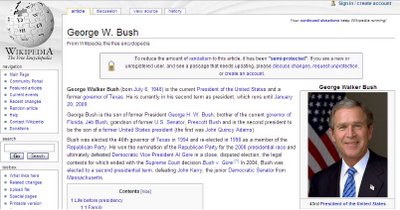
    This morning’s New York Times article points out that there is set of articles on Wikipedia that cannot be edited by most people.

    Wikipedia’s policy says that people can request to have pages semi-protected so that new and unregistered users cannot change the page’s information. There are some pages that are permanently semi-protected, but most are temporarily categorized that way in response to vandalism. Here is a list of pages that are currently registered as semi-protected.

    [Update: Steve of Blog About Libraries writes an excellent reflection about how this jives with the concept of Radical Trust.]

    Leave a Comment

    Google Spreadsheet Sharing

    I haven’t played very much with Google Spreadsheets, yet, but I did share a test sheet with my co-workers, and it seems that I’ve given them automatic access to the beta test. So if anyone wants to have a peek, email me or leave me a comment (only gmail accounts work, though, so be sure you have one of those first [Update: I can get you one of those gmail accounts, too, if you need one. Just drop me a line or a comment]).

    Leave a Comment

    Google Takes Over the World… With My Help

    I did it. I signed up for Google Spreadsheets, and I just got my acceptance letter.

    I don’t know why I feel a little sheepish about adding to the Google mania, but I can’t really justify not playing with something simply because the company comes out with a new product every two or three weeks. I always was a stubborn one, though. If everybody says I have to see a movie, I don’t see the movie… One of my less-admirable traits, I suppose.

    Ah well. It’s only a little feeling of sheepishness, easily ignored, easily dismissed. Let the playing begin!

    2 Comments

    NextGen Catalog Listserv Debut

    Yesterday Eric Morgan wrote to the Web4lib listserv wondering about starting up a new listserv exploring the catalog of the future (a topic that is becoming one of my de facto research areas because, well, I’m interested). Today it’s up and running and I’ve subscribed. You can join, too, by going here.

    One of the interesting discussions that came up while deciding on the name of the list (ngo4lib for “next gen opac” was nixed because it sounds like a government agency… but I’m glad it’s gone because I HATE the acronym “OPAC.” It just smacks of everything that’s wrong with our current discovery system. It’s incomprehensible to non-librarians. It specifies that this system is online, which only makes sense if you’re differentiating between this and the card version. And by specifying “public access” it makes it sound like there’s a whole bunch of other good stuff out there that we just don’t let the riff raff see. But I digress… a lot.) Anyway, the question came up whether a listserv was really the best format for this discussion, and the answer was very quickly and decisively “yes.” Hmmm. Really? Someone pointed out that email is integrated into our lives while checking blogs isn’t. But my aggregator is now a part of my day, from beginning to end, just like my email.

    Oh well, I don’t really care that it’s email. I was just interested in the speed with which other formats were dismissed. And I guess this way it’s more apparent that anyone can post, so that should help foster interaction.

    Anyway, I’m signed up and look forward to a lively discussion. I wonder if any of the major vendors will sign on. Innovative Interfaces? SirsiDynix? Listening in could be not only a great source of ideas, but also a great PR move.

    6 Comments
    css.php