Skip to content

Category: Me

Joining the Journal of Creative Library Practice

JCLPAnother year, another adventure. This year I’m honored, excited, and a little nervous to be trying my hand at editing a journal!

Joe Kraus recently invited me to join the editorial board of the Journal of Creative Library Practice. As soon as I saw the short list of wonderful librarians editing the journal, I knew I wanted to hang out with them and see what this young journal will become.

I know there are wonderfully creative librarians who read this blog — I’ve learned a lot from the comments and emails I get from you. So if you’ve got an article that highlights an interesting practice or solves a problem in an interesting way, drop us a line or submit a manuscript! Here are the instructions for authors.

Leave a Comment

We’re Published! “Swimming the Matrix: A Dialogue on Teaching Undergraduate Research”

Danielle Theiss and Kiane Kovacs have edited and published a book inspired by the work and writings of Barbara Fister, one of the librarians I most respect in the profession for her complex thinking, clear writing, and general all around amazingness as a person.

The book itself has chapters of all kinds, each of which is inspired by the three main areas of Barbara’s public voice: Change and Academic Librarians, Student Learning and Research, and Publishing and the Academic Library. And one of those chapters is a dialogue that Steve and I had about working effectively with undergraduates. It’s decidedly not  your average library science essay, and it was awfully fun to do. We hope you’ll enjoy reading as much as we enjoyed writing it!

Jastram, Iris, and Steve Lawson. 2013. “Swimming in the Matrix: A Dialogue on Teaching Undergraduate Research.” In Finding a Public Voice: Barbara Fister as a Case Study, edited by Danielle Theiss and Diane Kovacs, 69–84. Chicago: ACRL.


p.s. Kudos to ACRL for their fabulous author agreements.

2 Comments

USE-MAN! Copyright Basics for Academic Contexts

[A couple months ago I was asked to give a very brief overview of the use of copyrighted materials in teaching and research. The audience was faculty, staff, and students interested in the digital humanities, and I was the first in a panel of presenters who later covered finding reusable works and ownership of your own copyrighted material, work for hire, and student ownership of their own creative work. The day was a very informal one, replete with interruptions and digressions, but here is the gist.]

You, the cheerfully yellow user of information, are on a quest. You want to use somebody else’s work in the course of your teaching and research. You are Use-Man.*
UseMan

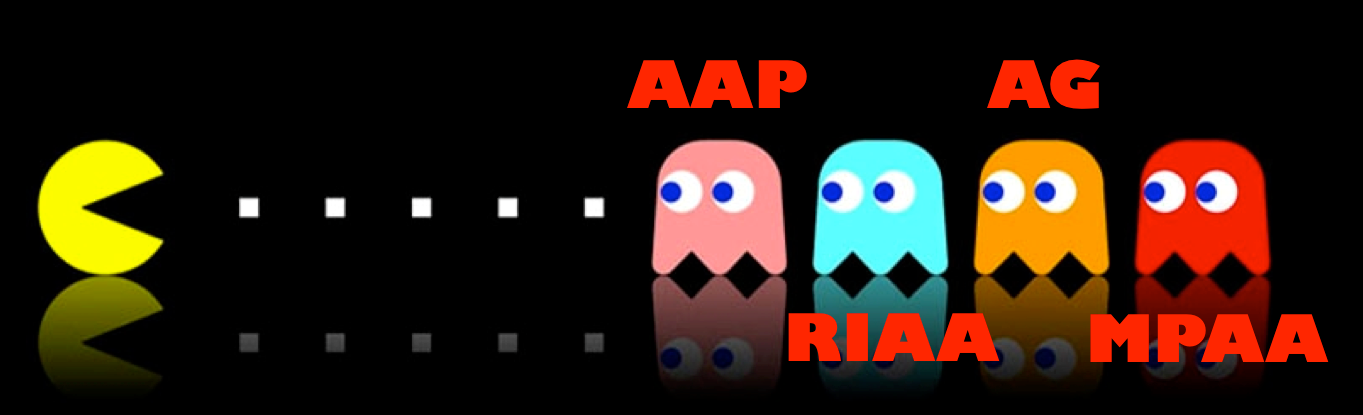
Bad GuysThis sounds relatively straightforward, but just as you get started, out pop the Bad Guys. These eager lawyers at the Association of American Publishers, the Recording Industry Association of America, the Author’s Guild, the Motion Picture Association of America and their ilk are charged with thwarting you at every turn. Their jobs are to help their associations make money, which means that they don’t want anyone copying their materials and (heaven forbid) make it so anyone could get at any of it without paying for the privilege.

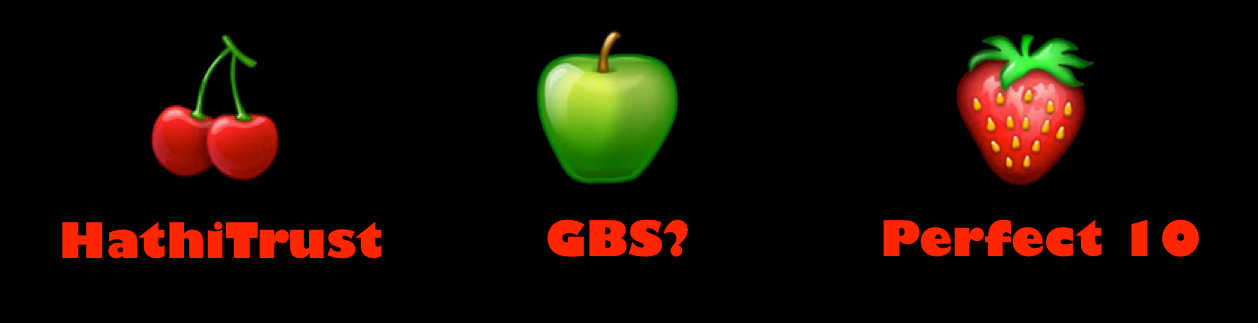
Power UpsAs you’re trying not to fall prey to the wily and over-protective lawyers, there are some power-ups along the way that can offer protection. These power-ups come in the form of your own growing knowledge of landmark court cases in which the high courts have told those Bad Guys to back off. The recent HathiTrust case, for example, provides a useful (and expansive) definition of transformative use that will give many a digital humanist a new lease on life.** The Google Books Settlement? Much of that was left kind of murky, but it is still a case that any digital humanist working with digitized text should know about. And if you’re interested in thumbnail images and deep linking, Perfect 10 is your case.

Ready to get started?

Level One

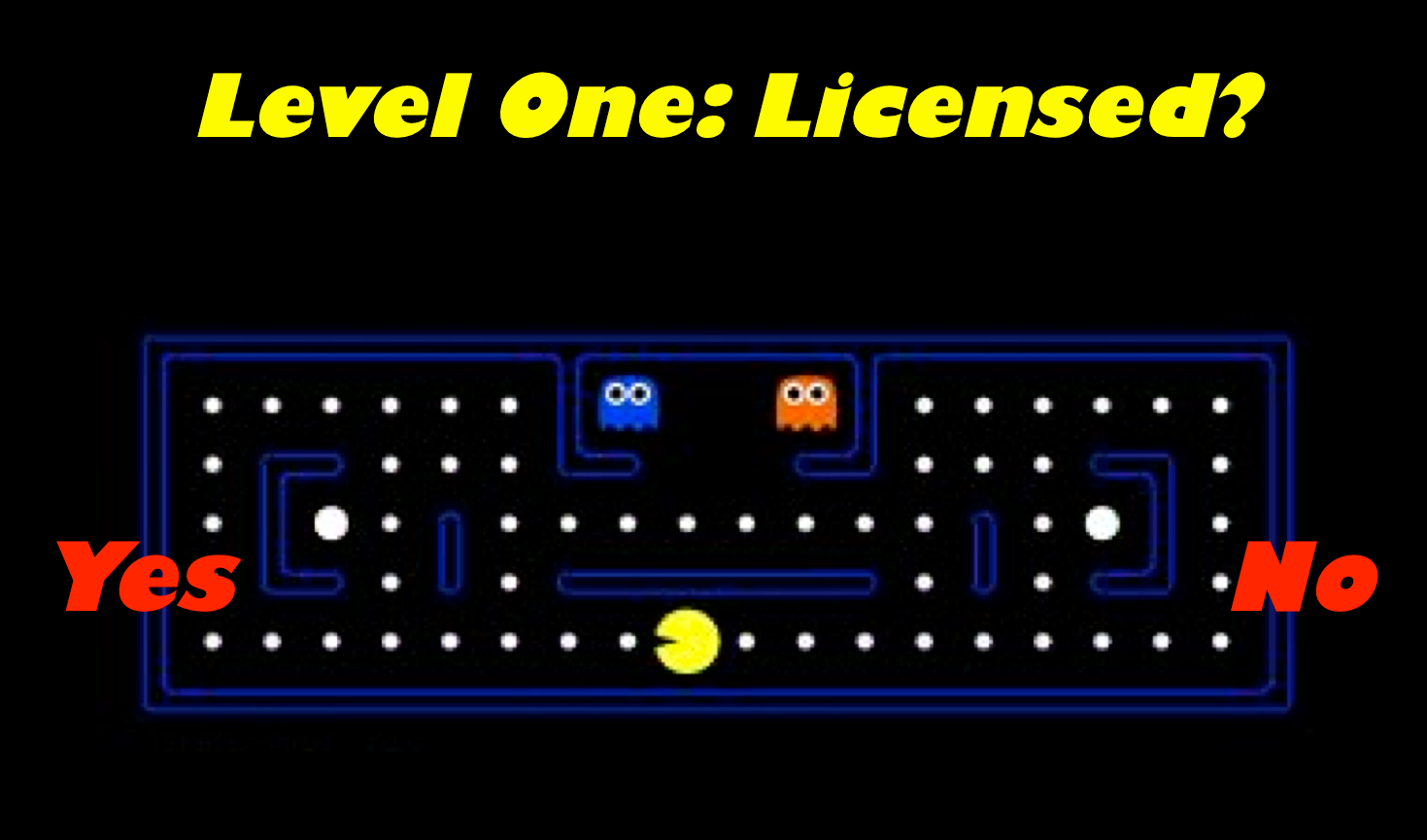
Level one is both relatively straightforward and also utterly crucial. Is the work you want to use governed by a license agreement? As a hint, pretty much everything available digitally is licensed, and licenses trump copyright. Want to use that full-page scan of a Victorian-era plate in a book? Better make your own scan unless your use of the professional scan falls within the terms of their license agreement. Your own scan will be totally fine to do whatever you want with because the original is out of copyright. But the professional scan is almost certainly brought to you by a license agreement.

If the work you want to use is licensed, the Use-Man game is over. Follow the license agreement and all will be well.

If the work you want to use is not licensed, continue on to Level Two!
Level Two

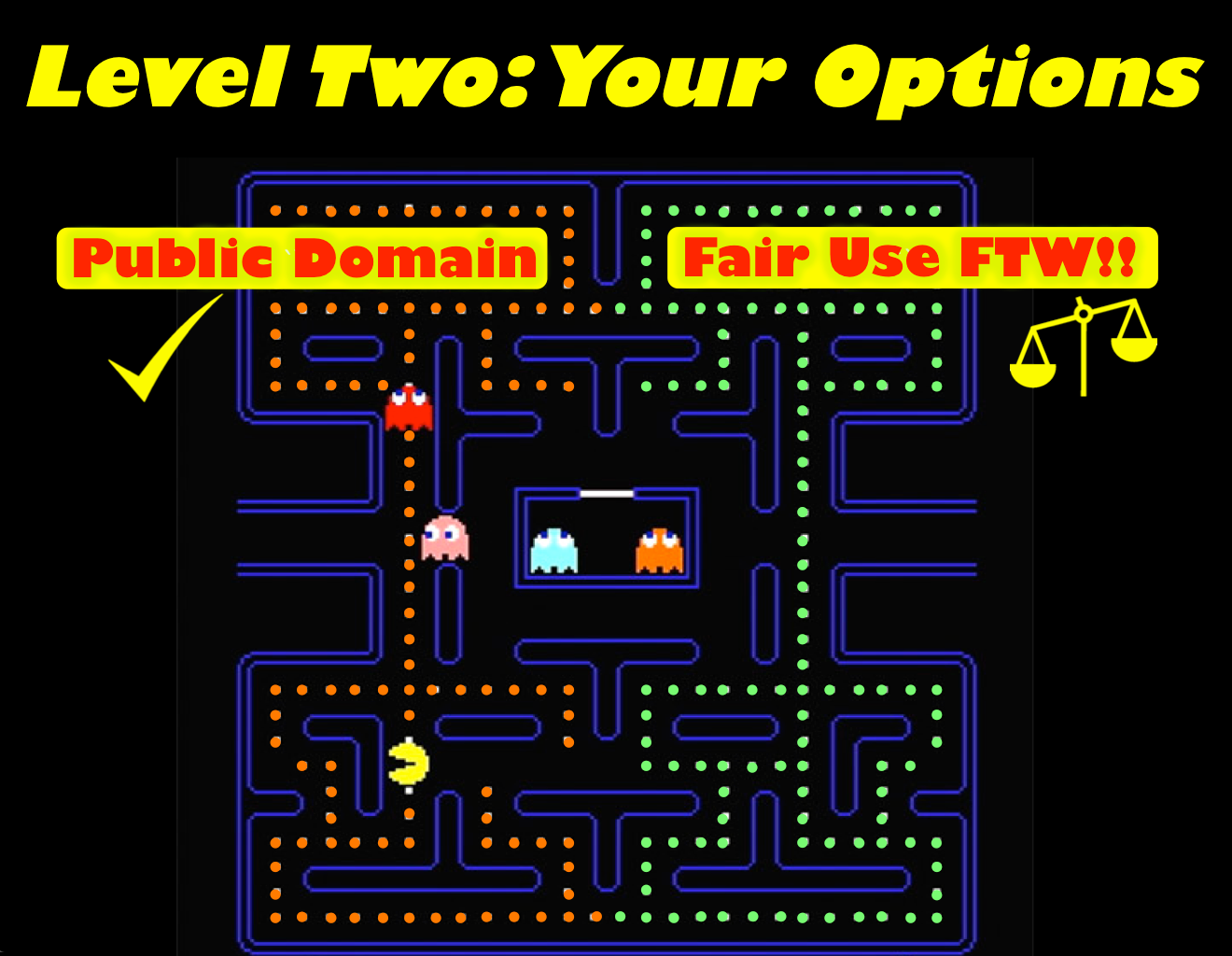
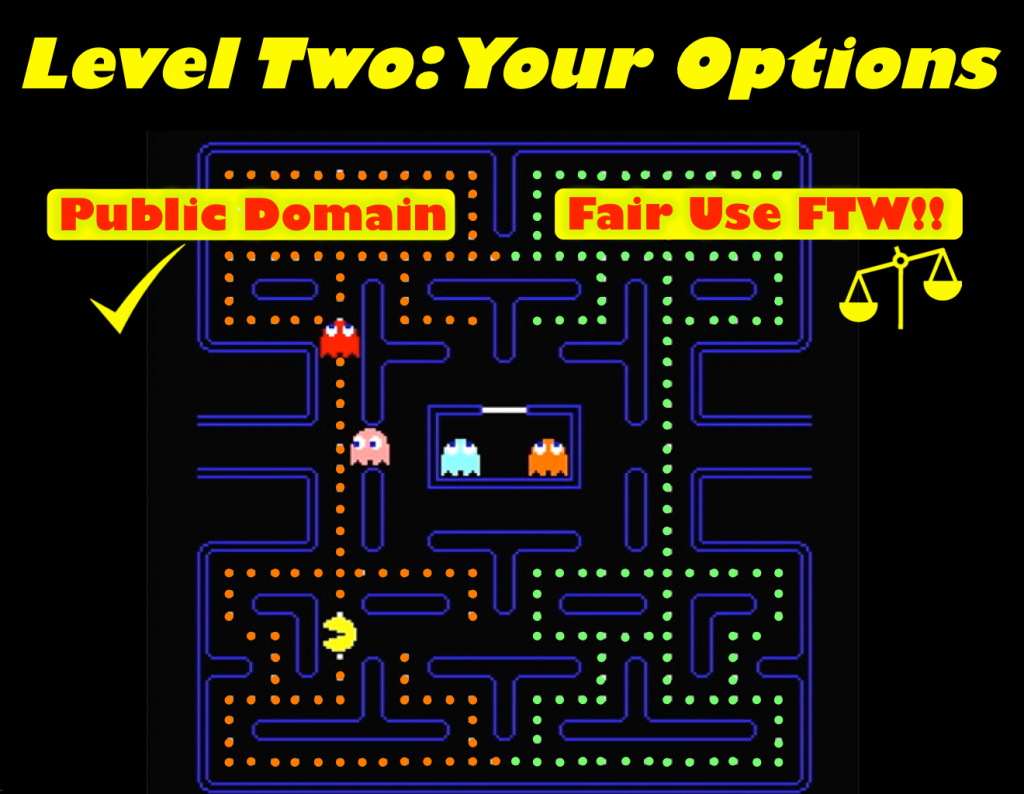
In level two there are two ways to win! Either you find that the work you want to use is in the Public Domain or you find that your intended use of the work falls under Fair Use. In either case you’re in the clear. You win!

Note that Public Domain does NOT mean “generally available to the public.” It means that there are no copyright restrictions on the work.

Note also that the four factor test for Fair Use does not require that every factor come up strongly in favor of fair use as long as the four together, considered as a whole, favor fair use. As Aufderheide and Jaszi say, “A typical fair-use calculation today can be distilled into three questions:

  1. Was the use of copyrighted material for a different purpose, rather than just reuse for the original purpose and for the same audience? […]
  2. Was the amount of material taken appropriate to the purpose of the use?
  3. Was it reasonable within the field or discipline it was made in? […]” (Aufderheidi and Jaszi p. 24)
It’s all about context and appropriateness. Luckily for us, judging context and appropriateness is something that we all do all the time as scholars within our communities. So don’t be scared! And remember your fruity power-ups!

What happens if you don’t win the game of Use-Man? You can decide either to use different material for your work, or to ask for permission from the copyright holder. But Fair Use was built for exactly the kind of work that we do in our teaching and research, so know your rights, know that they are written into the law itself,*** and keep an eye out for power-ups!

Finally, you may have noticed that I never once said “as long as you cite your sources.” That’s because none of this has anything to do with the ethics and rhetoric of attribution. Copyright is about the legality of use; citation is about the ethical and rhetorical culture of use.
* And yes, I am relying heavily on the idea of transformative use here. No actual arcade game was harmed in the making of this talk.

** Digital archives of text meant to be searched are, apparently, fundamentally different from individual books meant to be read.

*** “The fair use of a copyrighted work, including such use by reproduction in copies or phonorecords or by any other means specified by that section, for purposes such as criticism, comment, news reporting, teaching (including multiple copies for classroom use), scholarship, or research, is not an infringement of copyright.” (Title 17, Section 107, emphasis mine)

Aufderheide, Patricia, and Peter Jaszi. 2011. Reclaiming Fair Use: How to Put Balance Back in Copyright. Chicago: University of Chicago Press.

3 Comments

Classes and Appointments over the years

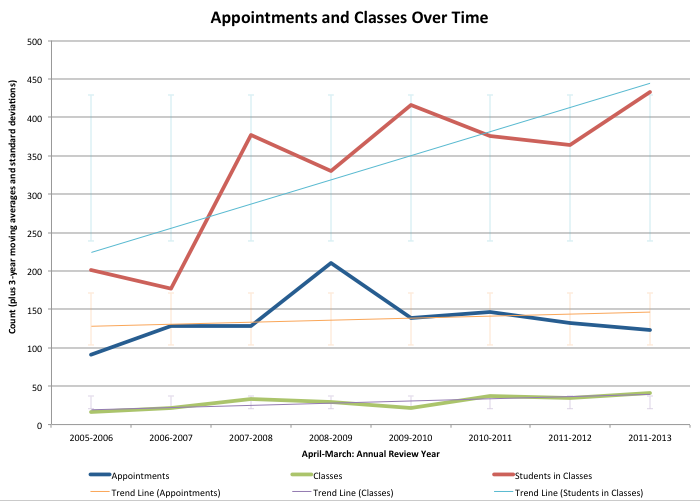
I’m currently writing my annual review document… or rather, procrastinating on writing my annual review document. In the process I made a graph:

appointments and classes

For the last three years we’ve been making a concerted effort to help students understand that they can ask many of their questions at the reference desk (especially students in first year seminars). We’ve also gotten more involved in curricular initiatives on campus, using more of our time to work on curricular-level projects than we used to. I think both of those changes are reflected in the downward trend in appointments. (And really, not a ton of change over time if you disregard that one weird year where apparently EVERYONE needed me.)

I think that curricular-level work, plus slow but steady relationship building with the faculty in my departments accounts for the upward trend in classes. This year I’m more than a standard deviation above the mean.

I’m sure my colleagues have very different graphs since our departments fluctuate in different ways. But I found my graph interesting, so I thought I’d share it.

Leave a Comment

CSI(L) Carleton: Forensic Librarians and Reflective Practices

“Wait, this is information literacy?” a rhetorician at our workshop exclaimed in excited surprise. “But this is so cool!” And we wanted to respond “YES!” not only from joyful pride but also out of recognition. After all, we too had had very similar reactions to our own work with information literacy, and not that long ago. We too had realized that information literacy could be different than we had originally thought (or that the ACRL information literacy standards had led us to believe). Information literacy could be more alive and integrated within the discourse of academic work. It could be more applicable across disciplines and genres and rhetorical goals. And these revelations remapped our practice.

So begins the essay my colleagues Danya Leebaw, Heather Tompkins and I wrote for In the Library with the Lead Pipe that was published last night. It focuses on how our Information Literacy in Student Writing project has helped us learn more about information literacy and how that has influenced our teaching and our work with faculty and departments.

Leave a Comment

Alice in Libraryland

SLA’s Future Ready 365 team invited me to add an honorary “special” to my librarian credentials and write a post for them, so I wrote Alice in Libraryland. The first paragraph isn’t very rabbit-hole-ish:

Imagine walking through the stacks in your favorite library. The slightly worn spines creating that familiar regular irregularity on each side, that distinctive smell of books and dust and filtered air, everything promising far more to explore than you could ever chart out in one lifetime, everything beckoning you toward its own particular rabbit hole of interconnected facts and ideas. Imagine pulling several books off the shelves to take with you, either to check out or to spread in front of you in the reading room.

After that? Well, I’ve already written with Steve Lawson about some ideas for staving off the insanity and steer us towards one model that might allow us to capitalize on the benefits of new formats without such potential for seeing white rabbits.

Leave a Comment

Uncovering Research Practices in Student Writing

When I was a baby librarian, I thought Information Literacy was about searching and evaluating. The ACRL standards had some other stuff in there, but it seemed like abstract stuff that I couldn’t do much about. Keywords, operators, relevance, currency, authority — just learn the formula and my work here is done. No wonder librarians were the only people who cared about information literacy, I thought.

In my defense, I was young. In my defense, this is how it had been presented to me all the way up through library school.

In the past three years, I’ve been part of a project that really expanded my thinking and made me fall in love with what information literacy could be and with the ways in which it really is relevant to people and projects on my campus.

But let me back up.

All of our sophomores are required to submit a portfolio of their writing, and passing this assessment is a graduation requirement. When they submit their portfolios, they’re given the choice of designating that their writing can be used for research, which many of them do, and lately the college has been doing three large projects (that I know of) based on these writing portfolios.

  1. Our quantitative initiative (QUiRK) reads a subset of the papers to determine how sophomores use quantitative evidence in their writing.*
  2. The writing program and SERC are pairing up for the Tracer Project, which studies how faculty development (which includes writing portfolio assessment) impacts student learning.
  3. And starting in 2008, we in the library have been reading portfolios to see how information literacy is revealed in academic writing at the sophomore level.

As part of that last one, my department had fascinating hours of discussion about what we could and couldn’t evaluate about information literacy when presented with a finished paper. One of the most interesting and useful of these discussions (for me) was the one which revealed that we could, in fact, assess evaluation of sources even when the paper didn’t use “outside” sources beyond primary sources or sources prescribed by the professor. We could watch students picking primary sources, even from assigned readings, that worked well together and could be used to make a compelling point, or we could see them cramming two such sources together and either treating them entirely separately or in other ways not using them instrumentally toward making a point. We also confirmed what we had always suspected: that implementation of attribution was about more than just mechanics, and that failures in attribution could often signal a fundamental misunderstandings of the sources the student was using or of the purpose of reporting evidence in the first place. And we articulated for ourselves some of the ways in which integrating evidence into a paper can help or hinder the student’s rhetorical goals.

We couldn’t assess much (if anything) about the actual steps in the process that resulted in the writing we had in front of us, but we could look for habits of mind associated with using evidence, and we could look for the ways in which conventions of communicating evidence manifest in sophomore level student writing.

In the end, after much testing and revision, we came up with a rubric for assessing information literacy in writing and sat down to score papers. And yesterday, we finally presented our work and some preliminary findings, handed around a sample of student writing and watched as the faculty and staff attendees pulled interesting and useful insights out of the writing and then all came up with exactly the same score on the rubric (inter-reader reliability!), and had a fun discussion about how this could be used on campus to build shared expectations for information literacy and to help inform our teaching.

For my part, participating in this project has fundamentally changed one of the major ways I think about my work. It was so liberating for me to realize in concrete fashion that “information literacy” does not equal “the research paper.” All of a sudden I discovered that I do have something to contribute to those parts of the curriculum that interest me but that don’t produce traditional research projects. All of a sudden I realized that I don’t have to help faculty squeeze research projects into courses where those projects don’t fit naturally, and that instead we could talk about context-building skills or source interpretation skills for thought-pieces, class discussions, and other non-research assignments.

For me, this project helped me realize that I actually do like the concept of information literacy and that it actually does have meaningfully deep and cross-cutting applications on a liberal arts college campus — that it’s not simply about making mini-librarians out of our students or about searching for searching’s sake. I’m hoping that as we open it up to include faculty readers this year, that same sense seeps through the campus. I hope this is something we can get behind and dig into and find interesting, and that what we learn from analyzing these portfolios will meaningfully inform our practice as teachers.

I’m just so excited about this project, and so glad to be involved in it. It’s probably been the most eye-opening and practice-changing project I’ve participated in.

* Rutz, Carol and Nathan D. Grawe. “Pairing WAC and Quantitative Reasoning through Portfolio Assessment and Faculty Development,” Across the Disciplines, December 2009; Grawe, Nathan D., Neil S. Lutsky, and Christopher J. Tassava. “ A Rubric for Assessing Quantitative Reasoning in Written Arguments,” Numeracy, January 2010.
[back to text]

1 Comment

The Age of Big Access

This week I had a post published over at ACRLog called The Age of Big Access. It starts:

While we were all busy wondering what it means to be a librarian in the Age of Google, we got flanked. This is not the Age of Google after all. That was just a distraction — a clever and dazzling light show. Meanwhile, behind the curtain, a totally different age was gathering itself: The Age of Big Access.

And even though I’ve had a couple of months to ponder this stuff since drafting it, my last two sentences still stand: “I was pretty comfortable with my role as an instruction librarian in the Age of Google. I’m totally at sea trying to figure out my role as an instruction librarian in the Age of Big Access.” I want access like an addict wants a hit, but maybe it’s killing me.

Leave a Comment

I Interrupt This Blog…

… to bring you pieces from my past.

This past summer I traveled to Chicago to hang out with librarians who were attending ALA Annual, but I took one day to ride the train out to the suburb I’d lived and danced in while living my previous life as teacher at the Academy of Movement and Music and a dancer and occasional choreographer for Momenta.

I’ve spent years trying desperately not to think about what life would have been like if I’d decided to pursue dance as a career, missing it so much that I didn’t even attend live dance performances for years. But I was finally ready to go back and immerse myself in the familiar sounds and smells of the old building, dig through the archived performance videos for hours and hours, and trace my favorite barre with my fingers (it was wobbly, and therefore forced me not to rely on it for balance).

Digging through archived performance videos is kind of a hit-or-miss affair. They’re labeled, helpfully, “summer dance festival 1999” and “Evening 7/21/2001” and the like, with no cataloging. (The librarian in me wanted to apply for a leave of absence to spend a few months making finding aids for them!) But in the end I was able to find three pieces that I’d choreographed. Over the last couple of days I’ve spent some time making them sharable online. And here’s one of them, choreographed in 2000 for some of the group of teachers and alumni who gather every summer to put on their own show. Some were and are professional dancers. Others (like me at the time) hadn’t danced in a long while, but still made yearly pilgrimages back to the Momenta studios to participate in this show.

I now return you to your regularly scheduled program. Thank you for indulging me.

2 Comments
css.php