Skip to content

Category: Professional Development

Human-Assisted Computer Coolness – or – Computer-Assisted Human Coolness

I realize that I promised a post long, long ago (4 days, to be precise) and never delivered. There are good reasons for that. But not interesting reasons. Short story: life is busier than usual at the moment.

But anyway… Monday was ARLD Day here (that’s the Academic and Research Libraries Division of the Minnesota Library Association as well as the local chapter of ACRL). And ARLD Day did something very, very right. They got John Riedl (who has a blog at GroupLens) to talk to use about creating the social web. Specifically, he looked at the top ten web sites in the United States (as ranked by Alexa)* and delved into their social aspects, and used this framework as a way to talk about research that’s happening among the developers of the social web.

For example, when he talked about the number one site, Yahoo (because it owns so many sites), he used Flickr as an example and talked about tagging. Did you know that initial research suggests that items get tagged with a few tags that almost everybody uses, and then a lot of tags almost nobody uses? Doesn’t sound so radical until you think that there’s no real curve if you graph this phenomenon. Statisticians would expect one of the tapering-off curves that we’ve come to associate with the long tail, but that’s not what happens here. Here there are simply a few tags that get used all the time for any given item, and a lot of tags that only get used a couple of times. Nobody knows what this means, but researchers are looking for ways to predict what those popular tags will be, or ways to help computers learn from early user tagging to predict which tags will become most useful as tagging continues. This. Is. Huge. Imagine pre-populating any catalog record with 5 to 7 useful tags! Imagine using this understanding of user tagging to revise and augment LSCH. The possibilities seem endless.

He also asked the question: Is tagging fundamentally a selfish behavior? This is important because you want tags in quantity and from multiple users. But how do you motivate users to add tags? Do you want the user to get something out of it or to feel the he/she is giving something to the community? If it’s a combination of the two (which everyone suspects is true), what’s the perfect mixture that will encourage as much useful tagging as possible? Well, so far the research shows a mixture, but that users are much more likely to add tags if they think this will help other people as well as themselves.

Not only that, but they had the best success getting users to add content (tags, ratings, and reviews) if they told the users a specific population their content would benefit, and if the system recommended items to which it thought you could add good content. (i.e. The system picks a movie that you will likely enjoy based on past behavior and tells you, “your review of this movie will particularly help fans of comedies and historical dramas.”) This combination of having targeted recommendations for community involvement and being told exactly who in that community you’ll benefit, was vastly more successful than more passive approaches.

Not only THAT, but they found the best content was submitted by users who knew their work was going to be looked at by another user. BUT, it didn’t matter if the peer reviewer was going to be an expert or not. Anyone will do. You just need peer review.

So far they’re testing this idea of teaching computers which tags are useful using their system MovieLens. Their users tag movies and then rate each other’s tags with a thumbs up or a thumbs down. And so far, initial results indicate that tags receiving thumbs down ratings are, in fact, poor, rarely used, and generally perceived to be poor. However, there’s not much pattern yet to the tags that get thumbs up ratings. They’re continuing to explore this.

One other aspect of this amazing keynote (probably the best keynote I’ve ever attended… no kidding!) that I think is particularly applicable to libraries is that as users rate and comment, they teach the company (or the library) what is important to them. I can envision combining failed search data, commonly used search terms, click-throughs, and direct participation (such as ratings) to figure out what research is being done, what kinds of sources are hot right now, and other such information that could inform collection development practices.

But as with any other social site, library applications would need an active community. Riedl pointed out that when Google bought YouTube, they paid for the community. They already had what he considers to be a better product, but they didn’t have the user-base, and that was worth more money than I can comprehend.

The community is also important because computers are bad at making judgments. They’re bad at looking at content and understanding what it is and what it’s about and how it’s related to other content. Humans, though, do this exceptionally well. So what the computer can do is find patterns in human behavior and crunch the statistical numbers for you. Computers calculate; humans judge. And figuring out how to maximize on these two skills is the subject of much research and development. And then figuring out how to trigger people to participate in these online collective efforts… that’s another who avenue of current research (see Karau and Williams in the bibliographical note below).

He talked about a lot of other things (such as how they’re working on the problem of keeping these user communities from gelling as only like-minded people can and instead encouraging people to see connections between their interests and either people or information that they might not agree with but that they will be interested in), but this is too long already. He also provided citations to a couple of articles,** but there are lots more listed in the research section of GroupLens or on his CV (PDF).


*In descending order: Yahoo, Google, MySpace, MSN, eBay, YouTube, Facebook, Wikipedia, Craig’s List, and Windows Live. He actually didn’t talk about because Windows Live because it’s “just another Google rip off,” so he included number 11: Amazon (for which he helped write the original recommender system!).

** Some references he mentioned:

Karau, S. J., and Williams, K. D. “Understanding individual motivation in groups: The collective effort model.” Groups at Work: Theory and Research M. E. Turner Ed. Mahwah, NJ: Lawrence Erlbaum Associates. 2001. 113-41.

Khopkar, Tapan , Xin Li and Paul Resnick. “Self-selection, Slipping, Salvaging, Slacking, and Stoning.” Proceedings of the ACM EC 05 Conference on Electronic Commerce in Vancouver. 2005. 223-231. (Preprint PDF here) [on the methods of decreasing user reputation on eBay, and how people go about avoiding this]

Resnick, Paul, Richard Zeckhauser, John Swanson, and Kate Lockwood. “The Value of Reputation on eBay.” Experimental Economics 9.2 (2006): 79-101. (Preprint PDF here) [on why reputation is important on eBay]

“Making a Guitar in Second Life” and “Suzanne Vega Concert in Second Life” (two YouTube videos about how craftsmen and artists are important even in a virtual world)

p.s. And since I’m a librarian, I also found this article on …. well, read the title.

Ling, Kimberly, et al. “Using Social Psychology to Motivate Contributions to Online Communities.” Journal of Computer-Mediated Communication 10.4 (2005). Online only.

2 Comments
Good Day

Today was ARLD Day here in Minnesota. I would write more than “it was awesome,” but I’m too tired and have too much other stuff to do. But I promise, I’ll write more than “it was awesome” as soon as possible. All I’ll say now is: developer of recommender systems + keynote = awesome. Think on that.

Leave a Comment

Looking Back

One of the most interesting things about going to two conferences in three weeks is that the contrasts between them become much more apparent. Take, for example, the dress codes. ACRL was definitely on the business casual side. We all looked exactly like what we were: 3200 librarians. At CIL, things were a little more casual and a little more hip all at the same time. We still looked like what we were, but there was a subtle difference.

Then there was the session envy… At ACRL, if you were sitting in a session that only you and about 10 other people decided to attend, you had a pretty good idea that everyone else at the conference knew something you didn’t and had decided to attend one of the 10 or so other sessions that would have been better. At CIL, if you attended a session that was only one third full, you knew that everyone else at the conference knew something you didn’t and had decided to attend the one REALLY hot session that period. (On the other hand, sitting in your un-full session you also had a seat and didn’t have to sit on the floor in the hall outside of the overflow room, so it wasn’t all bad.)

But no matter which conference, there are always library geeks. “Lunch 2.0,” for example, can only happen in a group of librarians. (In order to achieve Lunch 2.0, you must walk from your hotel and turn right toward many restaurants every day, lunch and dinner, until the last day. On that last day, you must turn left toward different restaurants even though “we’ve never done it that way before.”)

Looking back over these two conferences, I’ve met so many wonderful people, seen some truly cool stuff, and generally renewed my conviction that I’m in the best job ever, and I’m in it with the best companions around. It’s not without it’s frustrations (and after hearing many variations on the theme of “I could never do that at my library” I’m even more grateful for my co-workers and working environment than I was before), but it’s pretty darn amazing nonetheless.

Now, back in my “real world” of Sunday reference shifts, burgeoning to-do lists, classes, consultations, and meetings, everything seems just a little rosier than it did a few weeks ago. There’s no good reason for this. I have even more to do than I did before, and even less time in which to do it all. But at least for now, that doesn’t matter so much. I’m jealous of everyone who gets to go to Internet Librarian, but I’ll see you all at CIL next year. Just don’t have too much fun without me in Monterey, alright?

Technorati technorati tags: cil2007, acrl2007

Leave a Comment

Catalogs that are Both Useful and Fun

[Update 4/27/2007: LibraryThing for Libraries tour available here.]

[Update 5/14/2007: The Danbury Library catalog has LTfL active in it’s catalog (sample record here).]

I went to the exhibit hall the last morning of CIL, had a great time talking to Tim Spalding about Library Thing for Libraries (demo link coming soon to his blog, he promised). I want it. I need it. Gimme gimme gimme!

I almost always come out of vendor demos feeling a little like I need a shower. Stuff always looks great but there’s always the point when I ask a question and the vendors try to pretend they didn’t hear me, or understand me, or that I’m silly to think that would be an issue. Not so with this thing. There’s no downside. It doesn’t take anything away from the current functionality of our catalogs (and it’s “platform agnostic,” according to Tim, so it should work with any type of catalog out there), but it adds a whole lot of information and fun. You can see the most relevant tags (i.e. often used and cleaned up by a poor, overworked librarian at Library Thing) that Library Thing has for a particular work (not book). You can browse tags and retrieve your catalog’s holdings that match specific LT tags. And you can see related items! What’s not to love?

Anyway, when I’d finished drooling, I went back downstairs to sit around and wait for the next session to start: “Catalogs of the Future” starring Tim Spalding and Roy Tennant!!! (Did I have a good morning or what?) I sat down next to Jason and Michelle, who were also hoping to get good seats for that presentation, and was just about to blog about the coolness that is LTfL (I can acronymize ANYTHING) when Tim showed up and sat with us. Well, you can’t blog about somebody who’s sitting crosslegged on the floor four feet from where you’re sitting… And besides, that would have meant missing out on hearing how his colleague was speaking at the National Library of Australia that day, and how he was speaking at the Library of Congress the next day. Very cool.

This was one of those sessions that needed overflow rooms for the overflow room… but it was well worth the squeeze. Tim asserted that while we’ve been concentrated on fixing the three known problems of our catalogs (lack of usability, findability, and remixability), we haven’t paid much attention to increasing it’s funability. He argued that while the ILS may dis-integrate sometime in the future, we need to look toward making what we have NOW fun. Enter LTfL, stage left. LT increases by over 60,000 tags per day, and that’s enough to really DO stuff with. More is more when it comes to tags.

But even beyond that, our catalogs need a whole boatload of lipstick, blush, and mascara. Add pictures (and he is definitely still working on an open database of images, but he can’t say more than that just yet), allow inbound links (permalinks are essential), link out (Google, Amazon, you name it), and get your data out there.

These last two points were particularly interesting. He pointed out that we don’t want to be like big malls, were all the stairs lead to other places in the mall, and the exits are incredibly hard to find. “That’s how big corporate web sites work; the sites you want to leave immediately.” Instead, he said we’ll likely garner trust and become more useful if we are generous with our patrons’ attention.

Not only that, but if we’re generous with our data all the “bored programmers” out there who haven’t yet discovered library data would love to sink their teeth into our data and figure out ways of manipulating it. But they won’t struggle through MARC. We need mark, and our catalogs need MARC, but programmers don’t. So we need to figure out some way of opening our catalogs up and feeding our information out there in something other than MARC.

Then Roy spoke. His main theme? “Future? What Future? Catalogs ain’t got no stinkin’ future.” That’s not to say that we need to start over or throw out what we’ve got. We still need the ILS to do our work well. And contrary to what some people say, we still need good, detailed cataloging. But we don’t need to show this thing we use to the public. They need something different. They need a discovery system that manipulates our data for their benefit.

He also had a more is more theme. Maybe WorldCat is our future, and we should all sign on for WorldCat Local especially now that Open WorldCat has article-level records. (This would privilege the large libraries that actually submit their holdings information to OCLC.) This isn’t because they are the be all and end all of catalogs, but because they have enough aggregated information that they’re starting to be able to do really interesting things with all that data. (Things like WorldCat Identities, which I hadn’t played with before but which could be very useful.)

So I’m officially a Tim and Roy groupie. Can we start a fan club? I know a guy who can hook us up with T-shirts.

It was too bad that Tim was working on his presentation for LOC that night. We were all hanging out for our last evening together, and he worked. Too bad.

(This is a really bad picture of Tim working while we play.)

p.s. Did I mention that Meredith signed my copy of her book with Tim’s pen?!? I’ll allow visits to the book by appointment only, so call ahead if you want to see it. 🙂

Technorati technorati tags: cil2007

4 Comments

Blogging about Conference Blogging

I’m so bad at napping that I nearly always give up the struggle, even when I’m completely exhausted. So here I am blogging rather than napping. And speaking of blogging, I was sitting there at Steven Cohen’s presentation (or rather, on the stairs outside of the overflowing overflow room), taking notes and using my wireless connection to show people around me the stuff Steven was showing but that none of us could see (thank goodness for Google). Oh, and it was a good set of tools, even if Fleck does kick CiteBite’s butt, no matter what Steven says. 😛

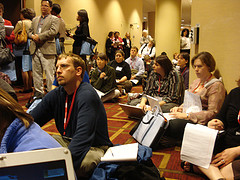
In fact, it was probably the intimacy of sitting on the floor together, hovering over a couple of laptop monitors, and getting all jazzed up over fun technology that led one of the other women near me to come up afterwards and ask how I manage to blog sessions. She said she’d seen me typing away at an earlier session, and she sounded more than a little skeptical that anyone could possibly type and listen all at the same time. So I showed her my raw notes (especially URLs for slides or other interesting sites), how I highlight in bold any portion of those notes that I think will make good inclusions in a blog post, and how I add parenthetical comments to remind me what questions or ideas the sessions sparked. Then I showed her how I take the notes and create posts around them whenever I get a minute (and some working wireless, which got pretty rare as the conference progressed).

“But you’re still typing,” she protested, “which seems like it’d make it harder for you to listen to what’s being said.” Thinking back, I only gave her one third of the whole answer to that issue. I explained that I can type a lot faster than I can write long-hand, so I actually hear more of the session than I would if I were writing on paper. But I didn’t explain that typing with an eye to synthesizing for a blog post helps me stay on task when I’m listening to presentations (as Nichole just blogged… it’s another inadvertent-blog-topic-convergence day). It forces me to look for the themes and primary points in the presentations. I don’t end up blogging every session, but I do end up taking blog-ready notes for almost every session.

And of course there’s the final third of the puzzle. When presenters end up explaining something I already understand, I can compose the actual blog posts while I keep an ear out for when the presentation moves on to topics or perspectives that are newer to me. The fact that I only posted a couple of times a day during this conference speaks to the general lack of such down-times for me, which is a good thing. But it did happen occasionally.

In the end, the skeptical woman walked away looking relieved that I wasn’t wasting my conference registration fee (or hotel costs, which was significantly more expensive). Maybe next year she’ll have a blogger banner on her name tag. 🙂

Technorati technorati tags: cil2007

2 Comments

CIL Aftermath

Sitting here in the airport, waiting to go home after a morning spent with such last-minute things as figuring out how much to tip hotel maids, everything seems suspended out of time. I’m exhilarated and exhausted all at the same time. Happy to go home, sorry to leave. It’s been four wonderful days full of ideas, inspirations, fun, and the best company imaginable.

In the absence of an internet connection (when did this become such an life necessity?), I took the time to draft this post and transfer my pictures from my camera to my laptop. Tagging them as I went, I had to giggle when I remembered the librarian next to me in one of the session when, asked to write down a tag for a picture the presenter projected, wrote her tag in perfect LCSH (including double dashes). You’ve gotta love librarians. And I must admit, I have librarianish tagging tendencies, too. I use plurals to describe countable nouns and singulars to describe uncountable nouns, I don’t often tag pictures of me “me,” and I rarely attach more than a couple tags for any picture. But I draw the lines at double dashes and qualifiers.

And you’d have to be a librarian to get a kick out of the jokes that were flying a couple nights ago at the Irish pub in town. The CIL snowball effect had taken hold and we’d gathered well over 20 librarians by the time we left the hotel. One of them (our personal jester, as it turned out) looked up as we sat in the pub, noticed a bunch of books lined up and tilting into the spaces where some had been removed, and asked “Does anyone have the compulsion to go straighten those books?” We giggled. That was only the beginning. That was before our jester (Eric Sizemore) nearly killed Steven Cohen by suggesting that we twitter in DDC… “How are you feeling?” … “745.5944” … and then we started twittering requests for DDC translations of concepts … and then some librarians started twittering us the answers. Yeah. We completely geeked out. You probably had to be there, but for those of us who were, it’ll live on in CIL lore for generations.

But now my plane is getting ready to board. I’m not a nervous flier, but I always get a little nervous about my seat neighbor. Two equal horrors may await me: it might be a nervous (or worse, an air-sick) flier, or it might be a talker. My duo combo of audio book on iPod AND magazine (which I pretend to read) should take care of the later, but there’s no help for the former. Luckily the former is very, very rare.

There are a couple more sessions I’ll blog about later. But for now, wish me happy travels.

Technorati technorati tags: cil2007

4 Comments

A World Digital Library in the Works

Ok, I’ve tried this a couple of times, now, and I think Blogger officially hates YouTube (maybe it’s some step-sibling rivalry or something). So here I go again… shorter… not as much excitement in my tone… and not as much detail. Blame Blogger.

This morning’s keynote was on the Library of Congress’ new project (scheduled to be available summer of 2008) to digitize culturally significant items from seven countries: the U.S., Brazil, Russia, Spain, France, Egypt, and the Netherlands. And yes, everything will be available in all seven languages. What a job.

The talk was interesting, but the demo video he showed at the end was very, very cool. Yes, I like shiny things… Very cool. Check it out:

Technorati technorati tags: cil2007

Leave a Comment

Is It Really Almost Over?

I’ve been having such a great time that it’s strange to think today is the last day of CIL. Some people are already heading out this morning. And everyone’s saying, “See you at Internet Librarian…” which makes me jealous that everyone else is GOING to Internet Librarian. Oh well.

Even though I’ve met new people every day, there are still a few of you out there that I just haven’t managed to cross paths with (at least, not knowingly). This is it, folks. Say Hi today or you’ll have to wait until next year. So if you see an olive green computer backpack wandering around on some girl’s back, there’s a good chance that back is mine. I haven’t seen any other olive green computer backpacks.

Technorati technorati tags: cil2007

2 Comments

Wrapping Up Day Two of CIL

With day two drawing for a close, my brain is full again. I need one of those pools of memories like in the Harry Potter books…

Today the most memorable quote of the day goes to Gao Tao. He was explaining Joomla and how they’d implemented it at his library. In the midst of telling us about decisions and meetings and other such fun stuff that you have to go through when implementing a major change in a library, he said, “The bad news is that you may get frustrated. The good news is that I just saved a bunch of money on car insurance.” Wow. The room erupted. And this was even after we’d grown to love him when he said to “please let me know if you’re having trouble hearing me, or if I start speaking in Chinese.”

Later I attended a presentation on Hennepin County Library’s inclusion of patron and librarian “comments” (reviews, annotations, etc.) in their catalog. Funny that I traveled all the way to DC to hear a guy who works just up the road… The most important thing I learned, though, was that rating and commenting should BOTH be present. I’d always kind of dismissed rating catalog records, but Hennepin has found that they end up with numbers (like “7/10” or just “5”) written in their comments. So obviously people want this feature.

Oh, and there were ponies in Michelle and Meredith’s presentation, as promised. But the theme had evolved by presentation time, so it wasn’t just a pony…. it was a pony with a monocle. I’m not clear on how the monocle thing started (even though I was in the room when the scheme was hatched the night before), but Jason donated his photoshop skills to add the monocle. It was cool. Oh, and the presentation was good to. 🙂

After coffee, I sat on the stairs outside of Steven Cohen’s “What’s Hot with RSS” presentation. Why the stairs? Because the overflow room was full… After we’d colonized the stairs people started sitting (in neat rows, for some reason) down the hall. Amazing. I wished I’d had internet access during that one because people around me kept asking to see the stuff he was showing, or wondered about alternatives to the tools he showed. But I didn’t. But I did get somebody else started on Twitter, and explained blogging to somebody else. Fun stuff.

Technorati technorati tags: cil2007

Leave a Comment

Old Media and New Media Working Together

There was a last minute substitution for this morning’s keynote. I don’t know what happened, so no juicy details from me, but whatever happened it resulted in a great talk by Andy Carvin (of PBS Learning.now fame) about how “Old Media” giants (such as NPR, CNN, and USA Today) are embracing the social web to extend their coverage and reporting power. And beta isn’t just for the web any more. NPR is releasing pilots early for comment and criticism here at Roughcuts.

In fact “participatory” and “transparency” were the real themes of the morning. “The people formerly known as the audience” (Carven quoting Jay Rosen) are becoming more and more instrumental in determining what gets reported and how it gets reported.

But I think he really hit the nail on the head when he said that as much as participatory environments really get things done, enrich “standard” content, and are generally recognized as a great idea, organizations are reluctant to “go social” because, and I quote, “People aren’t always comfortable sharing how they make sausages.”

But I think there’s more to it than that organizations (or individuals) think it’ll be embarrassing or icky or gross, or any of that. I think there’s at least as much of a perception that what happens behind the scenes isn’t interesting to people. At least, I know that’s true of my job. Almost every time my grandma asks what, exactly, I do at work (which is often, mostly because I’ve never been able to actually explain it well) I have trouble saying anything because I’m always sure that most of the day to day stuff I do and think about isn’t “interesting” (especially not to people who don’t live in library land).

Anyway, Carvin had a rich set of slides (PowerPoint file here) filled with an impressive number of examples. He didn’t get to all of them in his talk, but they’re definitely worth visiting. There are lots of links. Lots.

Technorati technorati tags: cil2007

2 Comments
css.php