Skip to content

Category: Digital Humanities

Boats and Ferries and Bridges, Oh My!: Digital Humanities support models

This morning my coworker Sarah Calhoun and I presented again at the Oberlin Digital Scholarship conference, “Building a Distributed Collaborative Model for Digital Scholarship Support at Liberal Arts Institutions: A Mixed Metaphor Salad.” Our other co-presenter, Austin Mason, couldn’t make it to the session, but he gets the credit for finding and bringing to us the metaphor that drove the session. He’d attended a session by Liz Milewicz of Duke University and gotten permission to reuse her metaphor. And the metaphor in question? Various methods of crossing water from one shore to another. Here’s how we used it.

“Automobile crossing rope bridge. 1923.” Photograph made accessible by the Field Museum Library. http://www.flickr.com/photos/field_museum_library/4462494439/

On occasion, supporting the digital humanities can feel an awful lot like trying to drive a car across a rope bridge. Either the infrastructure is inadequate for the project, or the project chose the wrong infrastructure to use to get across the river.

In an attempt to avoid this unfortunately pairing of project and infrastructure as much as possible, we propose thinking carefully about the infrastructure we put into place, and also about how to communicate clearly with researchers and with ourselves. We want researchers to find and use the right resources for the job, and we want to prevent siloed services that may duplicate effort or cause turf wars. And one way to think through these issues is to map out what’s happening on your campus.

Most campuses will have brave DIY-ers, who cross the river in daring ways using found objects (fallen logs) or special skill/access (base jumpers). These are important parts of creative research on our campuses, but they are not very repeatable or scaleable. They are not a great plan for a support model.

"Simple cable ferry, Gee's Bend, Alabama, 1939" by Marion Post Wolcott.
“Simple cable ferry, Gee’s Bend, Alabama, 1939” by Marion Post Wolcott. https://en.wikipedia.org/wiki/Cable_ferry#/media/File:Marion_Post_Wolcott_- _Old_cable_ferry_between_Camden_and_Gees_Bend,_Alabama.jpg

One of the low-barrier, low-overhead, repeatable methods of crossing might be a rope ferry. These work quite well either solo or with a ferryman, but they may not be terribly stable over time. Perhaps various semi-ephemeral things like free blogs or social media fit here, where researchers can get information up online, but it may not be stable over time if the researcher or the service move in new directions.

"Venezia - Ferry-boat Lido di Venezia"
“Venezia – Ferry-boat Lido di Venezia” https://commons.wikimedia.org/wiki/File:Venezia_-_Ferry-boat_Lido_di_Venezia.jpg

Or perhaps there are more modern ferries available. These are larger, more powerful, and require less effort on the part of the researcher. Maybe something like an institutional subscription to Omeka or WordPress fit here. They were for a lot of people interested in doing a lot of different kinds of things, and support can be pretty standard on campus.

"Brooklyn Bridge Manhattan"
“Brooklyn Bridge Manhattan” https://commons.wikimedia.org/wiki/File:Brooklyn_Bridge_Manhattan.jpg

But if you have a ferry running the same route over and over and over, and if you also have some money and staff for new construction, maybe it’s time to build a bridge. Some schools, for example, have a whole unit or a Center dedicated to supporting digital humanities. Some of these Centers are even iconic, like the Brooklyn Bridge. And I think that depending on the school, a massive, multi-lane bridge with tons of on-ramps and off-ramps might be a wonderful thing.

However, bridges really do require upkeep, they can become bottlenecks, they often have height and weight restrictions, and they may not serve all needs. Researchers are creative beings who may need to start in a different spot, end in a different spot, or get across in unusual ways. So at this point it becomes a matter of project portfolio management.
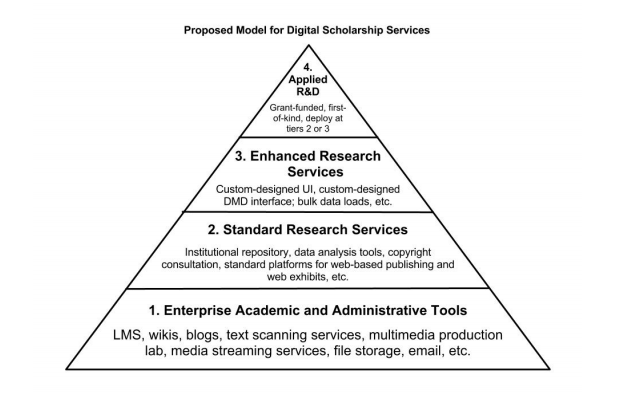
Vinopal, Jennifer, and Monica McCormick. 'Supporting Digital Scholarship in Research Libraries: Scalability and Sustainability.' Journal of Library Administration 53, no.1 (January 1, 2013): 27-42. doi:10.1080/01930826.2013.756689.
Vinopal, Jennifer, and Monica McCormick. ‘Supporting Digital Scholarship
in Research Libraries: Scalability and Sustainability.’ Journal of
Library Administration 53, no.1 (January 1, 2013): 27-42. doi:10.1080/01930826.2013.756689.

Jennifer Vinopal (who was also this conference’s keynote speaker, though we’d planned to site her even before we knew that), and her colleague Monica McCormick wrote a fantastic piece on “Supporting Digital Scholarship  in Research Libraries: Scalability and Sustainability” in the Journal of Library Administration. In it they recommend having an infrastructure such that the majority of project can use standardized tools that are well-supported on campus. Then allow for creativity by building in support for projects that can mostly use those standard tools but with some standardized consultation services, or with a bit of custom tweaking. But reserve some capacity for a few truly custom projects that will require a lot of support (and try to make sure that these project can be “first of a kind” rather than truly one-off projects).  So perhaps you have a couple of docks for some ferries not far from your bridge, or a landing area for your base jumpers, but there’s communication and vetting involved in committing resources to these special projects.

And no matter your solution, close communication between support and coordination folks will prevent boating collisions, or the building of duplicate bridges. To mix metaphors quite wildly, at Carleton we think of our coordinating folks as a three-legged stool: Library, Humanities Center, and Academic Technology. Representatives from these areas try to make sure that things move forward in a coordinated fashion even when the actual support and work of digital scholarship happens in all kinds of places on campus. We’re calling it a “coordinated distributed model,” and it is still in its infancy. We are currently tackling the question of what infrastructure to build and for whom, which tools will be our standard and which will we cut loose, who will be involved and to what extent, and how will we make sure that people who need us will find us?

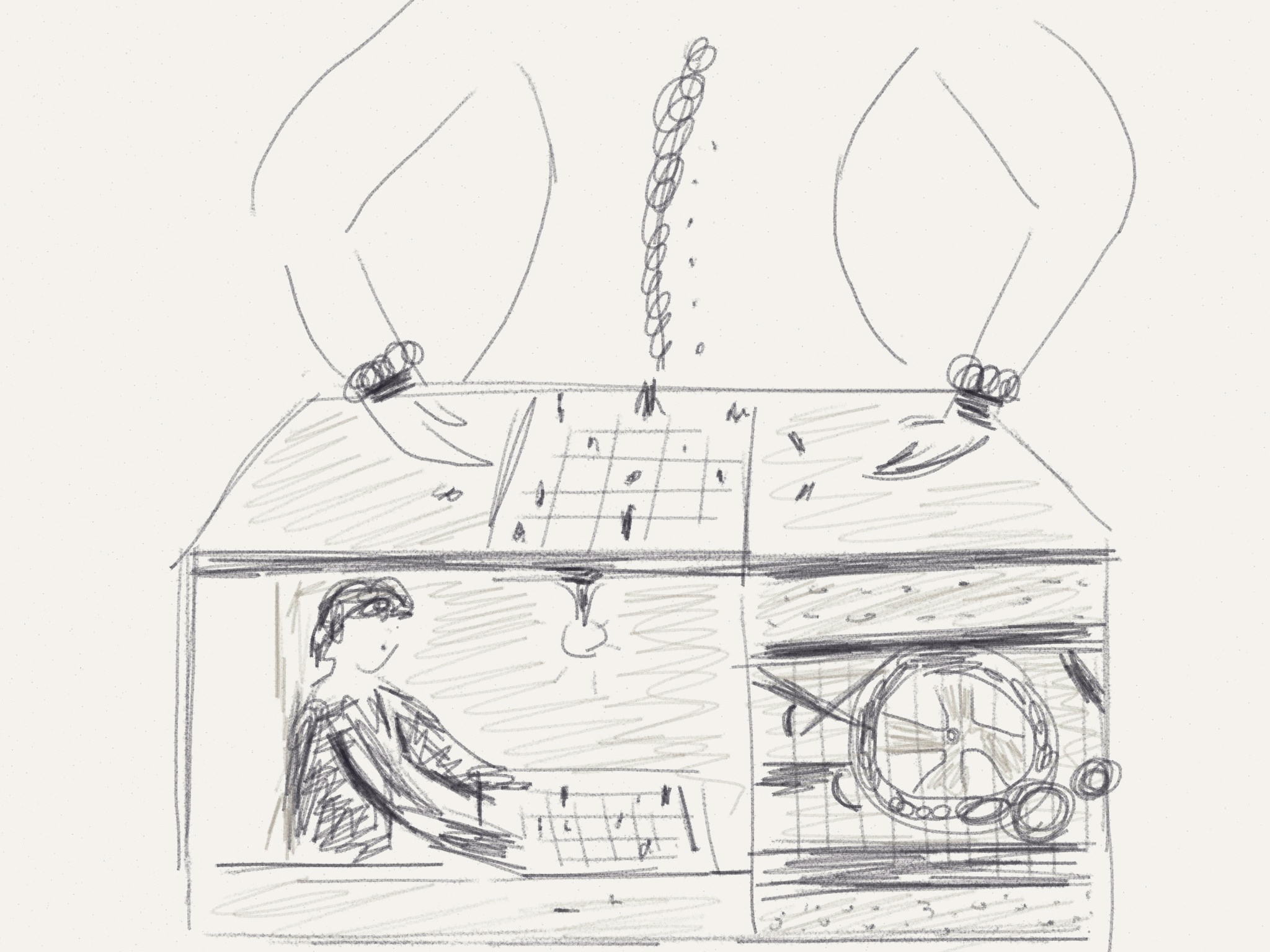
Exploring these questions, we handed out blank maps to participants and asked them to depict their campus’ current models, talking in small groups about how things work on their campuses, and comparing with others to find trends and themes.

Feel free to use or make your own. I just drew this sketch of a map on my iPad.
Feel free to use this map or make your own. I just drew this sketch of a map on my iPad. https://drive.google.com/a/carleton.edu/file/d/0B1hW_xoemoVvSklzYmJTNnFzWTA/view

One fascinating thing was that there were three participants from one college, and all three drew different maps. Others drew people drowning in the river, or people standing on one shore and gazing longingly at the distant shore. But one thing that became clear was that whatever infrastructure an institution adopts, it has to fit the local context. There’s no sense sinking a ton of money in a massive bridge if there’s no demand, or just because another school did it. And on the other hand there’s no sense leaving researchers to fend for themselves on campuses where lots of people have a similar need.

Then we handed out new blank maps and asked participants to think about an ideal infrastructure for their campuses over the next 5-ish years. There were so many interesting and useful responses. One person drew a crew of happy inner-tubers (beer implied), and someone at a different table drew one big inner tube. Most had more than one method of getting across. Others had thought about setting up villages or resorts on one side or the other to show the community that would be important, or close communication, or the bringing together of units that are currently separate. The creativity and thoughtfulness in the room was so inspiring!

At the end we asked participants what one thing they wanted to take back or change first at their institutions. My own answer was that I want to hand out blank maps to the people I work with on campus and see what we each think the current model looks like, and where we each hope it might go.

Leave a Comment
Data Management and the Humanities

Humanities Data: Document fragments from church archives in Cuba

This morning my colleagues Kristin Partlo and Sarah Calhoun presented with me on data management plans (DMPs). The session itself was mostly a conversation about some example DMPs from the collection of successful DMPs that was recently released by the National Endowment for the Humanities followed by conversations about how we might talk to faculty (using this DMP template as food for thought). But from this conversation a few themes crystalized for me.

Why would humanists care?

I think we often hear that “sharing the stuff of my research with the world” isn’t a huge motivator in the humanities. I’m not sure how broadly true that is, but it’s true enough with enough people that it bears thinking about. And I have heard skepticism, usually in the form of “nobody else will care about this stuff I’ve collected,” so how do we address that?

Sometimes I think maybe it’s a matter of vocabulary, so talking about creating “an archive” or “a digital collection” might capture imaginations where “manage/share your data” won’t. Even talking about how a bibliography is a described dataset can be useful because humanists are very familiar with practices of collecting, organizing, and sharing bibliographic information, usually at the ends of articles, books, and syllabi, but sometimes independently. Humanists have actually been doing data management since forever when you think about bibliographies. In this context, we care about versions (editions), standardized and encoded “data fields” (so that other researchers know if you’re referring to a title of a chapter, article, or book, for example), durable URLs whenever possible… Bibliographies are rich with descriptive and preservationist practices that can help inform management and sharing of files and information more broadly.

I think another aspect of why Humanists might care involves thinking about sharing with the sympathetic collaborator that is your future self. Your future self will forget the ins and outs of where you put or how you named your image files, or what the columns on your spreadsheet actually mean. Our computers are chalk full of the stuff of our research — PDFs, draft versions, images, audio, video. Knowing where all of those things are requires management of all of that data just so that you can find things again later.

Learn through analogy with the known

Kristin talks about how the monograph is largely self-describing. It has title, author, and publisher information in predictable spaces. There’s the table of contents, often an index and bibliography, and things like introductions and conclusions that describe the book for you.

Then there are style guides and formal or informal glossaries that people adopt, and these serve to help make your data (“data” writ large) understandable and consistent for other readers.

These are things that are familiar, so it’s easier to point to these things and remind ourselves that we’ve already seen the usefulness of self-describing units of scholarship and of somewhat standardized best practices. Now we just need to apply it to the digital stuff we’re working with more and more these days.

And in the past, libraries and archives were the main places that managed the sharing of shareable humanities data (primary and secondary sources), but the sharing involved researchers traveling to those collections (humanities “datasets”) to use them. Now individual researchers can create collections, or use collections without physically traveling from dataset to dataset. But this also means that researchers now have more responsibility to do some of the description and standardization that libraries, archives, and publishers formerly did a lot of. So yes, the work feels different, but it’s built on the same principles that humanists already value.

Formal vs informal data management

One of the interesting themes of our session and all the other data-related sessions I attended is that people talk a lot about the data management requirements of grant-funded projects. Meanwhile, I haven’t supported that work at all, but I have helped quite a few people manage their own individual or collaborative non-grant-funded projects. And I really think that data management becomes much more alive and broadly useful if I think about how the best practices identified and codified by grant funding agencies help us think about best practices for regular, every-day digital life, right down to the daily action of naming and putting a file into a folder on my computer. For me and for the people I’ve worked with so far, formal DMPs are alien things that don’t intersect with my life and research. But the spirit and practices reflected in those DMPs? THOSE I care deeply about. So perhaps shifting language from compliance to best practices, and shifting focus from grants to every day organizational practices, perhaps these things can help make data management less of an alien object that only scientists and social scientists ever touch.

Leave a Comment

The Digital Humanities and the Librarian

map visualization
Image by raph.ae/

Here at Carleton I’ve been tasked with helping to draft a proposal for a campus-wide digital humanities initiative and infrastructure. Being the librarian that I am, I’ve been spending a good deal of time reading the literature of the field in addition to investigating potential model programs at other institutions and pulling together what amounts to a SWAT analysis about our own institution. And one of the really interesting things in the literature of the field is how librarians are thought of (and think of themselves) in relationship to DH work.

There’s a sizable camp of  vocal “librarians should be full partners in the research” proponents. There are quite a few “provide good, quiet service and provide it well” advisers. There’s the “this is a new thing for librarians so we really need to figure out what we can do” camp. And there’s the “there’s nothing new under the sun for librarians so just do this” camp.

I fall somewhere in the middle of all this. There aren’t well-oiled mechanisms here or at many other institutions for humanists (as opposed to scientists) who want to do digitally inflected research, and yet this research is becoming more and more of an expectation in humanities fields. So in that sense there’s an awful lot to figure out, cobble together, and invent when it comes to supporting this research.

On the other hand, librarians have always studied and supported information use and dissemination, research methods, and scholarly communication cultures. We have always fought to make sure that intellectual freedom is a reality and that everyone has a chance to create new knowledge from the record of human thought. These things sit at the core of our profession — the core of our guiding documents and professional ethics.

A few years ago the humanities departments I serve became much more dependent on data and statistics as they engaged in scholarship, so I learned what I needed to know about finding, understanding, and using numerical information. Right now it’s becoming clear to me that the humanities research in my departments has taken on a decidedly spacial flavor, so it’s time for me to learn enough about spacial analysis and GIS to be conversant with the information and methods of the scholarship in my areas. And while I will never be a GIS specialist, basic familiarity is no more outside of my professional scope than leaning database searching was for the librarians who trained me. The stuff of scholarship changes, but our professional expertise lies first in understanding and facilitating how information flows and functions within scholarship, and it lies second in understanding the mechanics of locating the particular kinds of information that happen to be in use at the moment.

On top of all of this, the information that makes up the bulk of the data for humanities scholarship resides in various kinds of libraries, the “labs of the humanities.” The ties between librarian and scholar have always been particularly strong in the humanities. We geek out together over dusty codexes and digitized primary source collections, monograph browsing and frustratingly jargonless full-text article searching, bulky archival boxes and streaming video collections. Humanities scholarship has never been the solo enterprise that has gotten so much air time lately. Librarians and scholars have been there for each other through the ages, though the librarians’ role is often invisible to the broader community. The librarians aren’t listed as co-authors (and shouldn’t be!), but they do participate in very real ways in humanities scholarship’s inception, feasibility, creation, dissemination, and use.

So I think librarians and scholars function best when they are full partners with each other, and I think that “full partnership” often means playing a pretty invisible role.* I think that there is a lot that’s new that needs to be figured out, and I think there’s nothing new under the sun. But most of all I think that this is our world and our reality, and I think that we are equipped to tackle it, messiness and unanswered questions and all.


* There are some problems with invisibility, including things like being underpaid, over worked, etc. But that’s a topic for another post.


Here’s a bibliography of things that contributed to me thinking these thoughts.

Aarsvold, Nancy, Kasia Gonnerman, and Jason N. Paul. “Shaping the Roles of Academic Librarians to Meet Emerging Demands of DH Scholarship.” In Supporting Digital Humanities for Knowledge Acquisition in Modern Libraries, 44–65. Hershey, PA: Information Science Reference, 2015.

Maron, NL, and Sarah Pickle. Sustaining the Digital Humanities Host Institution Support beyond the Start-Up Phase. New York, NY, 2014.

Nowviskie, Bethany. “Asking For It.” Nowviskie.org, 2014.

Posner, Miriam. “No Half Measures: Overcoming Common Challenges to Doing Digital Humanities in the Library.” Journal of Library Administration 53, no. 1 (2013): 43–52.

Schell, Justin, Jennie M. Burroughs, Deborah Boudewyns, and Cecily Marcus. “From Digital Arts and Humanities to DASH.” In Supporting Digital Humanities for Knowledge Acquisition in Modern Libraries, edited by Kathleen L Sacco, Scott S. Richmond, Sara Parme, and Kerrie Fergen Wilkes, 234–252. Hershey, PA: Information Science Reference, 2015.

Vinopal, Jennifer, and Monica McCormick. “Supporting Digital Scholarship in Research Libraries: Scalability and Sustainability.” Journal of Library Administration 53, no. 1 (2013): 27–42.

What would you add to this list?

2 Comments

What are we DOING as we support digital humanists?

As I manage student’s workload and facilitate the projects they do in support of digital humanities projects on campus, I’ve noticed that one of the underlying dynamics that I have to negotiate is what The Work is that the students do. People talk about job descriptions and the scope of the service, but unarticulated below of if that are deeply held assumptions about what counts as meaningful work for whom.

The student workers themselves are divided on this point. Some of them are very good at zeroing in on core questions that help us think through the project as a whole and set baselines for future decisions. They engage with the process of defining projects, and documenting decisions, and engaging with the campus, and they see this as part of The Work. Other students see this kind of thing as “administrative” work. They would prefer to DO rather than plan or document. Planning and documenting is not The Work to them.

I can see the same thing playing out in different ways with the faculty heading up the projects. Some see the student workers as collaborators with whom to exchange ideas about how to proceed. Others see the student workers as people to cary out project duties as assigned.

Meanwhile, as I look at my own work associated with digital humanities on campus, I can see that I’m kind of at war with myself on this topic. First, I’m an interim in this position, which I’m not good at. A couple of times I’ve wanted to engage with questions or jump into action and my steady comrade-in-DH has reminded me that we should do things right rather than soon, and I’ve felt chagrined each time because I know this and I think that in my regular work I’m usually good at this, but somehow in my current situation I seem to get ahead of myself sometimes.

Another layer of my own internal struggle is that my main goals as the interim DH supervisor is to keep the program afloat and to document, document, document. I want the transition for the new person to be as smooth as possible, and I want to be an effective project manager for my students. But sometimes I worry that I might be too deep in the “admin stuff” (as one student calls it) and pulling my students too far in with me. I can totally relate to the desire to just plug away at a project.

Planning, documenting, and program development are important parts of the job for each of us. They are definitely a good part of The Work of digital humanities on my campus. The trick is to figure out the right balance for each person. I don’t think I’ve figured out that balance point yet.

Leave a Comment

Managing Digital Humanities Associates, Week 2

Well, classes start tomorrow, and I meet my student workers for the first time on Tuesday, so the time to get organized is NOW.

Along with several more useful meetings with people who have information and training to share about current DH projects on campus, this week a few over-arching things fell into place. First, the computers that the students will use (and, oddly, the positions that the students fill on campus) were officially blessed as “ongoing.” This means that the ancient computer will get replaced sometime in the next few weeks, and the newer computer will be automatically up for replacement when it reaches 5 years of age. What a relief! As anyone can tell you, the state of the digital humanities and of technology in general could be entirely different in 5 years, but whatever happens, I’m absolutely sure that faculty will still be performing scholarship, and student assistants will still need technology of some sort to help support that. So for now, that piece of academia’s future on our campus is a little less shaky. Whew.

A second big falling-into-place was that the college’s post-doc in Digital Humanities, Austin Mason, and I sketched out a kind of syllabus for our student workers. Their work is so very academic that this approach made natural sense to Austin and me. They have to get some basic training, but even more than that they have to learn to think like digital humanists. So they’ll each have the their own projects, but our weekly team meetings will also give them a chance to brainstorm with each other, explore topics in the field, and present their work.  We’re also going to explore more conscious and consistent participation in the DH community by putting our thoughts and updates out there in the DH blogosphere rather than locking it down in a Moodle site. The DHA program already has a blog that needs some work, so one of our group projects is going to be to clean up the current structure, About Page, Bios, etc, and develop a coherent structure and look for our future work. Mundane or private things can be published privately, but we’re going to use the site pretty heavily for both internal and external communication.

Along with that, I’ve spent a few hours today setting up a workspace in Asana for us and linking it up to a Google Docs folder structure. There’s a Gdocs folder and an Asana project for every DH project we’ll be supporting, and I’ve built in regular recurring tasks to ask for documentation and project management, along with prompts about when to check in with me.

Of course, I still haven’t managed to secure a table to put in the room where we’ll meet and work. Tables are, apparently, worth their weight in gold on our campus.

Leave a Comment

Managing Digital Humanities Associates, week 1

So, I’ve had this new responsibility for one week now, and what a week it has been! And I haven’t even met the student workers yet!

One thing that I think might be a distinct advantage of having a newbie in charge is that it gives all kinds of stakeholders on campus the chance to articulate their understanding of what’s going on and what they see coming down the pike. It’s kind of like having an external review without the external reviewers or the reports or the expense or the… well all of it except for the useful things everyone learns when they have to say their assumptions out loud. Now, I don’t think that people were necessarily in different places before this week or that I’ve triggered any “ah ha” moments or anything like that. I just think that it’s incredibly useful as we get ready to make decisions about the future of digital humanities on our campus to have everyone take a moment and say “This is what has been amazing so far, this is where I see things going, and here’s the stake I have in that future.” I’m going to do my best to document these things for the new librarian, but I also know that when we do hire the new librarian that person will add his or her own facets to these conversations.

I’ve also learned (again) that grant funding is a double-edged sword. We had a grant on campus years ago that was awesome but then left us with all kinds of aspirations and assumptions on campus that are no longer supported or funded. One tiny piece of that is one of the two computers my student workers will use. It’s now too old to function well but was bought with grant money and therefore isn’t on a replacement schedule, so who’s going to pay for it? And can we get it on a replacement schedule this time around so the headache doesn’t repeat itself ad infinitum? These are questions I hope to sort out during week 2. Wish me luck!

I’m also learning that this venture shares a characteristic with many of the exciting campus-wide initiatives that I’ve been a part of or heard a lot about: it is fueled by lots of talent and enthusiasm from many quarters on campus, but it is not (yet) part of a cohesive structure on campus. There’s nobody who “owns” digital humanities on campus, so coordination isn’t as tight as it could be and funding for things like computers (see above) is kind of up in the air. Luckily, solving that is high on the agenda for several of the big stakeholders on campus. Hopefully we can figure out how to get all the benefits of a cohesive structure without losing any of the start-up like innovation of the current semi-structure. (My own view is that this future cohesive structure should actually coordinate and fund the Digital Liberal Arts, not just Humanities, but more on that another time.)

And finally, the breadth and depth of the projects this small but growing group of student workers has contributed to is pretty awesome. And the students themselves seem like they’re going to be quite a team to work with (though I really wish they were all equally good at responding to my request for their schedules). I hope that I can give these students the structure and support they need so that they can keep doing the work they’re so obviously good at doing.

Here’s a little video about one of the projects that the students have worked on in the past.

Leave a Comment

Taking on someone else’s job (or, Hey look, I’m in charge of the Digital Humanities Associates now.)

As of today, I find myself in charge of the Digital Humanities Associates on our campus, seven exceptional student workers who partner with faculty on digital humanities projects while they also help build the digital humanities conversation, community, and infrastructure on our campus. It’s a temporary assignment until we hire a new librarian, but it’s a weighty one for me. There are so many hopes and expectations riding on this program, so many practical and political, technical and interpersonal aspects. So much room for excitement, engagement, and success. So much potential for failure.

Dutch Boy and Dike
“The Hero of Haarlem” from Hans Brinker; or, the Silver Skates: A Story of Life in Holland, by Mary Mapes Dodge (1865)

My good friend and outstanding colleague Heather Tompkins built the program from scratch (not alone, of course, but centrally important), and now she’s moved on to work her magic at St. Kate’s. Walking up to work this morning, everything felt slightly unreal, slightly fractured, as I realized that there’s a Heather-ish hole in our library now, and that I’m supposed to be able to patch one portion of that hole – keep the dike from bursting – while doing some semblance of justice to Heather’s vision for the DHAs and the digital liberal arts at Carleton.

Taking over from someone who has built a program from scratch is a daunting thing. You’d think that with a young program, now entering its fourth academic year, it’d be easier to pick up and move forward. There’s less history to learn, for one thing. But with less history comes fewer people who know that history who can support you as you find your way, more things that lived solely in one person’s memory, fewer stable pieces of infrastructure to cling to.

So today I’m going to pour over the documentation and notes that Heather left for me and the notes I took while she told me about her work, and I’m going to begin the process of wrapping my head around this new project.

Leave a Comment

DASHcamp: Digital Arts, Sciences, & Humanities camp 2014

Two weeks ago, I was able to attend DASHcamp at the University of Minnesota. It was such a rich and useful day, both in terms of what I learned and also in terms of the people I met. None of us wants me to write down all the things I learned and thought about that day, so here are the highlights.

Data Management and Curation Profiles for the rest of us

Data management is an increasingly important (and often required) step in research. The idea is to describe your data, any decisions you made while collecting and using your data, and any tools needed if others are going to use your data. Two tools are:

  • DMP Tool
    A tool provided by the California Digital Library that helps researchers develop a data management plan.
  • The DCP Toolkit — Summary of Interview Elements
    Summary by Kristin Partlo of the “DCP Interviewer’s Manual” of the Data Curation Profiles Toolkit, developed by Scott Brandt and Jake Carlson of Purdue University Libraries, the Institute of Museum and Library Services and the Distributed Data Curation Center. http://datacurationprofiles.org/

We started trying to think through the elements in these tools from the perspective of humanities data. The group I was in discussed textual data (other groups discussed video, images, sound, etc). It turns out, this is a complicated discussion! We decided that we would need some description of the level at which the primary source material is encoded (did you code down to the paragraph level? the word level? the chapter level?). We got so stuck on describing our data that we didn’t get much beyond that in my group, but the discussion was fascinating nevertheless.

One important point that came out of this conversation was that we don’t have to start from scratch as we think about data management for humanities. We can draw from at least two bodies of knowledge: scientists and social scientists who have thought through so many aspects of data management already, and archivists who are trained in managing and describing the “data” of humanities.

One real Ah-Hah moment for me was when we talked about how to start the culture shift that would result in people documenting their processes and decisions as they do their research in the humanities. Someone mentioned that teaching bibliographic and file management is an important step in the process. I do that already! I talk with students about how to make their raw material (PDFs, citations, research note) retrievable and sortable, and all I have to do is mention casually that this is a humanist’s data management.

Conversation about the term “Digital Humanities.”

One interesting conversation during the day involved when it is and isn’t important to claim the term “digital humanities” for your work or outreach. One person remembered back when there was e-Science and wondered when Digital Humanities would just be “humanities” again. Most of us were only interested in using the term when it’s needed to claim resources. You’ll need it for many of today’s grants, for example, or to get some kinds of support from a campus.

Tools:

  • VideoAnt
    The University of Minnesota developed this simple video annotating tool, and it’s free and open for all to use. It was originally used to help professors respond to video assignments, but now it’s also used for collaborative work or whenever people want to have text associated with specific points in a video.
  • Git and GitHub
    I’d heard a few people talk about using one or the other of these tools as document drafting tools, so I was interested to see how to use them and what the appeal might be. The room was full of academic technologists, instructional designers, and librarians, and it was interesting to hear the various ways they knew to use the tools. Some create HTML-based tutorials and use this as their editing and publishing platform. People who work with data librarianship can apparently search for shared and useable data there. For me, I think it looks pretty overpowered for most document drafting, and it’s full of unfamiliar terminology for most humanists (pull requests, branches, forks, etc). I think the version controls in something like Google Docs is more accessible to most of the folks I work with, but it was great to get an inside view into a new-to-me tool.

So that was fun

I really hope they hold this camp again next year. And if they do I’ll make sure to register before I share the information, because I want a spot!

Leave a Comment

The human in digital humanities

I find I often think of the digital humanities as a discipline in which scholars work with digital stuff to answer questions about texts. I know that’s not the full scope of the field, but that’s how I’ve most often interacted with it. And when I do this, I subconsciously apply only a Big Data connotation to the word “digital” — querying and analyzing massive datasets of all the words written by an author, for example, or publishing wiki-style so that the masses can contribute or change what exists. And this habit of defining the digital in these terms alone leads, I think, to Stanley Fish’s worries that the digital humanities are a dehumanizing field. He wrote an opinion piece called “The Digital Humanities and the Transcending of Mortality” in which he talks about the blurring of the individual into the digital collective, resulting in a concept of the individual that is no longer “an entity that can be said to have ownership of either its intentions or its effects.”

Perhaps dissociation from the human — the particular, the subject — is part of the post-postmodern project. But perhaps this worry about dehumanization is an early stage of understanding the digital humanities. One of the greatest changes that happens when you work with digital information is that you gain the capacity to perform large scale computation. That’s what the human brain is less good at, but that’s what computers do without breaking a sweat. So it’s only natural for many of us to subconsciously or consciously define “digital humanities” as highly computational and as primarily preoccupied with massive aggregates even when this definition does not describe all that is going on in the field.

Timothy Burke rejects Fish’s dehumanizing view of the digital humanities in his wonderful essay, The Author is Human. “In DH, authors are not dead, just brought down to human scale,” he writes. Authors aren’t the cultural monoliths of the pre-digital humanities — great minds that dominated the minds and imaginations of their times or ours. Authors are just… authors. In a sea of other authors, each one authoring away, any one author is uniquely that author. It’s just that that author’s intentions and effects do not completely overshadow other authors’ intentions and effects. In a way, I think Burke is saying something similar to what I said about focal flexibility.

My sketch of a Mechanical Turk.

So maybe the object of study is still fundamentally human, or at least not necessarily dehumanized, but maybe the praxis itself is less authorish than it was before. Maybe there’s often too much resistance in the materials, or too much of the wrong sort of resistance, making the whole enterprise feel less like communing with other minds over time and space and more like fighting with computer code and mechanics. Of course, the real work of human-computer interaction draws on the complementary strengths of mind and algorithm. Shyam Sankar’s TED talk on human computer cooperation demonstrates this beautifully leaves no doubt that even highly computational work still relies heavily on human intelligence and design.

Perhaps the very nature of the work itself, relying as it so often does on teamwork rather than a lone thinker, reduces the sense that the scholarship is as purely Authored. So much of the ethos and identity of the humanities is wrapped up in the idea (the myth?) of individual scholars thinking deeply and carefully about their subjects. With that as the backdrop, assertions like Beth Nowviski’s, that “the great project of humanities computing is the development of a hermeneutic—a concept and practice of interpretation—parallel to that of the dominant, postwar, theory­ driven humanities: a way of performing cultural and aesthetic criticism less through solitary points of view expressed in language, and more in team­based acts of building” sounds uncomfortably de-centering (Said in the Chronicle of Higher Education, and on her blog). It’s easy to feel as if this type of work places less value on the self of authorship and scholarship.

And in this case, any individual’s ownership of intentions and effects really is open to more disruption and dilution by the very nature of working as part of a team. Traditional humanities relied on more than one scholar as well, of course. Acknowledgements sections attest to this, but even without them we know from experience that knowledge doesn’t spring full formed from a brilliant mind in a vacuum. But more and more projects, particularly in the digital humanities  promote team members from the acknowledgements to the author line both in form and in deed. The selfhood of individual authors can no longer be seen (in fact or in myth) as fully owning their intentions and effects.

Even so, truly collaborative projects rely heavily on the spark of individuality that each partner brings, the rich tapestry of backgrounds, experiences, and predispositions that allow one partner to see facets of a project that the other partner would never have seen, or seen too late. This is what we wanted to spark off in our Digital Humanities Speed Dating event.

The human, it seems, is anything but an amorphous digital collective in the world of digital humanities. Both the subject and object of scholarship in the field rely on and celebrate the individual. This does not mean that things are the same, though. Authors are less monolithic things now, it seems, less singular. And right now that feels unsettling, particularly as we’re getting used to the whole idea and while the digital piece is so relatively new that it needs modify the term “humanities.” Perhaps as things settle into normalcy the word “digital” in the name won’t feel so inhuman, or perhaps we’ll dispense with the modifier altogether. However things evolve, though, it will be fascinating to watch the role of the self, the author, the human as it navigates the space of the digital humanities.

1 Comment

Digital Humanities Speed Dating

The director of our Humanities Center instituted a First Fridays informal gathering at our local pub geared toward people who are interested in digital humanities. It’s only met three or four times so far, and I had to miss the first one, but it’s been really great to sit around and listen to people say what projects they’re working on.

At the December gathering one of the profs there said what I think a lot of people were thinking when she admitted that she wasn’t speaking up because she didn’t know enough about the digital side of things to envision what she might do for a digital humanities project. She’s well aware of great digitization projects in her area, and web archives, but beyond digitizing things, what kinds of questions would she want to ask that computers could help her with? On the other side, the CS types said that they knew that computers could be great thesauri, but they didn’t really know enough about what keeps humanists awake at night to really suggest projects.

This seemed like such a fundamental question that we hatched a plan. We set up a “digital humanities speed dating” session. Humanists would come with some description of their own research, and CS-types would listen with their CS-perspective and would also talk about what they were working on. And maybe the more we knew about each other the more we would be able to see collaboration potential.

So this evening we conducted our Speed Dating session, and whatdyaknow, some CS profs and students had highly humanistic interests, and some humanists got really helpful ideas from the CS profs and students. My favorite moment was when one of our classicists was telling us about a set of fragmentary Roman documents that she is really interested in. They’re documents that record the auction prices of quite a few people’s property (they’d been convicted of something or other, and the proceeds were to be in some way presented to whichever god they’d offended). And people were discussing what she might or might not be able to learn from the fragments she has, and one CS prof said it’d be interesting to see if they could infer something about the data that’s missing. You could use each sale as a kind of user rating of the item, he said, and the missing items would be something like the things in Amazon or Netflix that haven’t yet been rated, and you could infer something about their potential value based on what had been rated/priced already. Well, that blew our humanist minds.

So after the gathering the CS prof went to talk to the Classicist a bit more, and then I happened to be there in the hall when he debriefed another CS prof. “Yeah,” he said, “I’m just going to take her spreadsheet and run a ……” and here he and the other guy went into a dialog that I assume wasn’t actually in Greek, but it might have been.

I love it when I come face to face with expertise I can’t even parse. And also, I think that’s part of the point of this whole thing.

2 Comments
css.php