This was actually the first set of primary sources that I pulled together, but it was before I realized that I should post these things here on my blog rather than in comments on other people’s Facebook posts. Anyway, you may have forgotten all about this uproar by now, but…
In late January there was a popular tweet storm (several of which have since been deleted) that lamented the constrictions that Trump’s perpetual candidacy puts on non-profits. It made two assertions: 1) filing for re-election on inauguration day is not normal, and 2) this would restrict non-profit speech about the President, since they are prohibited from “campaigning.”
The Primary Source Crusader (my own mashup of images)
How much does it cost to have Melania and Barron Trump live in New York rather than at the White House? How much do the President’s weekend trips to Florida cost?
Sadly, this is one of those questions that cannot be fully answered using officially published information, not least because the details of the budget for protecting the President and First Family are classified (as pointed out by Politico in paragraph 7). Not only that, but there are lots of judgements to make about what costs to include in these estimates since multiple parts of multiple departments are involved in multiple ways. This is one issue where we’ll probably have to wait for next year’s budgets and reports come out before we have a very clear picture of a) what the actual costs are, and b) how they compare to previous administrations.
Currently, news sources are relying on a combination of interviews with sources in the know and estimates based on past budgets and reports. Even Congress and the Government Accountability Office rely on commissioned reports that, themselves, rely on information that doesn’t seem to be publicly available. So with all of my usual caveats for this series* plus all the above as additional caveats, here are some of the past budgets and reports that I’ve been able to dig up…
The most recent estimates of domestic presidential travel are found in an October 2016 report by the Government Accountability Office. (I believe this is the report mentioned in the recent Washington Post article estimating costs of current presidential travel.) If this report, which focuses on a single trip, offers anything like an average estimate of costs per day for presidential travel, over and above typical security costs, we’re looking at about $901,000 per day when looking at only the Department of Homeland Security and the Department of Defense (not local police departments or other local services).
Meanwhile, local police departments also contribute to protection. Since no official numbers seem to be available for key numbers floating around on this topic, here are some that get quoted often, and where they come from. Quite a few news outlets are quoting the ballpark estimates of about $500,000 per day(provided by several anonymous sources to CBS in NYC and then quoted by other news outlets) as the local police force costs when all members of the First Family are in town for a day — it costs less President is not there with the rest of the First Family. Politico took a different tack, using NYPD overtime costs to estimate local costs for Obama visits to New York City. They reported this at somewhere around $8000 per hour during Obama’s recent 4- and 6-hour visits to New York City (paragraph 13). They also acknowledge that this is a blunt instrument when estimating costs on this issue since it only includes overtime and not straight salaries or infrastructure.
Back to government reports, a 2012 Congressional Research report on presidential travel talks mostly about international travel costs, but it mentions one trip to Hawaii in 1990, saying that it cost the Air Force “$1 million to $1.5 million.” (I haven’t yet been able to put my hands on the full text of that report, H. Rept. 102-985 from October 1992, and without that it’s unclear how long that Hawaii trip was or whether the 2012 report is using 1990 or 2012 dollars, but here’s an inflation calculator to play with if you like.) Without further information, this isn’t a very useful number.
Since the Secret Service protects presidential candidates in addition to the President, Vice President, First and Second Families, and visiting dignitaries, FY2016 was an expensive year costing $753,012,000 for protections operations and support. $100,853,000 was for the presidential campaign alone (page 7 of the section on Operations and Support).
They have requested $734,547,000 for FY2017 (page 1 of the section on Operations and Support).
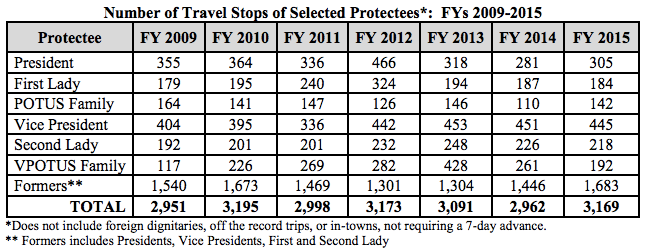
Numbers of trips Obama went on per year, durations not listed (page 14 of the section on Operations and Support):
If anyone else has found more or better primary sources for this, please let me know!
* Two caveats: 1) Not all knowable things are knowable using official, original published sources, but that’s the limit I’ve set for myself even when that’s inconvenient or frustrating, and 2) I am a librarian trained in tracking down and evaluating sources — nothing more or less than that. I’m doing my best to find the most authoritative version of the primary sources behind the news, and I welcome suggestions and corrections. If you or someone you know would like to add to my collection of primary sources, please let me know.
If you’re constantly wondering if you can believe anything you hear or read these days, constantly worried that you’ll be taken in by some tidbit of fake news (however we’re defining that at the moment), and overwhelmed and exhausted by the prospect of sorting out the real information from the bias, you are not alone. And I would argue that the history and rhetorical traditions of the mainstream media are partly to blame. There’s a lot that’s very, very good about good journalistic practices, but they could do better, and they could do it relatively easily in the age of online news.
First, what are they doing right? Becoming a journalist means becoming trained in ethical standards and methods fact-checking that involve getting independent corroboration from multiple sources before publishing. Another thing that is more invisible but probably more powerful is the publication process itself, which requires that stories get submitted for review by fact-checkers and editors prior to publication. There are multiple points built into the process for people to decide not to publish a story until it has more reliable sources, more or better corroborating sources, etc. This doesn’t mean that sources are unbiased, but it should at least mean that they aren’t deliberately publishing falsehood. And of course, mistakes can happen in journalism just as in the peer reviewed scholarly publishing world, but the system has been set up over journalism’s long history to minimize those chances, there are consequences for messing with the system, and there are multiple levels of staff to do all the work that the system requires.
But the long social and rhetorical history of the news can muddy the waters, too. Printing newspapers back in the day meant strict character and word limits and painstaking type-setting, none of which were conducive to any desire to add full citations to articles like we’re used to in academia. And besides, they were The News — sourced and fact-checked and vetted prior to printing — so readers shouldn’t need full cumbersome citations in order to believe what was being presented.
The problem is that at least for the online version of the news, linking to the study or bill or report when you mention it is trivial. If the New York Times can have an animated gif as its main image for a front page story of the online edition, they can certainly hyperlink these references in the online edition as well. Just as an example I spent over an hour trying to track down “an October government report analyzing White House travel” referenced in a Washington Post article yesterday (and I think I found it, but good grief do you know how many reports from how many parts of “the government” were presented or published in October, and in how many places the different reports could be published??). In fact, my whole recent series of posts has resulted from me asking the very basic question “what publication are they referencing in that article?” or “where did they get that number?” and then essentially providing the footnotes for the news stories I read.
Not only would links or citations help readers consume the news more critically just in general, but they would also help us distinguish between solid journalism and those publications that really are fake news in the original sense of the term. I think it’s long past time for newspapers to do themselves and their readers the courtesy of a citation when they’re referring to published documents.
The Primary Source Crusader (my own mashup of images)
Yesterday the Centers for Medicare & Medicaid Services (CMS) published their projections for National Health Expenditure, covering 2016-2025. Some numbers are floating around the news and social media, and these are the numbers that your lawmakers will (probably) be looking at as they propose healthcare spending legislation. If you’d like to see how accurate those numbers are, here is the report and the data tables for these projections.
Curious about how these projections stack up compared to the years since 1960? Have no fear, the CMS has you covered, summaries and data tables are available.
The projection tables include things like projected population, projected GDP, projected Medicare/Medicaid costs, and even details like projected costs for hospitalization vs medications, so the numbers are sliceable, diceable, and comparable in various ways.
Just to illustrate how you might build context around these numbers, here’s one way of looking at the table laying out total health expenditures (not just Medicare/Medicaid) from 1960-2015 (click to enlarge):
Table 1: National Health Expenditures; Aggregate and Per Capita Amounts, Annual Percent Change and Percent Distribution: Selected Calendar Years 1960-2015. Available from NHE Tables at Historical National Health Expenditure Data. (My annotations)
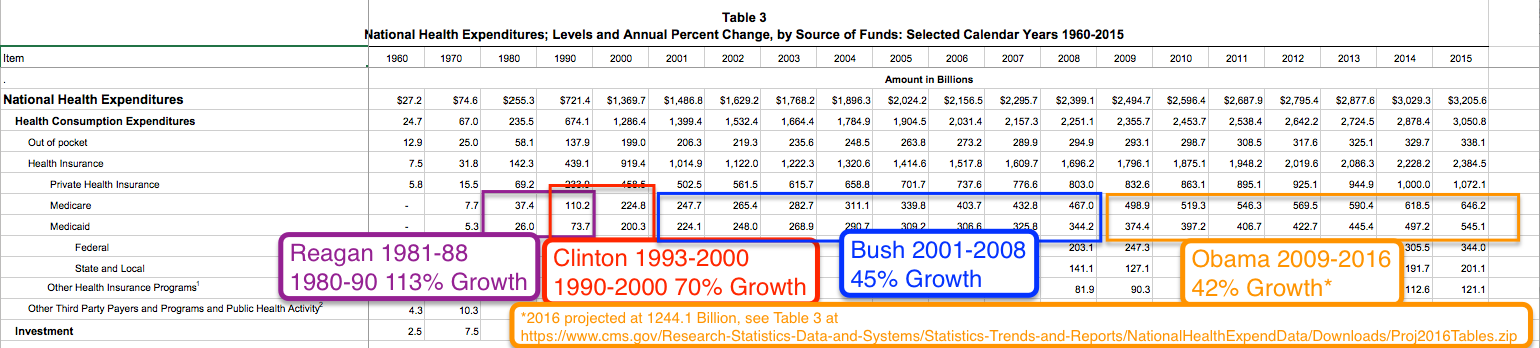
And then there’s a similar chart for Medicare and Medicaid spending over the same time periods (click to enlarge):
Table 3: National Health Expenditures; Levels and Annual Percent Change, by Source of Funds: Selected Calendar Years 1960-2015. Available from the NHE Tables at Historical National Health Expenditure Data. (My annotations)
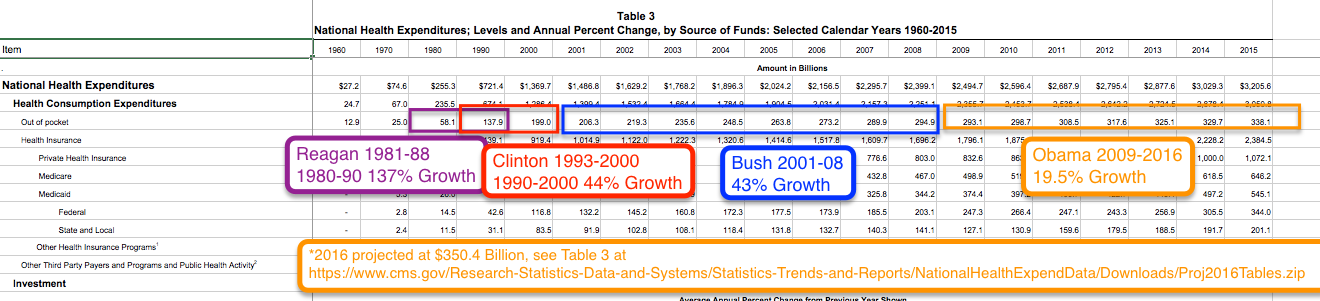
And finally, here’s a similar chart for people’s Out-of-Pocket spending over the same time period (click to enlarge):
Table 3: National Health Expenditures; Levels and Annual Percent Change, by Source of Funds: Selected Calendar Years 1960-2015. Available from the NHE Tables at Historical National Health Expenditure Data. (My annotations)1 Comment
The Primary Source Crusader (my own mashup of images)
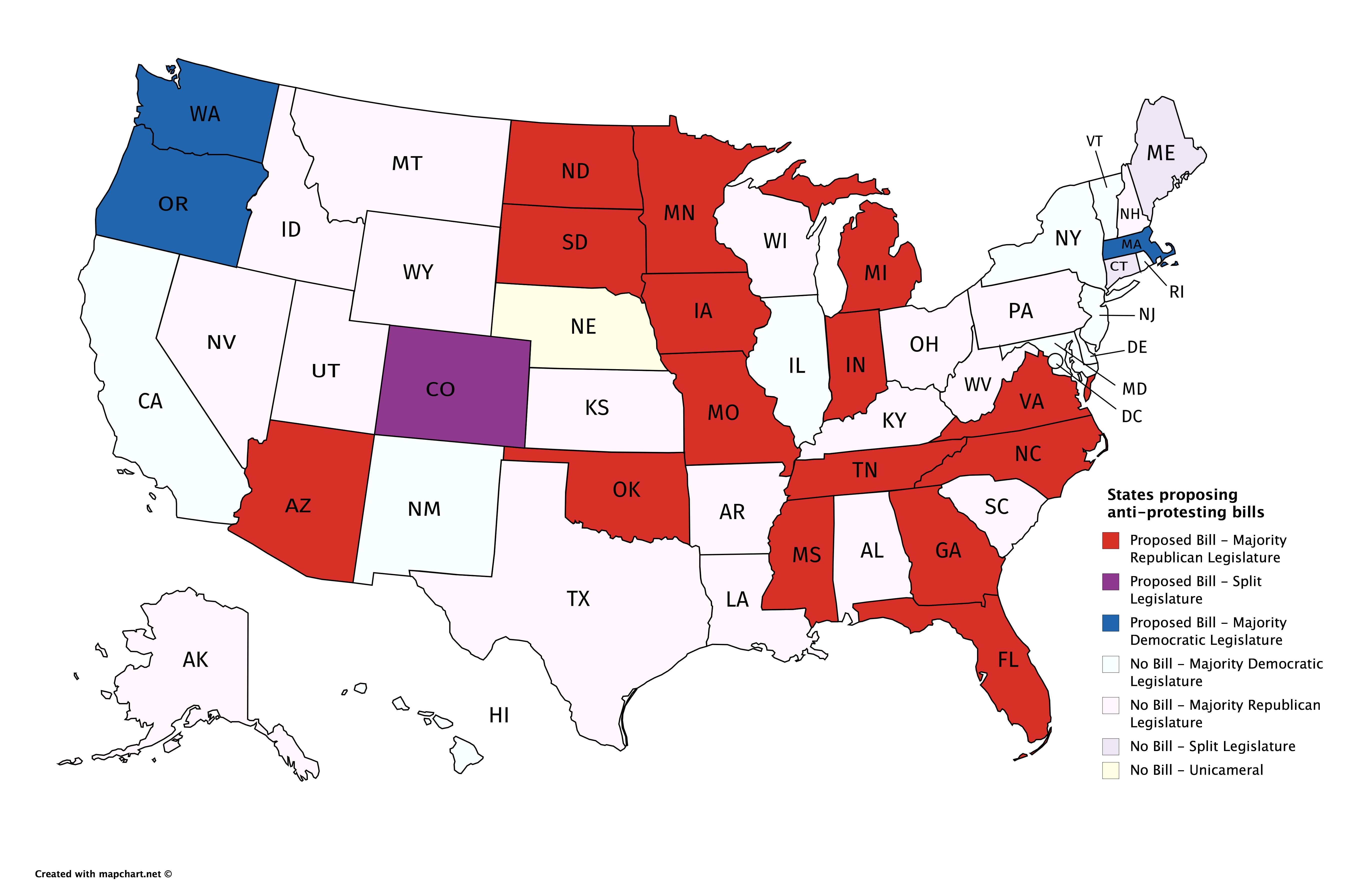
Passions are running high on the topic of protests. Some States have proposed legislation that would criminalize certain protest behaviors, and I was asked for information on exactly what they’re proposing and whether these proposals run afoul of our Constitutional rights.
With my usual caveats for this series,* here’s what I’ve found as I track down the bills referenced in recent news stories.
Last updated: 6/8/2017
Current count:
States introducing such bills:
19
Bills introduced:
31 (plus 1 or more possibly pending in NC)
SB 1142 (text of bill) introduced January 19th, 2017 – Expands the definition of “rioting” to include actions which “either disturbs the public peace or results in damage to the property of another person,” adds rioting to the list of offenses that can constitute “racketeering,” and then combines all of that with expanded definitions of “conspiracy” that explicitly includes planning a riot (here called 13-2903). If a person is guilty of conspiracy or “knows or has reason to know” that someone is conspiring, that person can get the same sentence as the person who committed the offense. Rioting is a Class 5 Felony. “A pattern of racketeering activity” could include a single act of rioting and could be punished in a variety of ways. (Declared Dead)
Colorado
SB 17-035 introduced January 13th, 2017 – Deals specifically with protests that involve tampering with oil and gas equipment, making it a class 6 felony. (Passed Senate, Failed in the House)
On the other hand, SB 17-062 introduced January 19th, 2017 – Would prohibit public colleges and universities from restricting student protests, such as designating specific times or places where protests are allowed. (Became Law)
Florida
SB 1096 introduced March 7th, 2017 – Prohibits obstructing traffic during protests or demonstrations, and exempts drivers from liability for injury or death to a person who is obstructing or interfering with traffic under certain circumstances. (Dead)
Indiana
SB 285 introduced January 9th, 2017 – Defines a “Mass traffic obstruction” as “an incident in which, as part of (or as the result of) a protest, riot, or other assembly, at least ten (10) persons obstruct vehicular traffic in violation of IC 35-44.1-2-13 (obstruction of traffic).” Requires a “responsible public official” to “not later than fifteen (15) minutes after first learning that a mass traffic obstruction exists in the official’s jurisdiction, dispatch all available law enforcement officers to the mass traffic obstruction with directions to use any means necessary to clear the roads of the persons unlawfully obstructing vehicular traffic.” (Passed Senate, in committee in the House)
Georgia
SB 160 Introduced February 10th, 2017 – Increases penalties for blocking “any highway, street, sidewalk or other public passage.” (Signed into Law)
Iowa
SF 111 Introduced January 19th, 2017 – Would prohibit people from “intentionally blocking the movement of traffic on certain highways.” (referred to committee)
Massachusetts
H 807 – “An Act Relative to Attempted Murder By Preventing Highway Access to Emergency Vehicles” introduced January 23rd, 2017 – Adds the words “or by blocking access to or upon the public highway or roadway for any purpose other than road construction, maintenance or official traffic direction by a public safety official” to the current statute. (in committee)
H 808 – “An Act Relative to Manslaughter by Protest” introduced January 23rd, 2017 – Adds the words “or manslaughter caused by reckless disregard of life while protesting or blocking highway or roadway access” to the first sentence of the current statute. (in committee)
H 809 – “An Act Relative to Intentionally Blocking or Preventing Access to a Public Roadway or Highway while Protesting with the Express Purpose of Preventing Passage of Others” introduced January 23rd, 2017 – Creates the following crime: “Notwithstanding any special or general law, or rule or regulation to the contrary, Any person who intentionally blocks or prevents access to a public roadway or highway while protesting with the express purpose of preventing passage of others shall be punished by imprisonment in state prison for not more than 10 years or by a fine of not more than one thousand dollars and imprisonment in jail or house of correction for not more than two and one half years.” (in committee)
Michigan
HB 4643 introduced May 26th, 2015 – “House Bill 4643 would amend Public Act 176 of 1939, which created the Employment Relations Commission, to modify the penalties for mass picketing. In addition to the current misdemeanor penalties, a civil fine could be levied and injunctive relief would be available.” (Passed House in December 2016, in committee in the Senate)
Minnesota
HF 390 introduced January 23rd, 2017, and SF 676 introduced February 6th, 2017 – Obstructing a roadway would become a crime, and the penalties for obstructing traffic to a highway or airport are increased. (both versions currently back from committee and awaiting vote)
HF 322 introduced January 23rd, 2017, and SF 679 introduced February 6th, 2017 – Governmental units would be allowed to sue to recover costs related to unlawful assemblies and public nuisances. (both versions currently in committee)
Missouri
HB 179 introduced December 8th, 2016 – Makes intentionally concealing one’s identity while engaging in “the crime of unlawful assembly or rioting” a class A misdemeanor. (currently in committee)
HB 826 introduced February 2nd, 2017 – Makes intentional blocking of traffic unlawful and designate it a class A misdemeanor. (currently in committee)
Mississippi
SB 2730 Introduced on or before January 16th, 2017 – Makes obstructing traffic a felony offense. (Officially died in committee 1/41/2017)
North Carolina
HB 249 introduced March 2nd, 2017 – Proposes that “A person is guilty of the separate offense of economic terrorism if the person willfully and maliciously or with reckless disregard commits a criminal offense that impedes or disrupts the regular course of business, the disruption results in damages of more than one thousand dollars ($1,000), and the offense is committed with the intent to do either of the following: (1) Intimidate the civilian population at large, or an identifiable group of the 29 civilian population. (2) Influence, through intimidation, the conduct or activities of the government of the United States, a state, or any unit of local government.” (currently in committee)
The News & Observer reported that State Senator Dan Bishop plans to introduce a bill making it illegal to “threaten, intimidate, or retaliate against a present or former North Carolina official.” Senator Bishop’s list of introduced bills, however, does not include such a bill. On 3/9/2017 he introduced a bill providing for the protection of former elected officials for 1 year after they’ve completed their terms of office, but it doesn’t specify what these protection officers would protect against. (not yet introduced)
North Dakota
HB 1203 (text of the bill) introduced January 9th, 2017 – Creates a “liability exemption” for “a driver of a motor vehicle who negligently causes injury or death to an individual obstructing vehicular traffic.” It also makes it “unlawful” to walk in the road if there is a sidewalk, on the shoulder if there is no sidewalk, or on the right-hand side of a two-way street. (defeated by the House)
HB 1293 (text of bill) introduced January 12th, 2017 – Expands the scope of criminal trespass activity under state law. (Signed into law)
HB 1304 (text of bill) introduced January 12th, 2017 – Makes it a Class A misdemeanor for someone to wear a mask, hood or other device that conceals their face when committing a crime. (Signed into law)
HB 1426 (text of bill) introduced January 16th, 2017 – Increases the penalties imposed for riot offenses. (Signed into law)
SB 2302 (text of bill) introduced January 20th, 2017 – Expands the Attorney General’s authority to appoint ad hoc special agents in response to a request for assistance. (Signed into law)
Oklahoma
HB 1123 introduced February 6th, 2017 – Increases penalties for trespassing on or tampering with “critical infrastructure” such as pipelines, refineries, or power plants. (Signed into Law)
Oregon
SB 540 introduced January 9th, 2017 – Would require public institutions of higher education to expel any student convicted of participating in a riot. (currently in committee)
South Dakota
HB 1087 introduced January 25th, 2017 – authorizes the recovery of attorney’s fees in civil actions relating to highway obstructions. (Signed into law)
SB 176 introduced February 3rd, 2017 – Allows the Governor to declare a “public safety zone” if “an event” looks like it “may consume significant public resources, poses a threat to public or private property, and poses a threat to the health and welfare of the public.” It would then be a Class 1 misdemeanor to trespass into that zone. Obstructing highways would also be a Class 1 misdemeanor. If passed, this law would expire in 2020. (Signed into law)
Tennessee
HB 668 and SB 944 (text of the bill) introduced February 9th, 2017 – Provides civil immunity for the driver of an automobile who injures a protester who is blocking traffic in a public right-of-way if the driver was exercising due care. (The senate version is in committee, the House version failed in committee)
Virginia
SB 1055 introduced January 11th, 2017 – Makes it a Class 1 misdemeanor to remain at the scene of a “riot or unlawful assembly” after being told to disperse. (defeated by the Senate)
Washington State
SB 5009 introduced December 15th, 2016 – Protests that cause “economic disruption” are illegal. “Sec. 1. The legislature recognizes and fully supports the ability of individuals to exercise their rights of free speech, press, and peaceful assembly, and to engage in other constitutionally protected activities. The legislature finds, however, that there is no right to harm another person or prevent 10 another person from exercising his or her rights. … Sec. 2. The prosecuting attorney may file a special allegation when sufficient evidence exists to show that the accused or an accomplice committed the offense to cause an economic disruption.” (currently in committee)
Can they do that?
The question seems to rest on the exact extent of the 1st and 14th Amendments’ protection for peaceful assembly, and what exactly “peaceful” means.
The 1st Amendment prohibits Congress from restricting “the right of the people peaceably to assemble.”
The 14th Amendment is the “due process” amendment, and it also prohibits States from making “any law which shall abridge the privileges or immunities of citizens of the United States” (which includes the rights from the 1st Amendment).
These amendments have been the subject of many a court case, and these have helped define the boundaries of “peaceful” and “assembly” and who is covered. — Extra caveats here that I am not a legal scholar, but following citations by people who are legal scholars (starting with Cornell’s Legal Information Institute and the Library of Congress) points to some of the key cases dealing with the right to peaceful assembly.
Whitney v. California 274 U.S. 357 (1927). States can impose restrictions if they are “sufficiently clear and explicit to satisfy the requirement of due process of law.”
De Jonge v. Oregon, 299 U.S. 353, 364, 365 (1937). Distinguished between the rights themselves and actions that can result from abuse of those rights. The justices ruled that legislation “can find constitutional justification only by dealing with the abuse. The rights themselves must not be curtailed.”
Hague v. CIO 307 U.S. 496 (1939). Justice Stone said, “The privilege of a citizen of the United States to use the streets and parks for communication of views on national questions may be regulated in the interest of all; it is not absolute, but relative, and must be exercised in subordination to the general comfort and convenience, and in consonance with peace and good order; but it must not, in the guise of regulation, be abridged or denied.” Even though this was not part of the main ruling
Cole v. Arkansas 338 U.S. 345 (1949). Reaffirmed multiple previous rulings that said the right to peaceful assembly does not include the right to interfere with traffic on public streets or otherwise threaten public safety and order.
Ward v. Rock Against Racism 491 U.S. 781 (1989). Held that governments can restrict the time, place, and manner of public assembly and speech as long as these restrictions are “justified without reference to the content of the regulated speech, . . . are narrowly tailored to serve a significant governmental interest, and . . . leave open ample alternative channels for communication of the information.”
* Two caveats: 1) Not all knowable things are knowable using official, original published sources, but that’s the limit I’ve set for myself even when that’s inconvenient or frustrating, and 2) I am a librarian trained in tracking down and evaluating sources — nothing more or less than that. I’m doing my best to find the most authoritative version of the primary sources behind the news, and I welcome suggestions and corrections.
The Primary Source Crusader (my own mashup of images)
By popular request, and subject to my typical caveats for this series,* I’ve been digging up primary sources having to do with recent public lands and environmental actions by Congress and President Trump. (This is a long one, and even more of a primary source overload than usual…)
As you read about these bills, remember that many bills and joint resolutions do not make it all the way through the process of becoming law. In the full list of current legislation, use the “Status of Legislation” filter on the left-hand navigation menu to see which items have progressed through one or both chambers of Congress. Anything can be “introduced” and then “referred to committee,” but it takes some coordinated action to get the item passed even one chamber of Congress.
(Last update was 3/1/2017 — there are just too many to keep up with after that…)
Fossil Fuels and the Law
(Indented bills have been signed into law.)
Representative Don Young (R-AK) introduced H.R.49 – American Energy Independence and Job Creation Act on January 3rd, 2017. (currently in committee)
This bill directs “the Secretary of the Interior to establish and implement a competitive oil and gas leasing program that will result in an environmentally sound program for the exploration, development, and production of the oil and gas resources of the Coastal Plain of Alaska.”
✼ Several congressmen have introduced bills and joint resolutions “disapproving” the “Stream Protection Rule” 81 Fed. Reg. 93066 (December 20, 2016). H.J.Res.11, H.J.Res.16, H.J.Res.38, and S.J.Res.10 all “disapprove” of the same rule according to the procedures used to roll back previous legislation (as discussed in further detail in my last post in this series). In short, if they pass the House, the Senate, any relevant committees, and are signed by the President, they would invalidate the “Stream Protection Rule.” That rule starts, “We, the Office of Surface Mining Reclamation and Enforcement (OSMRE or OSM), are revising our regulations, based on, among other things, advances in science, to improve the balance between environmental protection and the Nation’s need for coal as a source of energy” (according to its own summary). As of 2/16/2017, Joint Resolution 38 has been signed into law.
✼ Congressman Bill Huizenga (R-MI) introduced H.J.Res. 41 on January 30th, 2017.
This is one of the Joint Resolutions that seeks to roll back previous legislation (as discussed in further detail in my last post in this series). In short, if it passes the House, the Senate, any relevant committees, and is signed by the President, it would invalidate the “Disclosure of Payments by Resource Extraction Issuers” rule, 81 Fed. Reg. 49359 (July 27, 2016). The bill summary states: “The rule, mandated under the Dodd-Frank Wall Street Reform and Consumer Protection Act, requires resource extraction issuers to disclose payments made to governments for the commercial development of oil, natural gas, or minerals.” As of 2/17/2017, this Joint Resolution has been signed into law.
Representative Kevin Cramer (R-ND) introduced H.J.Res.45 on January 30th, 2017. (referred to committee)
This is one of the Joint Resolutions that seeks to roll back previous legislation (as discussed in further detail in my last post in this series). In short, if it passes the House, the Senate, any relevant committees, and is signed by the President, it would invalidate the “Management of Non-Federal Oil and Gas Rights” rule, 81 Fed. Reg. 79948 (November 14, 2016). That rule is intended to “improve [the U.S. Fish and Wildlife Service’s] ability to protect refuge resources, visitors, and the general public’s health and safety from potential impacts associated with non-Federal oil and gas operations located within refuges” (according to its own summary).
Congressman Scott R. Tipton (R-CO) introduced H.J.Res.71 on February 13th, 2017. Later Senator Steve Daines (R-MT) introduced S.J.Res.29, an identical bill. (referred to committee)
This is one of the Joint Resolutions that seeks to roll back previous legislation (as discussed in further detail in my last post in this series). In short, if it passes the House, the Senate, any relevant committees, and is signed by the President, it would invalidate the “Consolidated Federal Oil & Gas and Federal & Indian Coal Valuation Reform” published at 81 Fed. Reg. 43337 (July 1, 2016). This rule amends “regulations governing valuation, for royalty purposes, of oil and gas produced from Federal onshore and offshore leases and coal produced from Federal and Indian leases. This rule also consolidates definitions for oil, gas, and coal product valuation into one subpart that is applicable to the Federal oil and gas and Federal and Indian coal subparts.”
Representative Bruce Westerman (R-AR) introduced H.J.Res.82 on February 16th, 2017. (in committee)
This is one of the Joint Resolutions that seeks to roll back previous legislation (as discussed in further detail in my last post in this series). In short, if it passes the House, the Senate, any relevant committees, and is signed by the President, it would invalidate the rule “Onshore Oil and Gas Operations; Federal and Indian Oil and Gas Leases; Measurement of Oil” 81 Fed. Reg. 81462 (November 17, 2016). From its summary: “This final rule updates and replaces Onshore Oil and Gas Order Number 4, Measurement of Oil (Order 4) with new regulations codified in the Code of Federal Regulations (CFR). It establishes minimum standards for the measurement of oil produced from Federal and Indian (except Osage Tribe) leases to ensure that production is accurately measured and properly accounted for.”
Representative Keith Rothfus (R-PA) Introduced H.R.1119 – SENSE Act on February 16th, 2017. (in committee)
“To establish the bases by which the Administrator of the Environmental Protection Agency shall issue, implement, and enforce certain emission limitations and allocations for existing electric utility steam generating units that convert coal refuse into energy.”
Representative Tom Rice (R-SC) introduced H.R.1179 – Discouraging Frivolous Lawsuits Act on February 16th, 2017. (in committee)
This bill proposes that if a citizen sues under the Federal Water Pollution Control Act, the judge has no choice but to have the losing party of the suit pay all litigation costs. It would also remove the EPAs authority to deny or restrict the use of land for disposal on environmental grounds, and prohibits the government from exceeding the requirements of the law when setting up compensatory mitigation to replace the loss of aquatic resources when dredging or filling actions damage an area.
Senator Jeff Flake (F-AZ) introduced S.453 – Agency PAYGO for Greenhouse Gases Act on February 27th, 2017. (in committee)
Requires that the EPA pay for all projected increases in cost it wants to finalize any new rule that limits greenhouse gas emissions and is projected to imposed increased costs on a federal agency.
Interested in federal subsidies for fossil fuels?
Try the Subsidy Tracker 3.0 from Good Jobs First, generally cited as one place where people can go to search for economic development subsidies and other forms of government financial assistance to business.
Representative Bob Goodlatte (R-VA) introduced HR 5 – Regulatory Accountability Act of 2017 on January 3rd, 2017. (Passed the House, in committee in the Senate)
This bill seeks to amend the Regulatory Flexibility Act (RFA) and the Small Business Regulatory Enforcement Act of 1996 (SBREFA) in ways that would impact the U.S. Forest Service (USFS) and Bureau of Land Management (BLM) when they revise or amend land management plans. It includes language indicating that in addition to direct economic effect of final rules, proposed rules that include “any indirect economic effect (including compliance costs and effects on revenue) on small entities which is reasonably foreseeable and results from such rule (without regard to whether small entities will be directly regulated by the rule)” would now require review under the RFA. The bill also proposes prior to publishing a proposed rule, the Chief Counsel has to put the rule through an extensive review (Sec 306). However, “The Chief Counsel is empowered to waive the review panel requirements if they are deemed impracticable, unnecessary, or contrary to the public interest.” 13 environmental groups have signed a letter opposing HR 5.
Representative Paul Cook (R-CA) introduced H.R.491 – Santa Ana River Wash Plan Land Exchange Act on January 12th, 2017. Later Senator Dianne Feinstein (D-CA) introduced S. 357, an identical bill. (both referred to committee)
“This bill directs the Department of the Interior: (1) to quitclaim to the San Bernardino Valley Water Conservation District in California approximately 327 acres of identified federal land administered by the Bureau of Land Management, and (2) in exchange for such land, to accept from the Conservation District a conveyance of approximately 310 acres of its land.”
Representative Mark Amodei (R-NV) introduced H.R.1106 – Small Tracts Conveyance Act on Febrary 16th, 2017. (in committee)
This bill allows for the transfer of public lands to states or private individuals who own adjacent land under certain circumstances.
Senator Jeff Flake (R-AZ) introduced S.467 – Mohave County Federal Land Management Act on February 28th, 2017. (in committee)
Conducts the Department of the Interior to sell certain lands in Mohave County.
President Trump’s Executive Actions on the Environment
There is no good way to provide a link to the full list of Executive Actions on energy and the environment because so far the Executive Actions that seem relevant have been classified under subjects like “Business & Industry” and “Money,” though primarily under “Business & Industry.” There is, however, an “issues” page on the White House website that lays out President Trump’s goals around Energy. Here it says that “President Trump is committed to eliminating harmful and unnecessary policies such as the Climate Action Plan and the Waters of the U.S. rule.” With that in mind, here are the Executive Actions that are relevant to energy and the environment.
Executive Memorandum: Streamlining Permitting and Reducing Regulatory Burdens for Domestic Manufacturing, 82 FR 8667 (January 30th, 2017)
Instructs the Secretary of Commerce to review existing Federal regulations on domestic manufacturing and recommend ways to streamline those regulations. It mentions in particular that the Secretary of Commerce should speak to the Secretaries of Agriculture and Energy, the Administrator of the Environmental Protection Agency, the Director of the Office of Management and Budget, and the Administrator of the Small Business Administration (paragraph 3).
As a side note: the early temporary freeze on EPA grants and contracts as well as the early temporary directive that the EPA not to talk to the media or post information on blogs or social media appear to have been conducted through channels that didn’t leave officially published source documents. Because of this, I also can’t determine whether these actions are unusual compared to previous executive transitions using official documents.
Cabinet
Three cabinet members will have significant power over energy policy and the environment.
* Two caveats: 1) Not all knowable things are knowable using official, original published sources, but that’s the limit I’ve set for myself even when that’s inconvenient or frustrating, and 2) I am a librarian trained in tracking down and evaluating sources — nothing more or less than that. I’m doing my best to find the most authoritative version of the primary sources behind the news, and I welcome suggestions and corrections. If you or someone you know would like to add to my collection of primary sources, please let me know.
The Primary Source Crusader (my own mashup of images)
People talk about Congress “rolling back” or “reversing” various legislation from the Obama administration. People who didn’t like that original legislation are relieved, and people who did like it feel cheated. So can they really do that so easily? What’s on the chopping block? And is this different from previous changes in Congressional or Executive power? Subject to my “source documents behind the news” caveats,* here’s what I’ve been able to gather on the topic.
Can they do that?
Yes. Since March 29, 1996, Congress can “disapprove” of previous legislation under Chapter 8 of 5 U.S.C. §802 as long as the Join Resolution is received by Congress within 60 legislative days (which in no way resemble calendar days) and then passes both the House and the Senate, plus any relevant committees, and is then approved by the President.
§802. Congressional disapproval procedure
(a) For purposes of this section, the term “joint resolution” means only a joint resolution introduced in the period beginning on the date on which the report referred to in section 801(a)(1)(A) is received by Congress and ending 60 days thereafter (excluding days either House of Congress is adjourned for more than 3 days during a session of Congress), the matter after the resolving clause of which is as follows: “That Congress disapproves the rule submitted by the ____ relating to ____, and such rule shall have no force or effect.” (The blank spaces being appropriately filled in).
(b)(1) A joint resolution described in subsection (a) shall be referred to the committees in each House of Congress with jurisdiction.
(2) For purposes of this section, the term “submission or publication date” means the later of the date on which—
(A) the Congress receives the report submitted under section 801(a)(1); or
(B) the rule is published in the Federal Register, if so published.
What’s on the chopping block?
A record number (see below) of Joint Resolutions had been submitted in accordance with Chapter 8 of 5 U.S.C. Here is a complete list to date.
You can use the “Status of Legislation” filter on the left-hand navigation of the full list of these joint resolutions to explore these joint resolutions according to how far they’ve made it through the three major steps process of passing first one Chamber of Congress, then the second Chamber, and then the President. (These joint resolutions also have to go through any relevant committees, but those aren’t filterable in the same way.)
You can also use the “Subject – Policy Area” filter the full list of these joint resolutions by general topic (Energy, Environmental Protection, Financial Regulation, Eduction, etc).
How long until this window of time closes?
[Update: I’m pretty sure the window for new joint resolutions has closed]
It’s hard to say, since a legislative day can span or skip several calendar days and since there are several scenarios under which congress can introduce the joint resolution. The Congressional Research Service created an entire report out of it for this year. It all depends on how many times the chambers of Congress adjourn. The Congressional Record‘s Daily Digest is essentially the meeting minutes of Congress and lists when the chambers adjourn in the proceedings of each day.
No shifts of party majority happened between 1996 and 2001.
2001 was complicated. The President changed from Democratic to Republican. The House remained Republican, as it had since 1995. The Senate was so evenly matched that it switched back and forth a few times (when the vice president changed party and then a couple senators switched affiliations). By November 2002 the Senate had settled back into being Republican majority, as it had been in since 1995.
2017 – The President changed from Democratic to Republican. The House and Senate remained Republican. (This section will be updated as needed – last updated 4/19/2017)
* Two caveats: 1) Not all knowable things are knowable using official, original published sources, but that’s the limit I’ve set for myself even when that’s inconvenient or frustrating, and 2) I am a librarian trained in tracking down and evaluating sources — nothing more or less than that. I’m doing my best to find the most authoritative version of the primary sources behind the news, and I welcome suggestions and corrections.
The Primary Source Crusader (my own mashup of images)
NOTE: This executive order has now been superseded by a new executive order, 3/6/2017.
It can be hard to sort out reality from rumor, and it seems like whoever we’re talking to at the moment thinks our news sources are either too liberal or too conservative. Coupled with this, the rhetorical traditions and contexts of newspapers (liberal or conservative) don’t include the same conventions of citation that I depend on in order to evaluate claims (more on that another time). So what are the original sources that everyone’s reporting on and interpreting? I’ve decided that tracking down these primary sources makes a pretty good hobby for a librarian, so here’s what I’ve collected so far on the topic of Trump’s Executive Order on immigration.
But first, two caveats: 1) Not all knowable things are knowable using official, original published sources, but that’s the limit I’ve set for myself even when that’s inconvenient or frustrating, and 2) I am a librarian trained in tracking down and evaluating sources — nothing more or less than that. I’m doing my best to find the most authoritative version of the primary sources behind the news, and I welcome suggestions and corrections. If you or someone you know would like to add to my collection of primary sources, please let me know.
I will update this post as more information becomes available (and note any updates clearly).
Who does the Executive Order restrict from entering the United States, and for how long?
Section 277(a)(12) of the INA, 8 U.S.C. 1187(a)(12) is part of the Visa Waiver Program for Certain Visitors. This particular section states that the Visa Waiver Program does not apply to people who have been to “Iraq, Syria, or any other country or area of concern,” regardless of these people’s nationality, since March 1, 2011 (meaning that people who have been to these countries would need visas to enter the United States). Countries or areas of concern will be decided by the Secretary of State.
In February 2016, the Department of Homeland Security announced that Libya, Somalia, and Yemen had been added to the list of countries of concern, bringing the total to 7.
After the Executive Order was signed, further official documents provided clarification and updates.
On January 27th, 2017 The Deputy Assistant Secretary for Visa Services, Edward Ramotowski, issued an internal memo, which says: “I hereby provisionally revoke all valid immigrant and nonimmigrant visas of nationals of Iraq, Iran, Libya, Sudan, Syria, and Yemen, subject to the exceptions discussed below.” Those exceptions are: “the following nonimmigrant classifications: A-1, A-2, G-1, G-2, G-3, G-4, NATO, C-2, or certain diplomatic visas” and “any visa exempted on the basis of a determination made by the Secretaries of State and Homeland Security” on a “case-by-case basis.” (This memo was made public as part of the Louhghalam et al v. Trump case 1:17-cv-10154 (D. Mass.). Information about that case, including links to all available primary sources associated with the case, are available through the University of Michigan Law School’s Civil Rights Litigation Clearinghouse.)
On January 29th, 2017, DHS Secretary John Kelly announced: “I hereby deem the entry of lawful permanent residents to be in the national interest,” making green cards a “dispositive factor” in the case-by-case analysis of immigrant and nonimmigrant entry into the United States.
As of February 3rd, 2017 the main provisions of this Executive Order have been halted by Judge Robart’s Temporary Restraining Order.
[Update 2/16/2017] Today the Department of Justice indicates that the President intends to rescind this Executive Order and draft a new one. They say, “Rather than continuing this litigation, the President intends in the near future to rescind the Order and replace it with a new, substantially revised Executive Order to eliminate what the panel erroneously thought were constitutional concerns” (Supplemental Brief, page 4)
Are Muslims banned?
The Executive Order does not mention specific religions in its current restrictions.
The only mention of religion as a factor in executing the provisions of this order comes in section 5(b), where it says that after the 120 day suspension of the U.S. Refugee Admissions Program, when that program resumes, the Secretary of State should “prioritize refugee claims made by individuals on the basis of religious-based persecution, provided that the religion of the individual is a minority religion in the individual’s country of nationality.” The CIA World Factbook includes official statistics on religious affiliation by country, which indicates that Muslims from these countries seeking refugee status will not be allowed to make their claims on the basis of religious-based persecution since Islam is not a minority religion in any of these countries.
[Update 2/4/2017] The class action lawsuit Al-Mowafak v. Trump, case 3:17-cv-00557 ( N.D. Cal. ) is explicitly testing the idea of the “Muslim ban” by using Trump’s tweets in conjunction with his Executive Order.
(f) Suspension of entry or imposition of restrictions by President Whenever the President finds that the entry of any aliens or of any class of aliens into the United States would be detrimental to the interests of the United States, he may by proclamation, and for such period as he shall deem necessary, suspend the entry of all aliens or any class of aliens as immigrants or nonimmigrants, or impose on the entry of aliens any restrictions he may deem to be appropriate.
1) Nondiscrimination
(A) Except as specifically provided in paragraph (2) and in sections 1101(a)(27), 1151(b)(2)(A)(i), and 1153 of this title, no person shall receive any preference or priority or be discriminated against in the issuance of an immigrant visa because of the person’s race, sex, nationality, place of birth, or place of residence.
Many court cases are currently testing the legality of the Executive Order and its ramifications. Official documents associated with these cases are available through the University of Michigan Law School’s Civil Rights Litigation Clearinghouse (which is useful because many legal documents are otherwise only available for a fee, even though PACER). Of particular note:
On February 3rd, 2017, Judge Robart issued a Temporary Restraining Order as part of the States of Washington & Minnesota v Trump case 2:17-cv-00141 (W.D. Wash.). This order says that the federal government is not allowed to enforce sections 3(c), 5(a), 5(b), 5(c), and 5(e) of the Executive Order. The order is nation-wide and in effect until we hear otherwise.
On February 3rd, 2017, White House Press Secretary Sean Spicer issued a statement via Facebook saying that the White House will block Judge Robart’s Temporary Restraining Order “at the earliest possible time” and citing 8 U.S. Code § 1182 as the legal grounds for the Executive Order. (Yes, Facebook was the official announcement vehicle. I triple checked.)
[Added 2/5/2017] The Al-Mowafak v. Trump case 3:17-cv-00557 ( N.D. Cal. ) is explicitly testing the question of whether Trump’s Executive Order is a “Muslim ban” and, because of that, its constitutionality. The complaint in this class action suit draws on Trump’s tweets to make its claims.
Is this Executive Order Like Obama Administration Immigration changes?
December 18th, 2015, H.R. 2029 – Consolidated Appropriations Act of 2015, which included many previously separate bills. Of specific interest, it included the language of H.R. 158 – Visa Waiver Program Improvement and Terrorist Travel Prevention Act of 2015. This language exempts people who have been to”Iraq, Syria, or any other country or area of concern” from the Visa Waiver Program (i.e. it requires that individuals who have been to those countries must apply for visas rather than being allowed to enter the U.S. without visas under certain circumstances).
[Update 2/14/2017] Notable among Obama’s actions is the emphasis on “individual aliens” who have been found to violate laws or sanctions. This maintains the 14th Amendment‘s Due Process rights, which the courts have ruled apply to non-citizens as well as citizens. (See for example Hague v CIO: “Freedom of speech and of assembly for any lawful purpose are rights of personal liberty secured to all persons, without regard to citizenship, by the due process clause of the Fourteenth Amendment.” And, “It has been explicitly and repeatedly affirmed by this Court, without a dissenting voice, that freedom of speech and of assembly for any lawful purpose are rights of personal liberty secured to all persons, without regard to citizenship, by the due process clause of the Fourteenth Amendment.”)