Skip to content

Category: Copyright

A practical guide to the 2016 Georgia State eReserves Copyright Case for Librarians

Wikimedia Commons
Wikimedia Commons

The academic library world has been watching the Georgia State (GSU) eReserves copyright lawsuit with interest for half of my career, and now there’s a new ruling in the case. On the one hand, I recommend reading the ruling because there’s interesting language in Judge Evans’ Fair Use assessments for each item at issue, and every time I watch someone who knows a lot about copyright go through the four factor test I learn a little bit more about how I might apply it in my own work. On the other hand, it’s 220 pages long, so there’s that.

Oh, and another thing, I’m not a lawyer and don’t even play one on TV. I’m just a librarian who takes an interest in copyright but has no legal advice to give.

History of this case

In case you’ve forgotten how we got to this ruling, Cambridge University Press and a few other publishers sued GSU over book chapters that had been scanned and loaded into GSU’s eReserves system, 99 items in all, of which Judge Evans ruled on 74. The first ruling in that case was back in 2012 by Judge Orinda Evans (and I wrote a Practical Guide here). The publishers weren’t particularly thrilled with the outcome, so they appealed the case, and the appellate court handed down a ruling in 2014 that sent the case back to Judge Evans with instructions about how to amend her item-by-item Fair Use analyses (and I wrote a Practical Guide here). This Judge Evans has now done for the 48 items that the publishers thought were still at issue, resulting in the 2016 ruling that came out on March 31st. If you’re interested, here are all the details and filings involved in Cambridge University Press et al. v. Patton (this case’s official name).

One of the main things that the appellate court asked Judge Evans to do was a much more thorough analysis of the “Market Effect” (Factor Four), delving into year-by-year sales and permissions licensing fees to see what the effect of unpaid nontransformative copying really might have been on those two markets. This plus the appellate court’s insistence that there should be no “mechanistic” Fair Use analysis means that the new ruling isn’t very generalizable to on-the-ground decision-making in our libraries and classrooms. Still every new ruling helps to clarify the boundaries of Fair Use, so this one is still worth paying attention to.

In this case, of the 48 items under consideration, 4 were ruled to be copyright infringement, and all of these 4 had previously been ruled infringement in the 2012 version of the ruling. Interestingly, of the 48 items, only 2 decisions changed as a result of the appeals process:

  1. One item had previously been rejected because the publishers hadn’t sufficiently proved that they owned the copyrights in the first place. This one was now ruled to be Fair Use, so the publishers must have provided that proof at some point.
  2. One item had previously been ruled infringement, and this time it was ruled to be Fair Use.

If you’re a real nerd, here’s a spreadsheet I made to track the item-by-item analysis and compare their outcomes between 2012 and 2016.

Highlights of what librarians should know

  1. This ruling makes it clear that there is no transformative nature to eReserves. Judge Evans says, “the excerpts are nontransformative because they are mirror-image copies of a part of the book” (page 5). I’ve heard some people wonder if readings like this might be transformative for various reasons including presenting only excerpts in juxtaposing items in ways the original publishers didn’t intend. This ruling makes it clear that rearranging how students experience the readings is not a transformative use.
  2. Because the copying was nontransformative, Factor Four (the “Market Effect” factor) was given the majority of the weight in the Fair Use analyses for each item.
  3. GSU’s status as a non-profit educational institution, and all of this copying done in the service of teaching, Factor One (the “Nature of the Use” factor) always favors Fair Use. One useful thing to note is that the professors in the courses were questioned about exactly how each of the readings figured into their courses, and this information informed both Factor One and also Factor Three, the “Amount and Substantiality” factor. If the amount copied was “narrowly tailored” to the professor’s pedagogical goals (see page 22 for example), that helped tip things toward Fair Use.
  4. For each item, two markets were considered: the market for sales of the full book, and the market of permissions fees for the book chapter(s) when available. The publishers worked very hard to make it look like if there are licenses available for the chapters, then faculty and librarians should pay those fees almost without thinking. Nancy Sims (J.D., M.L.I.S.) and Kevin Smith (J.D.) strongly advise the opposite. Smith’s contention is that there will only be a market for those licenses if we pay for the licenses all the time. If we don’t pay for the licenses unless we really have to, then there’s no market to effect. I think what he has to say on the matter warrants a nice long quote:

    “We should resort to paying for licenses only very rarely, and when there is no other alternative.  The simple fact is that the nature of the analysis that the Court of Appeals pushed Judge Evans into is such that licensing income for the publishers narrows the scope for fair use by libraries.  To my mind, this means that whenever we are faced with an e-reserves request that may not fall easily into fair use, we should look at ways to improve the fair use situation before we decide to license the excerpt.  Can we link to an already licensed version?  Can we shorten the excerpt?  Buying a separate license should be a last resort.  Doing extensive business with the Copyright Clearance Center, including purchase of their blanket campus license, is not, in my opinion, a way to buy reassurance and security; instead, it increases the risk that our space for fair use will shrink over time.” (emphasis mine)

  5. At the appellate court’s demand, Judge Evans was directed to pay careful attention to Factor 2 (the “Nature of the Work”) factor. This is the factor where if the item is creative, that makes copying less fair, and if it’s not creative, that makes copying more fair. (At the extreme, lists of phone numbers in the phone book are not creative enough to be copyrighted.) Some people have painted this with a very broad brush and said that fiction is creative and non-fiction is not creative. That’s obviously not nuanced enough. It was really interesting to watch Judge Evans evaluate each excerpt looking at writing style and whether the author provided opinion or evaluation. One item’s analysis on this factor ended with, “Author opinion, subjective description and evaluative expression dominate. Factor two disfavors fair use” (pages 36-37). Only 2 of the 48 items in this case came through with a “favors fair use” on Factor Two. The other 46 were either neutral or disfavored fair use.
  6. Given all of this, but #3 and #5 in particular, it was reinforced for me how important it is that the faculty member do the fair use analysis before putting things on eReserve. There’s no way that library staff would be able to carefully weigh the four factors without reading the works and knowing exactly how they will fit into the syllabus.
  7. And finally, I really appreciated Kevin Smith’s point that since very little of the Market Effect analysis is possible without court orders, making Fair Use decisions in “Good Faith” becomes all the more important. That way employees of non-profit educational institutions or libraries are not subject to statutory damages. (And I would add to his point that keeping records of these good faith decisions is very important.)

Further Reading (by people who know more than I do):


2 Comments

PSA: “Instructional Use” is not a Thing

Wikimedia Commons
Wikimedia Commons

One of the most common things I hear when talking to people, especially faculty, about Fair Use is “But this is an instructional use, so it’s ok, right?”

Instructional or Educational Use is not a uniquely determinative thing in copyright. It just isn’t. It would be so educationally useful to post all those PDFs to a website so that people without library access could read them, but being educational isn’t the only litmus test. I really really wish it were because I’m pretty much in favor of opening up information as much as we can to as many people as we can, but Fair Use isn’t about re-publishing stuff, it’s about making use of stuff.

Now, in-classroom use, THAT is a thing in copyright that doesn’t get enough air time. Section 107, the Fair Use section says that reproductions “including multiple copies for classroom use” may be just fine, depending on those famous Four Factors. Reproduction for research purposes: probably fine (but do that Four Factor test as always). Reproduction that is necessary for comment and criticism: same deal. Reproduction that is “instructional” or “educational” though, is just too broad a brush. Almost everything is educational in some way.

That said, don’t be too scared to make excellent uses of the Fair Use provisions of copyright law. If we don’t use them, we will lose them. Market Effect will come inching ever inward if we let it. Arm yourself with those Four Factors and use them as they were intended: to extend conversation and allow for the creation of new knowledge while being fair to the rights holder.

[Updates for additional clarity on my mini-rant:

  • Classroom use is not the ONLY venue for educational Fair Use. It is simply one spelled out use that we on college campus can take advantage of.
  • Republication can be Fair Use, but it isn’t necessarily Fair Use just because we are educators. The Four Factors are still the important points to weight.]
3 Comments

Silver Linings in Fair Use

The 9th Circuit just came out with a ruling that “copyright holders must consider fair use before asking services like YouTube to remove videos that include material they control” (quote from the NYT; Wikipedia also has a useful summary; and hardcore copyright nerds can read the full decision). So that is good news for the Fair Use side of copyright. 

Now, nobody knows exactly what “considering” fair use means, and the case will almost certainly be appealed. Still, this is a very interesting moment for copyright folks, YouTube and its ilk, and pretty much anyone who has ever had copyrighted material stripped out of their uploaded content for dubious reasons. As far as I can tell, music and movies are the two areas where fair use has been practically non-existent unless people have lots of money for lawyers and all their ducks in a row, so any hint that fair use is a real thing that applies to these kinds of content is pretty exciting to me.

And here, for your viewing pleasure, is the Dancing Baby… who is now at least 9 years old.

Leave a Comment

New adventures: International Copyright

Wikimedia Commons
Wikimedia Commons

I’ve always said I don’t know anything about international copyright. Knowing anything about domestic copyright has seemed like quite enough of a challenge for me. But I guess all things must come to an end.

So here’s what I know now about international copyright.

  1. There’s that Berne Convention you always hear about (full text here). Essentially it says that the countries that have signed onto that treaty agree that they will apply their own copyright laws to foreign works used in their countries. So a French work used in the United States has all the protections that a United States work has in the United States. No special registration required. The author owns all rights to their creative expression (except those granted to users under Fair Use) as soon as the work is fixed in a tangible medium, unless they sign those rights away to publishers and such.
  2. Then theres the TRIPS Agreement (full text here), which says that everyone who signed that agreement will follow articles 1-21 of the Berne Convention, except for the “moral rights” laid out in Berne Article 6bis. Again, no special registration required. Authors own their rights. Fair use applies.
  3. All of which leads us back to good old U.S. Copyright Act

So now you know what I know about international copyright.

Leave a Comment

The Georgia State eReserves Case Appeal Decision: a practical guide for librarians

Wikimedia Commons
Wikimedia Commons

Last Friday the 11th Circuit Court of Appeals handed down its opinion on the Georgia State (GSU) eReserves Case. The Cambridge University Press et. al. v. Patton ruling (the case’s formal name) sounds pretty dire if you only read the good parts version: they reversed the original District Court decision which library folks had mostly liked quite a lot (and which I wrote about here).

Now, if Judge Vinson had had his way, the ruling would have been pretty dire. For real cringe-worthy reading, have a go at his concurring opinion starting on page 113. But the majority opinion upholds much of the method of thinking about copyright that the original District Court opinion used and which made so much sense to me (with a few caveats, but really, it was pretty good).

The Gist

In effect, the new ruling says that the District Court got things mostly right, but occasionally wrong, and that now the District Court has to go back over everything and come up with a new ruling based on the Circuit Court’s instructions on how to think about things differently on a few points. Now, this could mean that not a whole lot changes the second time around, or it could mean that a lot changes on the case-by-case analysis, but for the most part I’m encouraged to see that the parts of the analysis that matter to us will remain largely unchanged.

Also, I should note that neither court opinion is law outside of the 11th Circuit (which is Georgia, Florida, and Alabama), and that whatever the District Court comes up with next will likely be appealed again, so this saga could go on for decades. Even so, these opinions give us some good guidance on how to think through the copyright decisions that we make every single day, so they are worth reading and understanding. Also, the opinions quote heavily from important case law on copyright, so they serve as an excellent introduction to the major cases involved in educational copyright.

More Detail

For those of us who deal with the day-to-day work of providing course readings to students, here are the portions of the case that are relevant to our decision-making.

First of all, the plaintiffs (the publishers) really wanted the Court to make a ruling on whether eReserves, as a system and a practice, was a violation of copyright law, just in general. They cited non-transformative distribution of published works as copyright infringement. The Court refused to make that judgement, which is good news for libraries and higher education. (Had it been left to Judge Vinson, things would have gone very differently.) A practice or system can’t be fair use or not, only individual uses can be fair use or not. And furthermore, even non-transformative uses can be fair use in some circumstances (see page 73).

So if we’re to make decisions on a case-by-case basis, what will that look like? Well, one of the strengths of this ruling is also one of the things that makes our jobs harder. The Circuit Court rejects all “bright lines” or simple math that will “mechanistically” determine whether a particular use is fair or not. There’s no checklist available that will spit out a perfect answer. In fact, the District Court’s initial plan to assign each of the four factors of fair use a point and then just add up the points at the end is the primary thing that the Circuit Court said needs to be re-thought. Instead, the Circuit Court says that you have to weigh each of the four factors while you ultimately try to decide if the use will promote rather than hinder the kind of knowledge creation and sharing that copyright law was intended to encourage. The Classroom Guidelines are not law and cannot be used to make blanket categories of things fair or not fair (see pages 88-89). In fact, they say that even “best practices” can only get you so far — that only an “individualized fair use analysis” will do the trick (page 85).

While all of this is consistent with the law and with prior cases, it also makes it really tricky for libraries to advise classroom instructors about what is and is not permissible when it comes to putting readings on eReserve. In effect, this decision is saying that if you say “10% or 1 chapter and everyone’s happy” you could still be in danger of infringing or causing infringement. Instead, this ruling suggests that the only way to move forward intelligently is to make and record individual, case-by-case assessments for each use. Recording the decision-making process is important because if an employee of a non-profit educational institution, library, or archives makes a decision “in good faith” that the use is fair use, the court will not levy statutory damages (see section 504(c)(2) of copyright law). If you’re looking for a model of this kind of policy, the University of Minnesota has a fantastic web form that talks people through their case-by-case analyses and then allows them to save a copy of their decision-making process: Thinking Through Fair Use. One option would be to have classroom instructors attach something like this as a cover sheet with anything they submit for eReserves.

So, how then shall we think about the four factors? The first factor is often seen as a win for educational copying (especially since “multiple copies for classroom use” is written into the fair use section of copyright law, section 107). The 11th Circuit says it’s not quiet that simple, but then ultimately says that GSU’s uses were non-profit enough and educational enough that the first factor favors fair use pretty much across the board.

The second factor was up for some debate. The District Court said that since the works at issue were all non-fiction, the second factor weighed in favor of fair use. The Circuit Court countered that there can be plenty of creative intellectual work in non-fiction publications, so this factor really has to be applied on a case-by-case basis to each use. At best this factor is neutral in determining whether the use was fair or not.

Predictably (by now) the third factor also has no easy answers. You can’t just say “10% or 1 chapter will always be safe.” Instead, you have to decide if you’re taking just what you need in order to accomplish goals that are consistent with fair use. Essentially, you have to balance this factor with the other three on a case-by-case basis.

Practically speaking, the Circuit Court sets an impossible bar for making decisions about the fourth factor, the Market Effect factor. They would like the case-by-case analysis to come up with a yes or no answer to the question: Will this use substantially impact the market for this work or for licenses of this work (but only the license piece if there’s a substantial license market for the piece)? There’s really no way for someone outside of the publishing industry to have access to the numbers and projections that would make this determination possible. Probably the closest approximation would be to decide that if there is a license available for digital excerpts, we should assume that that weighs against fair use for the fourth factor. I’m not happy with the license market becoming a market, and I’m really not happy with the massive emphasis on economics, but that appears to be the way the 11th Circuit is thinking about things. Remember, though, that having one factor weigh against fair use is not the whole story. You still have to weigh that one factor against the other three and against the ultimate mission of fair use and copyright. No easy answers allowed.

And finally, a word of caution. You may find people talking about what constitutes a “whole book” when calculating percentages copied. This issue has not been decided. The publishers want it to be the main body of the book, and GSU wanted it to be all the pages in the published book, including the index and tables of contents and such. The District Court decided not to answer this question because it was raised too late in the proceedings, and the Circuit Court said that the District Court was within its rights to decide not to decide.  So far, that’s as much as we know.

More coverage from people who know more than I do:

1 Comment

Why would you want to keep your copyrights when you’re not planning to republish?

nonexclusive

Wikimedia Commons
Wikimedia Commons

A scholar I know in another field (Hi Dad) recently asked his publisher for an author agreement that would let him retain his copyright while the publisher retained non-exclusive rights to do whatever the publisher needed to do, now and forever. The response was interesting to me because one of the biggest questions was “Why would you want these rights, anyway? We don’t understand.”

This was actually the first time I’ve thought about that question in that way. Of course nobody’s planning to take the same volume to another publisher, and realistically a whole huge volume isn’t something normally republished in PDF online, either. So realistically, what might a scholar reply to this question?

Here’s what I came up with this morning, but I’d love to hear your thoughts on the matter.

You are not being paid, so it makes sense to retain ownership of the thing you produce. Further, if you repurpose your material in the future, it will save you the time and expense of seeking copyright permissions to use your own work. You give many presentations that might benefit from the inclusion of the material you produce, you teach courses where you might want to reproduce or display portions of your work. You may want to distribute a “good parts version” at a conference (which would further your goal to share knowledge widely and would also be a good teaser for people who might have been on the fence about buying the full work). In addition, once the publication goes “out of print” you’ll have recourse to find a new avenue for distribution. You are certainly not trying to limit the publisher’s work in any way, but you would prefer not to have them limit your work.

I can imagine a clause in the contract (though I’ve never seen an example) where you also agree not to produce a directly competing product. You’d want to word that carefully so that they couldn’t claim breech of contract with other, similar scholarship that you would produce with or without owning the copyright to this particular work. Realistically, you’re not going to take this work and re-publish it on your own to compete with their version of the volume, but they may want that in writing.

I also shared my ACRL author agreement with him (still my gold standard for author agreements).

I’ve only ever published with library types, so I don’t have to articulate all this stuff when I ask for a non-exclusive agreement — it’s kind of built into our profession. Have you had similar conversations? What resonated well?

6 Comments

Portal’s Alternate Author Agreement

After the peer review and copy editing process, my co-authors and I sat down to the last step in getting our article published by Portal. And their standard author agreement is actually pretty darn good!

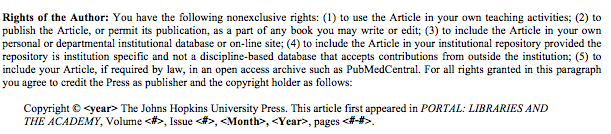
Standard Agreement
Standard Agreement

My professional values, though, include an author’s right to his or her own copyrights whenever possible. So, bolstered by Catherine’s report that she had asked for an alternate agreement for the same reasons, my co-authors and I asked if there was any way we could retain our copyright while still granting the journal all the rights it needs in order to conduct its business. And here is the result!

Alternate Agreement
Alternate Agreement

I’ve always respected this journal, but now I’m even more pleased to have an article accepted there (probably coming out in April).

1 Comment

The OTHER nasty underbelly of copyright

We got a letter from the Copyright Clearance Center on behalf of someone who wants permission to use a chapter out of a book published in 1960, so I set about figuring out what the book was and who could sign for the college. Simple right?

The permissions request form listed the author as Pierre Corneille and the book as “The Continental Model.” Ok, off to the catalog. Surely we own something if people are asking our permission for it. But the author’s name didn’t bring anything up, and it listed him as being alive and kicking in the 17th century, so that was confusing…

Then it turns out that Corneille was the original author of the chapter in this work of compiled essays, and the essays were all translated from the french by two guys. Ok, so this would probably be pretty straight forward. I’d just check to see if they’d renewed the copyright before sending the paper work over to the vice president’s office and he’d sign and we’d be done.

So I searched the Copyright Renewal Database from Stanford REALLY hoping nobody had renewed it so that I wouldn’t have to keep figuring out if we owned the copyright. Unfortunately, they had. And just to throw an extra wrinkle into the mix, the two authors were listed as the renewers, which probably means Carleton doesn’t own the copyright. So maybe this won’t be so bad. I’ll figure out if one of them is alive and send the paperwork off to him.

But then I found both of their obituaries. So now I have to figure out if the copyright might have fallen to us. WHAT A PAIN. So after a couple of phone calls, it seemed like the next step was our college archives. We need to know if there’s any contract that would tell us that we’re the copyright holders. And just to make this more interesting, the book turns out to have been jointly published by Carleton and by the University of Minnesota Press, and have been published using grant funding provided by then-president Larry Gould (for whom our library is named, by the way).

So then the archivist hunted for any paperwork associated with the two professors or with that grant from Gould. He didn’t find anything, so now we’re pretty sure that since the two guys renewed the copyright, their estates must hold the rights. The poor prof will now get a form letter back with the “I do not hold rights to this work” checked.

And the kicker is that, the prof who asked for our permission has asked to use one chapter from a book, and to use it for a class reading distributed to five students. So the use falls squarely within fair use, but there’s no way on this earth that the Copyright Clearance Center is going to pass that message on to the prof from me.

What a royal pain! We should start charging the CCC for fear mongering.

2 Comments

If Copyright had a reality TV show…

I can see it now. The teaser for the premier would quote TechDirt’s post: “‘Warner/Chappell is almost certainly guilty of massive copyfraud — perhaps the most massive in history — in claiming a copyright it clearly has no right to.’ And what is this this copyright they’re talking about? A copyright that’s so lucrative Warner/Chappell will go to any lengths to keep people paying for permissions and so ingrained in our culture that people will shell out permissions money right and left to be able to include the copyright work in their representations of our life? Find out on this week’s episode: The Dark Side of ‘Happy Birthday.’“

bd6cf791a464fadad40f4438fe5e36e35dThat’s right. “Happy Birthday,” that famously copyrighted work that plagues script writers everywhere and that earns Warner/Chappell millions a year in licensing fees? Probably isn’t copyrighted after all. Oops.

So pop some popcorn, grab a beverage, and let’s see how this plays out!

Leave a Comment

My glamorous life: copyright notices for copiers

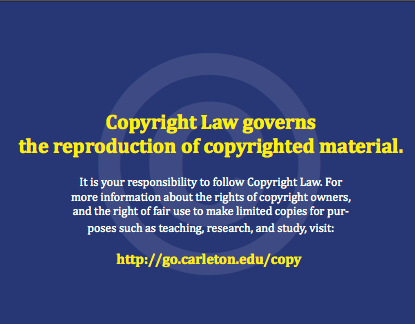
Lately I’ve been involved in the glamorous side of helping to run a library: negotiating about trash pickup and posting copyright notices. I’m pretty sure nobody wants to hear about trash, but I did learn something odd about those copyright notices that section 108 requires libraries to post near copiers. Turns out? There’s no standard wording for them. The notices I’d seen were so legalistic that I figured they must have that wording required by law, but no. So if you got here by asking Google what those notices should say, the answer is apparently “whatever you want.”

Since I’m not really a fan of notices, I originally went pretty minimalist and educational with my proposal for our library, basically pointing people toward our copyright website. But in the end, here’s the compromise we arrived at:

copyright notice
Licensed under CC0. Do what you like with it!

The actual printed signs didn’t turn out quite right because of quirks of our printing services (somebody decided it needed an inch-wide frame of black? Because copyright isn’t associated enough with doom and gloom?) but since I’m not really a fan of notices I hung them anyway rather than demanding a do-over.

2 Comments
css.php