Skip to content

Author: admin

Serenity Prayer for Email Lists

Give us grace to accept with serenity
the fact that other people’s list posts cannot be changed,
the courage to delete the posts we’d wish changed,
and the wisdom to distinguish between those worth reading
and those which should be moved, unread, to the trash.

P.S. From Jane… an image to go with the prayer.

2 Comments

One-Upped

I had to write my yearly performance appraisal document this week. It seemed like I’d just done this. To say the year flew by doesn’t come close to capturing the how nearly Time came to breaking the sound barrier this year. And I hate writing these things. It’s like writing a cover letter all over again. Still, when it’s all over it’s kind of nice to look it over and realize that you’ve had a productive second year of being a librarian.

Should you ever have this experience, be sure to read this. Your hat will fit less snugly again, and all will be right with the world.

2 Comments

Wish Me Luck: Tackling One of the Least User Friendly Databases We Have

Tomorrow I have to teach a WilsonWeb database for the first time. I’ve recommended databases we get through Wilson to students but never had to concentrate on one before.

It’s just a simple class… 8 students, two databases, simple assignment. We’ll be meeting in the reference area and working on our big SmartBoard together, and then we’ll move to individual computers in the reference area. Even so, I’m feeling the need to dig into WilsonWeb tutorials (which, by the way, if you click “help” and then “tutorial” when you’re in a database, it asks you if you’re using a Bibliographic Database, Full Text Database, Biography Database, Image Database, Standard Catalog Collection Development Database, Multiple Databases, or a Facts Database… What the… Even I had to back out, go figure out what kind of database I was in, and then come back before being able to access the stupid tutorial! Shouldn’t “help” know what kind of database I’m in?!? Yeesh.)

So, to help me should I ever have to teach this stuff again, here are the more-or-less helpful things I’ve found so far.

Maybe one of these will explain why I can never navigate these databases without hurting my brain, why when you think you’re opening a single citation you’re actually just switching to the “full” display of the result list, and why the thesaurus is so clunky to navigate. And it’s a good thing we’re not working on a full text database. The HTML full text option from those is incredibly bad. All formatting in those full text articles appears as multiple question marks.

Don’t get me wrong. The interface is better than it was last year. But still… (Oh, and the page that announced the enhancements listed in the link above included the URL as text, not a link. Seriously.)

Sorry… I’m more than usually grumpy at the moment. It just seems like the vendor of our library-related databases should be more usable. As it is, it’s a sad irony.

Leave a Comment

Know Your Copyrights: a New Guide for Faculty and Teaching Assitants from ARL

ARL has just released a brochure called “Know Your Copyrights” (PDF) which it says “gives faculty and teaching assistants in higher education an easy-to-scan explanation of when and how they can legally use intellectual property in their teaching, often without requesting permission or paying fees.”

I just gave it a quick read and I’m impressed. It covers educational use very well, and even touches on how to manage the rights of the things you produce, and all with a healthy library influence. There’s also a handy quick-reference chart near the end that is one of the best I’ve seen. My only gripe is that it occasionally commingles the law with non-legal guidelines without calling attention to which are which.

On the plus side, it’s released under a Creative Commons license which specifies that derivative works are fine as long as they include attribution and aren’t commercial.

You’re either able to pay for the beautifully printed copies or… you can download a PDF for free.

[Update: Just to clarify, the guidelines I mentioned aren’t “illegal,” they just aren’t law. For example, when the guide says that copying a timely article when you’ve just found it and don’t have time to seek permission is generally accepted as fair use, this directly references the “spontaneity” section of the Classroom Guidelines, which were never adopted as law but are nevertheless widely accepted by publishers. Nothing in the legal code says anything about time crunches.]

Leave a Comment

A Little More on Stats

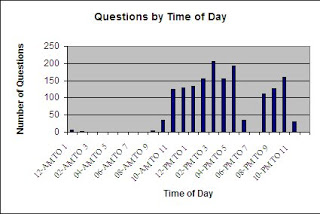
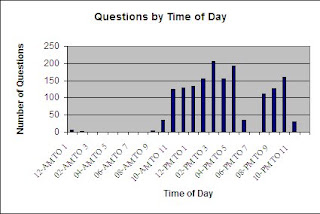
After writing that last post, I did some more analysis of our reference desk stats (I do love having data dumps from our online knowledge base into Excel!). Did you know that over 7% of the questions we’ve fielded were answered while there was no scheduled desk coverage? Almost 2% of all questions were answered between 10 and 11 at night, and reference service ends at 10 on Sundays and Monday through Thursday. Another 2% were answered in the hour before reference services begin Monday through Friday.

These I can understand. But what’s with the average of one question per term week answered between midnight and 9AM? 9 of these 14 questions occurred between midnight and 4AM. I can tell you right now, those weren’t answered by me!

Leave a Comment

Reviewing Stats: Revealing Insecurities


Like most libraries, we keep reference desk stats. These are more or less unenlightening. Numbers of transactions… sortable by date and time, length of transaction, type of question (reference, directional, technical), type of patron (student, faculty, staff, community), how the question came to us (at the desk, by phone, by IM, etc), and even who answered the question. We even go that extra mile and type in the question and a sketch of our answer. …Still mostly unenlightening for most purposes.

The way I see it, we’re driven by a quadruple motivation: we’re used collecting statistics, our administrations want statistics that’ll help them justify the money it takes to run a library, and we want to figure out what we do all day, and we want to figure out what our users need.

And before you discount the first motivation, consider some of the statistics you keep. Are these useful? Be honest.

And not so sure that a primary motivation is to figure out what we do? Maybe this isn’t a ubiquitous motivation, but I know that I have a really hard time articulating what it is to be a librarian. It’s not just about the number of people that ask me questions. In fact, I’d go so far as to say that the number of questions is somewhat incidental, kind of like the fact that the number of flowers in a garden has little direct correlation to the quality of the garden. Still, when I lack any other explanation for why I put in extra hours of work last week, or why I have to be selective about the new tools I’d like to play with, or the new initiatives I’d like to be a part of, I grasp at these statistics as a concrete way of quantifying my workload.

Unfortunately, this usually leaves me even more confused about how I spent my time. Yesterday night, as I tried to figure out why I’d run completely dry of imagination and energy in the last couple of weeks, my stats weren’t very enlightening, so I looked even farther back. Since September 12th (so, in exactly 5 months) I’ve answered 383 reference questions and conducted 109 individual consultations. Add to this the two library committees and the campus committee I’m on, and even the special projects I’ve been a part of… and I still don’t know what I’ve been doing. (Along the way I noticed that I had reference consultations with many freshmen and only 5 seniors in fall term, and with many seniors and so far only 1 freshman in winter term… interesting.)

So here’s the problem as I see it. We’re collecting a lot of numbers in a desperate attempt to tell a story about what we’re doing. That story may be something like “Look at the benefits your money has allowed,” or it may be “look at what our users are doing, now what more can we do to support that?” But what’s harder to do is to come up with the stories we think will best capture what we do and how we support our users, and then collecting stats that will help us tell those stories.

I’m not saying we need to predefine the stories. I’m saying that maybe gate counts and reference stats, as we keep them now, may not actually give an accurate picture of the services we provide, and I wish it were easier to come up with stats to keep that would more accurately reflect the stories we see around us every day. And I also think that the stats that help us coordinate our services may not be the same stats that we use to communicate with people outside the library.

We’ve begun to make a stab at it at my library, but I’m sure that as soon as we’ve got some time to devote to it we’ll want to continue rethinking what we collect and how we collect it. So far we’ve discovered that it would be nice to flag reference questions so that we can get a count of how many of them are complex research issues compared to the number that are fundamentally skill-based (“how do I find this call number,” “how do I find the text that goes with this citation,” etc). This will help us talk to faculty members who have a hard time comprehending both how lost their students can be in an academic library, and the exciting stuff we can do with students who have really complex research needs.

We’ve also been collecting information about where students hang out in the reference area, where they do their group work, where they work alone, and where they use their laptops. It would a lot of fun to map these activities using GIS or something (…says I, who have no idea how GIS works…), or use this information to inform later reorganization of other spaces in our library.

But I’m still frustrated with two things: how difficult it is to capture the story of the library (especially if you’re collecting numbers without planning the type of stories that would be meaningful to our audiences and ourselves), and how dependent I am on these types of numbers to define what I do. Why am I so unsure about my purpose on campus that I resort to counting the number of times people come to my office or the desk? Why is the campus so unsure of our value that they ask for these numbers, or do we give them the numbers because we can’t think of anything else to give? Is there a more meaningful way to tell our story? And would administration buy into a new narrative structure now that we’ve made them so accustomed to gate counts? What would the new narrative even look like?

4 Comments

On Tiny URLs

I hate getting emails where my email program correctly identified only half of a URL as a URL, making it entirely useless unless you copy and paste into your browser. It’s one of those little things that’s just annoying. Of course, then I laugh at myself that I think it’s such a pain in the neck to have to highlight the URL, control c to copy, alt tab to my browser, click into the address bar, and control v to paste. It all takes less than 3 seconds. I mean really, is that such a hardship?

The answer seemed to be TinyURL, which makes any big honkin’ URL into a nice, tidy little URL that no email program will choke on. There’s even a nifty Firefox extension.

But here’s the catch. I’m suspicious whenever anyone sends me a link that’s a tiny URL unless I know the person who sent it to me. There was a comment added to this blog recently from someone I don’t know, and it took me a long time to get up the gumption to click the stupid thing. How was I to know that it would just lead to someone’s blog? There’s no domain name to give me a clue. It just says http://tinyurl.com/[some numbers and letters to make a unique string].

I hadn’t realized just how dependent I am on reading URLs to see what I might be getting in to. Not that they’re perfect or that they can’t lie. But at least there’s some clue.

Leave a Comment
css.php