Skip to content

Month: August 2009

The Method of Multiple Working Hypotheses

This morning, a Geology professor presented one of her assignments to this workshop that I’m attending, and one concept jumped out at me. She said that one of the things that makes Geology difficult for freshmen is that all evidence can be interpreted in multiple ways (Sound familiar? It sure does to me from both my Literature and my LIS backgrounds). Turns out, this was articulated as a philosophy of studying Geology back in 1897 when T. C. Chamberlin published his ideas about The Theory of Multiple Working Hypotheses.

Holding more than one hypothesis in your head leads to “certain distinctive habits of mind,” particularly thinking critically about each hypothesis and being more thorough in looking at the range of potential evidence (845-846). The idea is that if you don’t get attached to one theory, you won’t fall into the trap of only seeing or “lingering with great pleasure” on the evidence that fits that theory (840). You’ll also always have to confront the issue that one or the other of your hypotheses might not stand the test of research, which forces you to constantly evaluate each one’s validity.

This strikes me as exactly what I’ve struggled to articulate to my students who come to me with research questions for which they’d really just like to find some articles from which to pull supporting quotations. Whether the questions are overly simple (how better to know that you’ll find supporting evidence?) or impractically difficult, my students really aren’t interested in evidence that complicates their projects. (The major exception being those who feel they should find at least one source that definitively and categorically disagrees with them, in order to tear it to pieces while demonstrating that they’ve considered counter arguments. But this is not really holding a counter-hypothesis in mind.)

If I can get students to entertain the possibility of at least temporarily holding another hypothesis in mind, perhaps they’d be more thorough in their research, and perhaps they’d be more able to take a critical look at what they’ve found.

Of course, I should note that Chamberlin identifies a couple of disadvantage to this approach. First, it’s not something that “young scholars” can do very well (848). (Hmmm… that seems to include my entire audience.) And second, you can’t express “more than a single line of thought at the same time” (857). In other words, in the middle of our lightning fast 10-week term, I’d be asking them to entertain the possibility of doing a bunch of research that wouldn’t contribute directly to their final product. That’ll go over like a lead pipe to the head.

Still, I wonder if there’s a way to be more conscious about this as a method of thinking while acknowledging that it is not entirely practical for my students.

Chamberlin, T. C. “Studies for Students: The Method of Multiple Working Hypotheses.” The Journal of Geology 5.8 (1897): 837-848. [Available via JSTOR]

Leave a Comment

At a Faculty Development Workshop, Learning about Argument

I’ve spent the day at a workshop run by a grant-funded initiative called “State Your Case” and that’s examining how to help students develop and support a point of view, an academic argument. The professors in the room are now working on assignments from upcoming courses that they’ve brought here to revise, and since I don’t have a course to work on, I’m thinking about the stuff I learned this morning about what goes into a good argument and how this will impact the work that I do, and I’m also thinking about what, exactly, I’m doing here anyway. The first will have to wait until my brain kicks back in to higher gear later, but the “what I’m doing here” part is something I find really interesting.

I’m actually thrilled to be here even though all the workshop portions don’t really apply directly to me. I’m constantly trying to figure out how to reinforce the fundamental projects of the classes I support rather than flit more or less irrelevantly around the peripheries. (This isn’t just because I balk at the idea of being more or less irrelevant, just generally, but also because students will learn better from me if I seem less irrelevant.) Opportunities like this, where I get to sit in a room full of teaching faculty and learn together what these fundamental projects are and how they want to go about guiding students through them, are absolutely invaluable. We get to develop a shared vocabulary, align our pedagogical goals, and negotiate our priorities.

I’m also thrilled to have been invited to join this group. Four years ago I attended a similar workshop and constantly had to face overt or implied “why are you here” questions. That has been singularly absent this time. Maybe it’s that the faculty at Carleton have recently grown accustomed to having these interlopers from the library wandering among them at these things (and several have taken it upon themselves to directly invite us, which is wonderful), and that these other professors are taking their cue from the cohort from Carleton. Maybe it’s that I’ve become better able to say “I’m here because I work closely with students as they go through the process of matching evidence to argument, and because I want to reinforce the fundamental projects of your courses, so I need to know this stuff too.” Most likely it’s a combination of the two.

Whatever the reason, though, I’m here and learning a lot and enjoying it.

Leave a Comment

Simile

I never really noticed the simile until relatively recently. I mean, I knew it existed. I knew good authors used them. I knew bad authors used them. I knew I loved to use them. And then I read The Road and ODed on them.

Apologies to people who loved that book, but finishing it was an exercise in stubbornness on my part. Every single paragraph had at least one tortured simile and soon I progressed from marveling at the unending stream of them to rolling my eyes as each new one appeared (rolling eyes doesn’t improve reading speed, just so you know) to grinding my teeth with every new “like” that appeared. The simile that nearly caused me to fling the book across the room was particularly gratuitous and tortured: “By day the banished sun circles the earth like a grieving mother with a lamp” (28).

Seriously?

That’s the last sentence of one paragraph. The next paragraph starts, “People sitting on the sidewalk in the dawn half immolate and smoking in their clothes. Like failed sectarian suicides” (28).

Seriously??

Since then, I’ve developed a theory about similes. My theory is that I love them in extremely small doses and from extremely good writers who know when not to use them. My theory is that the books that I really like have very few of them. My theory is that they are too-easy crutches for writers who have authorial inferiority complexes. Or superiority complexes. Either way. My theory is that I used too many of them when I was first trying to write “well.”

I just finished The Angel’s Game by Carlos Ruiz Zafón, and I just started re-reading Empire Falls by Richard Russo, and both are blessedly light on similes. Thank goodness.

McCarthy, Cormac. The Road. New York: Random House, 2006. [Google Book preview]

9 Comments

What I’ve Been Up To

It’s hard to believe that August is nearly half over. It’s harder to believe that the second half is likely to be the busier half. In part because I want to remember what I want to write about later, here’s a list of the biggies that we’ve worked on so far this month:

  • We revised the rubric we’re using to evaluate the level of information literacy in sophomore writing portfolios. (Even just coming up with this rubric has been a fascinating project. I can’t wait to see what we learn from it later, but I actually can’t imagine the results being any more educational than the rubric-planning process has been.)
  • Then came that Mini-Immersion day, which was also hugely instructive.
  • In between all of this, I’ve been building LibGuides like there’s no tomorrow. (I tell you, building guides in these things are ridiculously engrossing and … dare I say it … FUN.) Here are my guides so far. I love it that I’m able to add guidance about keeping track of your research along the way, or studying abroad, or even just add search boxes for musicians or Russians. I still have one for English majors to do, and one on finding book reviews. Then it’ll be time to start creating course-specific guides for Fall term.
  • Today we started actually reading sophomore writing portfolios using our new rubric. It’s slow going, but seems like it’ll be useful in so many ways. It also gives us a chance to spend time sitting out on the huge comfy red couch in the reference room. Last time I sat there I was getting ready for Immersion.

Tomorrow I have a meeting with a professor and several other academic support units about her support-intensive course, more portfolios to read, and hopefully a LibGuide to finish.

Busy is good. Especially when it’s the kind of busy that requires creativity, rewards initiative, results in growth, and reminds me just how engaged, thoughtful, and talented my colleagues are.

Leave a Comment

Welcome!

Welcome to the new version of my blog. If you’re seeing this in your feed reader, woohoo! You’re all set. If not, I know one of two things about you. You either a) landed on this page in its native habitat and should really subscribe to my new feed, or b) REALLY aren’t seeing this post at all, and there’s not much I can do about that. Most people in the world will fall into Category B.

While you’re here, let me know if there’s something that’s not working the way you think it should (internal permalinks are definitely one of those things, I know — I’m investigating my options there). Perpetual Beta, Baby!

6 Comments

What I Retained from Immersion 2006

Three years ago, I attended ACRL’s Information Literacy Immersion. The name is corny, but apt. It’s intense. Not every hour of it is the Best Experience Ever, in a large part because many of the faculty weren’t very good teachers (which is ironic, isn’t it?). But the chance to have a full week to really sit back and think about pedagogy was a wonderful thing.

Since then, I’ve done a lot of teaching, my co-workers and I spent some time teaching each other our best modules and philosophies last year, a friend attended this year’s Immersion, a few others and I organized “Mini-Immersion” for the instruction librarians of the 5 liberal arts colleges in the Oberlin Group (more about that later), and I’ve participated in some great LSW FriendFeed discussions (like this one) that forced me to really think about what I do, what I’ve learned, and what I still have to work on.

So what did I retain from Immersion ’06? In my head, I think of it as both a lot and not much at all. It feels like a lot because a few things fundamentally changed the way I approach instruction, I hope for the better. At the same time, I know that there are a lot of specifics about learning theories, learning styles, and assessment techniques that I’ve forgotten, and I’m pretty sure there were other things that I don’t even remember having learned in the first place. I remember being bored with several sessions (and my notes from those sessions are uselessly dominated with things like “so tired,” “kill me now,” and “death by handout”), but I don’t remember what I was supposed to be learning during those sessions.

And yet, I would recommend the experience to anyone who does instruction because the three things that changed my instruction have been just that valuable to me. Your three things might be different, but hopefully they’ll be even half as valuable. My three are:

  • Be your authentic self when you teach
    First of all, I love Randy Hensley. He was our instructor for the sessions on instruction, and he is A-Maz-Ing. Baruch is lucky to be getting him. But that’s not really a learning outcome, just my overwhelming impression from Immersion. Back to what I learned. Lots of what I had read about instruction included becoming a perfect teacher-person. This person was able to make students laugh, gain their trust, be wise, be organized, be spontaneous, be an authority figure… in other words, be one in a million. So I’d go into classes trying to impersonate this amazing teacher. And because I’m pretty good at impersonations, this stood me in good stead for a while, but it left me less willing to try things I was less comfortable with because I was already using up all my energy projecting Perfect Teacher onto everything. Learning to play up my strengths was so freeing. It meant that I could give myself permission to include mini-lectures if that’s what the class called for (even though the literature is constantly telling me that it should be Active Learning or nothing), or feel free to start a class on citation with an “I’m such a dork that I actually LOVE citation” attitude, or not feel like a total failure because I’m kind of bad at leading discussions while my co-worker can draw students out like you wouldn’t believe. It also gave me permission not to care about things that felt gimmicky to me, because if it felt gimmicky to me, there’s no way I’d make it feel important and relevant to my students. Basically, it taught me that just like not all clothes look good on all people, so also all teaching “best practices” will fit into my classroom. And that’s ok. What counts is that I interact authentically with my students.
  • As you’re planning a session, get in the habit of switching from “I will teach” to “I want the students to learn.”
    If I want to be thorough, I build real learning goals using the formula “The students will” + [verb phrase] + “in order to” [goal]. So, for example, “Students will recognize key functions of a database interface in order to navigate unfamiliar databases by making educated guesses about functionality and options.” Then I figure out everything students will have to know it order to do this (it could be quite a lot!). I don’t always have time or energy for developing formal learning goals, but at the very least I always consciously switch from “I will teach” to “the students will learn,” and suddenly my decisions become easier.
  • You can get to 2-4 learning goals in a 50-minute session. Seriously. And usually more like 2 or 3.
    There’s always so much to teach and so little time, but packing more in there really won’t help anyone. Figuring out learning goals helps me to prioritize not on the level of “I’ll emphasize x over y and give z the least time,” but also by helping me decide what to leave out altogether. Which is always sad, but necessary. (I get around this by making subversive handouts for most of my classes.)

Since Immersion, I’ve added one more maxim to my list: Shifting the emphasis to active learning and constructivist pedagogy doesn’t negate the need for some straight up, potentially boring, pedagogically outdated training. My students need to know the difference between a journal citation and a book chapter citation, and I want that piece to take 3 minutes rather than 15 so that we can get to some actually interesting active learning. But now, I use learning goals to help me make a choice about where this kind of training is important in a class rather than using that as my default.

So yeah, I’ve learned quite a bit in the last three years, but there’s a long way to go. I’d really like to figure out how to draw students out more effectively in discussion. I’d like to think more about how to emphasize the transferable skills in everything they learn. I feel like my active learning components lack creativity. And I’d like to figure out how to work with professors even more closely to make sure that we each reinforce the others’ work with the students so that my one-shot session doesn’t just wither by itself on the syllabus. I really think library sessions can reinforce or even advance the content piece of the course, and I think the professors can work information literacy pretty innocuously into more than just the one day without sacrificing time or content (I’ve seen it happen over and over, and I’m hungry for more of that).
5 Comments

LSW Raising Money for the Louisville Free Public Library


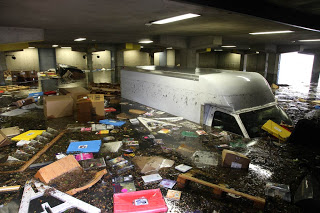
Yesterday, rain descended on Louisville in a big way, and one of the places hit especially hard was the main public library. I watched Twitter posts and pictures roll in from my friend and fellow LSW member Greg Schwartz and couldn’t believe my eyes. They’re estimating $1 million in damage right now (books, servers, computers, bookmobiles, everything).

So Steve Lawson has started a project in the name of the LSW. Our goal: $5000. Here’s the official announcement from his blog (recreated here for your convenience and through the glories of his CC license):

I have set up the email LSW.LFPL@google.com and linked it to my PayPal account. I intend to collect money at that address until September 1, at which point I’ll send a check in the name of the Library Society of the World to the LFPL Foundation. You can just send money to that email address using PayPal, or use the button below:

[This button works much better on Steve’s page.]

If you’d rather send a check, send it to the Library Society of the World Clubhouse, PO Box 7893, Colorado Springs CO 80933. Make the check payable to Steve Lawson.

Don’t worry about how much you can afford to donate. My own contribution will be small-ish, between $20 and $50.

But there are about 300 members of the LSW room on FriendFeed. There are close to 1,000 members of the LSW group on Linkedin. I would like to think we can raise at least $5,000 for LFPL by September 1. That’s only $17 per FriendFeed member, or $5 per Linkedin member.

For this to work, you have to trust me. I promise that every dime that comes through PayPal or check will go to LFPL. (PayPal takes a small cut if your donation is charged to your credit card (rather than your bank account) and if you don’t choose the option to pay those fees yourself, so it’s possible that I won’t get the full amount of your donation. I’ll only be able to donate the money I actually receive after PayPal fees.)

On September 1, I’ll total up what we have raised and send it to the library. If you would rather give money yourself instead of sending it to me, here is the address and phone number given in the Louisville Courier-Journal:

The Library Foundation
Attn: Flood
301 York St.
Louisville, KY 40203
(502) 574-1709

Five thousand dollars or more for Louisville Free Public Library by September 1. Think we can do it? I’ll keep you posted.

I think we can do this.

Leave a Comment
css.php