Skip to content

Month: May 2008

A Dose of History

Scoville

This week a student came to do a staff development presentation for us here in the library. He’d done his senior thesis on the history of the library building and the stylistic metaphors each incarnation used as a foundation.

I was completely captivated. I wish I’d taken notes because now the talk is receding into a mysterious and tantalizing blur of impressions and phrases. “The second building to be built on campus was the library.” … “The original library was built in what was, at the time, the quintessential library style. Anyone would have looked at that building and known it was a library.” … “The 1956 building strove for universality of style, a very modernist enterprise.” … “Two art history professors were the driving forces for bringing buildings in the modern style to Carleton.” … “The 1984 building was designed to fit with the buildings that made up its context.”

I haven’t been able to find an image of the 1956 version of our building, but what I found striking about the remodel wasn’t brought up in the talk. The 1956 building (which I can’t find an image of, sorry) had a grand “drawbridge” entrance, which was supposed to “usher students into the halls of learning” or something like that. But it also had the effect of making the library something that stood apart, something that you had to cross a long bridge to get to. The new building entrance seems to lean forward to be part of the campus rather than reserve itself as a hallowed destination.

8 Comments

The Midwest Library Technology Conference

For the last couple of months, I’ve been helping to plan a conference. It’s been a very interesting experience. Exciting, confusing, thrilling… all at the same time. But it’s shaping up even more nicely than I had dared to let myself hope. We have two days of sessions planned. The second day will be all hands-on workshops. The first will be sessions made up of one primary speaker to set the stage for a few people to show how the topic at hand played out in their work lives, all of which will be followed by discussion.

One of the most interesting parts of the experience for me has been sitting in the planning meeting and listening to everyone’s vision of the ideal conference and then making as much of it as possible happen amidst the practicalities of real life. What can we realistically pull off this year? What should we put on the list for next year and the year after? And now, with registration open, I still can’t really believe my ears when I hear that people are signing up. This is really going to happen! And you know what? I think it’s going to be really fun.

John Reidl (who’s talk last year is still one of the most interesting keynotes I’ve ever heard) will open the show, and Rachel Smith and Alan Levine of the New Media Consortium will speak in the middle of the first day. There’ll be sessions on things like cyber scholarship, open source, taking our public services online, and managing digital collections. And there’ll be workshops on everything from usability testing and multimedia content creation to Facebook and digital archiving.

If you’re interested, registration is easy and the price is low. I highly recommend it, though I do say so myself.

4 Comments

One of My Blogging Blindspots

People talk about blogs being conversation spaces in a large part because of their comment features. And I love the fact that people can comment on blogs. I get ridiculously excited when people comment on the posts I put up here (seriously, every single time it’s like I’ve never gotten a comment before). And I like the option to respond to other people’s thoughts (though I do this far too rarely). But I almost never think to check other people’s blogs to see if there’s a conversation unfolding in their comment threads. Except for a handful of times over the last three years, someone else has had to say something like “did you see that comment on so-and-so’s blog?” before I’ll remember to go check on these things. Personally, I think the fact that I read blogs through my RSS reader hinders my comment reading. I rarely click through to the posts themselves. But clearly other people are able to do it, and I know they’re using RSS readers, too.

I won’t say this is my biggest weakness as a blogger, but it’s right up there. So I’ve been watching with interest as other blogger–librarians undertake the 2008 Comment Challenge. And while I watch them work through this challenge, I’ll try to think about my own commenting and comment-watching practices. How important is it that I watch comments? Am I OK with my default mode of catching up with comments when somebody else reminds me to go look? If not, is there a way that I can remember to check comments on other people’s blogs that fits into my online lifestyle?

Those of you that have this thing figured out. How do you do it?

p.s. Goodness! I just realized I missed my blogaversary… over a month ago! This blog is now entering its third year.

13 Comments

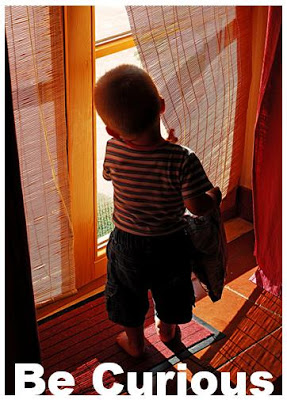
Passion Quilt: Be Curious

Ever since Greg tagged me, I’ve been mulling over a seemingly unanswerable cluster of questions. It goes something like this: “What? I have to choose just one thing? And how can I quantify ‘most passionate’ when I’m not given to passion? And it should probably be serious, right? And… one thing? Really?”

As often happens, I learned what it was that I wanted to say when I wasn’t actively thinking about this challenge. All of a sudden, while munching my sandwich and mentally rehearsing an upcoming instruction session, the phrase “Be Curious” popped into my head. Without curiosity libraries, childhood, and life would be pretty barren. And thus my Passion Quilt contribution was born.

Places to go from here:

The original meme rules (with commentary):

  • Post a picture from a source like FlickrCC or Flickr Creative Commons or make/take your own that captures what YOU are most passionate about for kids to learn about…and give your picture a short title. (Check, though I must say that if you search Flickr for “curious” you get a boat load of cute cat pictures.)
  • Title your blog post “Meme: Passion Quilt” and link back to this blog entry. (Mostly check and check.)
  • Include links to 5 folks in your professional learning network or whom you follow on Twitter/Pownce. (Clearly my rule-following ability can only be sustained through one and three-quarters rules. Consider yourself tagged, or not, as you wish.)

Technorati technorati tags: passion_quilt

Leave a Comment

The Whirlwind Class

After my first year here, when I realized that I needed to sell the power of a library instruction session from the inside rather than the outside (meaning, by actually teaching rather than begging for time) to those departments that hadn’t made much use of my services, I came up with a plan. The plan was to point out that students would come seek me out for help if they knew my face and could see that I’m a real person and not scary or mean or intimidating or any of those things. I pointed out that if professors were structuring their classes in a way that relied on their students coming to me rather than having me come to their class, they’d have to give me at least a little face time.

For reasons I’ve described before, this mini-class idea was especially important to the language departments, but it wasn’t just them. In a 10-week term, pretty much every professor is jealous not of hours, but of minutes of class time. It’s been one of the most interesting challenges of my time here to figure out a) when library sessions really are important and how to explain that to faculty, and b) when they’re not as important, and how to get students the help they need without the structure of a classroom.

So here I was, offering whirlwind sessions of 10, 15, or 20 minutes here and there. I’d bop in, hand out my trading cards and maybe a subversive handout, explain how to find my Availability Calendar, and then teach the class one thing that so boggled their minds that they’d realize I might be worth coming to see with questions later. My goal was to teach something that the teacher wouldn’t have known. Something flashy. Something so pithy and assignment-relevant that if this was the only thing these students learned all term, I’d be ok with that. And you know what? This is very very hard to do. I put more time into preparing these mini classes than I do into most of my hour-long classes.

And for the most part, I’ve been very pleased with them, and several of them have grown over the years into either longer sessions, or into more sessions over the course of the term. But they’re certainly not good for every situation, or even most situations. They’re really only good if several conditions are met:

  • It’s an upper-level class
    I have zero time to cover the basics.
  • Students will be working on wildly different topics
    I’ve had times when students did come to me after my whirlwind class, but I spent the first half-hour of every appointment going over the very same processes and resources… NOT a good use of anyone’s time.
  • I get the first portion of the class period, not the last
    Even when I finish my bit on time, the sessions usually stretch on as the professor and/or students ask questions. Of course, this leaves me in the odd position of having professors who think I accomplished a lot in 15 minutes, when really I was in their classrooms for twice that long.
  • I don’t have too many of them in a term
    They take a long time to prepare, and I would never have time to see every student in every class in every department I serve as an individual appointment.

Still, they do serve their purpose sometimes, and if nothing else, it’s a foot in the door. Still, I’m becoming a little bit uncomfortable with the thought that I might become known as “the one who can do a 15 minute class.” In reality, this is not enough time, and students do struggle with this stuff, and accessing and deploying the literature of a field is an integral part of becoming a scholar in that field. Simply plunking keywords into databases is only the first baby steps in that process. And really, if professors work with me and tell me what their course goals and readings are, I can craft a longer session that isn’t just an add-on to the class. They can be chalk full of course content and therefore not actually take much away from the incredibly precious minutes in a 10-week term. And I don’t want to undermine the efforts of my colleagues as they also struggle with ways to make their content and expertise an integral part of the classroom experience in their departments.

p.s. Yes… I know… I’ve been tagged. I’ll work on it. Really I will.

2 Comments
css.php