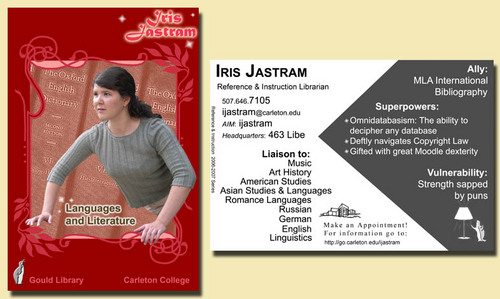

At long last, we’ve had time to put images of our new trading cards up online. You can see all of them here.
Learning in Libraries and Loving It*
I’ve heard from people who want to know what our library has on it’s “Watch List,” so I thought I’d post them here.
But first, a little bit of the back story. If you remember, at the end of last year we had a series of surprisingly interesting and stimulating meetings about out library’s strategic plan (my posts about these meetings are here and here, and now a draft of the plan is available online as a pdf). Part of this plan involves watching trends and developments in the library world outside of our college. So each department made up a list of the things that they either are or would like to be watching, and then the full library staff met to pare the list down to those items that seemed interesting and important to the library as a whole and that meshed well with our strategic plan. Now we have a blog (visible only to library staff, and which I wrote about here) in which we track what we’re seeing, and we use WordPress’ category function to label each post according to the watch list item or items it covers. We can also use the blog space to suggest new items for the watch list, or to discuss taking items off the main list if those topics have stopped being of interest.
And here’s what we’re watching.
Collections:
Electronic, new and emerging formats:
Access to our collections:
Services:
Digitization:
Equipment (hardware & software):
Space:
Campus Initiatives:
Other:
So… I’m thinking of listening to some podcasts. What good ones are out there? I’ve got the SirsiDynix Institute and Talking with Talis. What else should I be listening to? Or should I come to terms with the fact that I don’t have time… No, that doesn’t sound like fun. ;P
2 CommentsUp until this year, librarians have made little tick marks on a grid to indicate questions answered at the reference desk. We had a new grid every day, and we could tick off how many short questions and long questions we answered every hour, as well as how many questions we’d solved jointly with the IT help people, and how many questions we simply referred to the IT people (I’ll write more about our IT help later, but for now suffice it to say that we have joint service point in the library). I hate to think how much time was put into compiling these paper tick marks each week.
But this year, we’ve beefed up our statistics. In fact, it’s becoming much more than a statistics-collection project. We’re building a knowledge base and learning from our co-workers’ reference interactions.
How are we doing all this? We’re using LibStats, a free, open-source, PHP/SQL database designed by library people at the University of Wisconsin, Madison. This term, we’re using the default install which is perfect for reference interactions either at one location or multiple locations. We had grand plans of customizing the install to allow us to track our instruction and appointment statistics and notes, but we ended up simply taking the default settings so that we could get the system up and running in one day. (Seriously, it didn’t take more than a few hours to set up and get the minor field customizations entered. We got our web team to install the database, and then told the system what values to include for things like “patron type” and “question type.”)
Check out the demo, if you want to play around, but here’s a little run-down of what it does and what I like. You can specify location, patron type, question type, time spent, and librarian VERY easily. Then you can either click “Save Question” or you can type in the question and the answer before saving. You can also go back and change saved questions, backdate them, or add comments. (We use this to help each other out with questions, build in more complete answers, and so on.) We also each initial our questions, which helps with follow up. (It also means that you can filter to see how many questions you have answered this week, which is fun.)
My favorite feature, other than how completely easy it is to use, is that the database remembers your settings so that, for example, when I’m in my office and want to enter an email question I got, I open the database and it remembers that last time I worked from this computer I was in my office, so that location code is already selected for me and my initials are already suggested for me. Or if I go out to the reference desk, I don’t have to specify “Reference Desk” as a location because it remembers that from the last time that computer was used. It remembers all the values you specify, simply adding a date/time stamp to each entry whenever you click “save.” This drastically reduces the necessary clicks.
You can also search questions by keyword, and this is where the knowledge-base comes into the picture. Our database is only 5 weeks old, but already I can search to find passwords to things or for answers to those questions where you know the answer is right under your nose but you can’t think of it. We can also mark trends in questions, so it’s easier for liaisons to get in contact with their professors and say, “hey, we’re seeing a lot of questions about your numerical essay assignment.”
I can’t speak for my co-workers, but I know that this has helped me keep track of things like the questions I get at home or in my office via email. Now I can access the database from anywhere and just enter my question and answer. No more remembering to run out to the desk and make those little tick marks. And we’re hoping to do some database customization over winter break that would allow us to check a box saying that the question still needs attention, which would allow us to flag questions needing follow up, or use the system more like a trouble/ticket system.
Oh, and you can do queries and reports (there are some default reports, but for everything else you’d need to know SQL), or you can do a data dump into Excel and play with data to your heart’s content.
5 CommentsYesterday was impossible. The entire library came to a standstill (or at least a slow and distractable crawl) at the news that one of my co-workers was having a baby. But, after an entire work day of not getting any work done, the news came that mother and daughter were doing fine.
Then there was celebrating… and then students started shushing us… and we retorted that since we’re on the fourth floor and since it was a special day, we could make a little noise.
Now we all wonder what we’re going to do at the baby shower we’d planned for next week…
Congratulations Ann!
[Update: here are some pictures]
Leave a CommentHead on over to See Also, where Steve Lawson writes thoughtfully (as usual) about the connection between research and writing, information literacy, and the differences and similarities between librarians and disciplinary faculty.
To what extent should librarians help students see multiple sides of the scholarly conversation, develop their own arguments, or give other advice about constructing effective presentations? The only answer I have is “it depends.” It depends on a lot of things, but one of the most important is the librarian’s relationship with the professor. I know one professor, for example, who encourages her students to meet with me as they’re deciding on a topic, as they’re writing their papers, or at any other time in the iterative writing process. She and I in effect double team the students, pushing them to think not only about the answers to their research questions, but also about what makes a good research question in the first place. On the other hand, I know professors who bristle if I do anything more than teach the difference between keyword and subject searching. One professor would prefer me not to talk about evaluation of sources because that’s something properly done during office hours and by “struggling through” drafts.
While I would never suggest that librarians should usurp the professor’s role, I think that there are three specific ways in which we are uniquely placed to help students as they learn to engage with sources. First and most obviously, we are trained to think in terms of sources. We can make educated guesses about whether the information sought would be collected in a compilation, submitted to academic journals, explored in depth in a monograph, reported on in the news, or entered into an encyclopedia. We are adept at jumping straight to the questions “who would publish about this and where would they publish it?” Over the last few weeks, I’ve become acutely aware that most students cannot make educated guesses about these sorts of things. They just guess.
Second, we do not grade students. I’ve had students express confusion to me when they wouldn’t have jeopardized their standing in class to ask a “stupid” question. And I’ve had a couple of good responses from professors who, when I alerted them to a pattern of confusion in their classes, took steps to alleviate that confusion.
Third and most important, librarians are not usually as deeply immersed in the particular subject matter at hand as are the faculty. This often seems like a liability since we can’t simply pull related facts and theories out of our memories and construct searches from this base of knowledge. But far from being a liability, this is actually our greatest advantage. Because we don’t simply “know” the topic at hand, we get to model learning about the topic with the student. The hardest part about this is remembering to narrate our thought processes to students as we work together. I was reminded of this earlier this week when a student asked me how I knew which record in a result list to open. I explained that I didn’t and then consciously narrated through scanning the result list, picking up on clues from publication types and titles, looking at years of publication, and so on. Then I’d click on the record and narrate what I was seeing: title, author, publication name, subject headings, abstract. All this is new to students (especially first year students, though some seniors are almost here), but after a few minutes of this type of modeling most students will begin to take ownership of the search, suggesting new directions, pointing out records to open, and eventually running off to continue on their own. When we model learning, taking notes, going back and modifying old searches, picking up on clues, and getting excited when we find a juicy article, we’re not only helping students locate the information they need, but we’re also helping them learn the art of research.
On a related note, I would add that in addition to negotiating where librarians’ skills overlap with and complement disciplinary faculty’s skills, we should also consider how our skills overlap with those of the writing professionals on our campuses. Last spring I was invited to attend a meeting of writing professionals in our region, and it was eye-opening for all of us to realize that we both think about our jobs in similar ways, and that we both work with students on the same projects. And yet, students are trained not to expect too much help with mechanics and “proof reading” at the writing center. Writing professionals and faculty both expect students to learn about constructing effective arguments when they work with writing tutors. Why should it be so different for librarians? Just as writing tutors work with writers more than with papers, so also academic librarians are in the business of working with researchers, not simply of providing research.
Leave a CommentJennifer over at Life as I Know It pointed me toward a new blog and a new idea, all in one post. The new blog is Library 2.0: An Academic’s Perspective by Laura Cohen (into my aggregator she goes….), and the new idea is that of making library web pages in the form of a wiki.
Here’s what Laura writes:
There are some people who rightly sing the praises of the Ann Arbor District Library because its site is blog-based. However, blogs are restrictive relative to wikis in that the typical user cannot create an entry but only comment on it. In the library context, librarians are in control of their Web site content and users can only respond. This is valuable, to be sure, but in terms of radical trust (a Library 2.0 buzzword), it falls short. […] The technologies exist to make library sites a joint venture, in which librarians and their constituencies work together to create an online presence that hears voices from both sides of the fence. In a way, this type of site would remove most of the fence.
This is an idea I haven’t heard before, and just based on that I’m inclined to say “Cool!” That’s my default reaction to ideas that bring together fun and usefulness, interaction, learning, and (hopefully) improved service. And I think this idea has the potential to be meet all of those coolness criteria.
However, my personal experience causes me to pause, just a little. Would the presence of wiki functionality actually increase participation? I’m not sure. Laura is not advocating a wiki-only approach. She mentions combining wiki and blog bases to come up with a more interactive environment. But the suggestion that a wiki is more interactive than a blog got me thinking.
I know that when I view a wiki, I am hesitant to change the content unless I either own the wiki or I’m one of a small group of people working on a collaborative project. Each page in the wiki looks and feels to me like a draft of someone else’s paper. I’m happy to comment on it and let the other person change the content, but I don’t want to go changing another person’s writing willy-nilly.
In fact, I’m even less likely to change a wiki than I am to post to a massive listserv, and for many of the same reasons. Call it shyness. Call it respect. Call it pathological inability to force myself on someone. Call it what you will, but the fact is that I’ve only written to a large listserv a few times in my life, and I’ve never changed any substantive content on “someone else’s” wiki.
Blogs, on the other hand, present no barriers to me. I’m happy to comment because I’m not fundamentally changing someone else’s work, but I can still add my two cents. And I create my own content secure in the knowledge that even if people disagree with me, all they can do is comment, so all the time I spend drafting will not be wasted. (Well, I guess wasted time could be argued… but we won’t go there now.) Not only that, but my content isn’t going directly to someone’s inbox unless they specifically want ME in their inbox. They can visit me or subscribe to me at will, but I’m not forcing myself on them.
So where does this leave me? I think my answer is still “cool.” I like the idea of including a collaborative and constructive research space where patrons can work with patrons, librarians with patrons, and librarians with librarians, and where everyone can contribute to the research experience. This collaborative space to include blog space for patrons who wanted to write and comment individually or in groups. Patrons should also have note-taking space via the library, citation managers, and the ability to tag and review resources that they find (see this earlier post for more on my wishes for a research portal). But as a library user, I’d also like the basic, predictable structure of an HTML page to organize my experience so that when I visit my library’s web page tomorrow I’ll still know where to find the catalog. What’s more, my reservations are based only on my own interactions with collaborative platforms, so others may have an entirely different take on it.
Ultimately, I end up with a similar reaction to Jennifer’s: I think the ideal research space would include a combination of a bunch of tools and formats which serve users and librarians and which, together, allow for constructive and healthy interaction.
p.s. What is the plural of “wiki”? I’ve seen “wikies” and “wikis” in use. Does it have an official plural? You’ll notice I scrupulously avoided plurals in this post even though that made the language a little wonky.
Leave a Comment
It was a dark and dreary morning when I got to work today to find a large envelope waiting for me. “Another publisher’s catalog,” I thought, as I opened it.
But it wasn’t a catalog. It was a stack of copies of an article I wrote with one of my library school professors and which has just been put out by Online Information Review. Suddenly the day doesn’t seem quite so dark and dreary.
Zhang, Jin and Iris Jastram. “A Study of Metadata Element Co-Occurrence.” Online Information Review. 30.4 (2006): 428-453.
p.s. This is also my 200th post!
6 CommentsSearch and discovery is changing rapidly in libraries. Last January the North Carolina State University Libraries overlaid their ILS with an Endeca-powered search interface (here’s their catalog, and here’s their announcement from last January). This caused quite a bit of talk about dis-integrating out library systems and was a key feature in my research into the future of the catalog (see my list of related posts below).
Since then the NextGen Catalog listserv has undertaken to plan out the catalog of the future and WorldCat has gone open-access and web 2.0-ish.
And last night, ResourceShelf alerted me to the fact that McMaster has just overlaid their catalog with Endeca (Endeca press release here and McMaster’s news item here). If this trend continues I see three possible futures for our catalogs: our ILS vendors will improve their search interfaces, third party search vendors will get better and better at working with MARC and library ILSs, or (best of all) both the previous two will happen and libraries will have a real choice in search and discovery systems and functionality for the first time.
Related posts:
Most of my co-workers spend most of their time working with juniors and seniors. They teach classes for these more advanced students, and their appointment slots fill up with students needing complex data, high-level scientific research, or rare primary sources.
I, on the other hand, have spent my time this fall almost exclusively with freshmen. In fact, so far this term I’ve only had two appointments with seniors. And because I’m the liaison to the English department, and because most freshmen take various incarnations of English 109, I end up teaching classes mostly for freshmen. Consequently, I find myself teaching an entirely different genre of class than my co-workers do.
In some ways, I have it easier. I don’t have to worry about those left-field questions about SciFinder Scholar, and I don’t have to worry about my status as a non-expert in whatever field the students are studying. Hey, they haven’t even chosen majors yet!
On the other hand, though, these are hard classes to teach. The research topics range far and wide when the only requirement is to “write a research paper,” so it’s hard to choose a resource for them to learn that will benefit everyone in the class. The students are also inundated with introductory sessions for academic services, so they often come in prepared to be bored. And besides, what do you leave out when they need to learn about database searching and catalog searching and finding encyclopedia articles and evaluate web pages… All this and they don’t know how to read a call number, let alone understand that you can’t look up journal articles in the catalog. I also don’t get to delve into the really fun stuff – the advanced searching techniques, the specialized bibliographies, the thrill of the hunt.
Not only that, but the “everything’s on the web” attitude is now compounded with a new assumption: everything has always been on the web. Last week I had a student looking for government information from 1985-1990. The state government agency in question had digitized documents back to 1993, but not to 1990. “Why didn’t they archive their older web pages?” the girl asked me, bewildered. It took me a minute to realize that she was asking why all the wonderful documents that they’d put up online prior to 1990 had been taken down! As I explained that Google has only been around since 1997, and that the web was pretty much unusable by the general public before 1995, this poor freshman’s eyes got bigger and bigger.
In the face of such confusion, I’ve decided that I have a new mission at work. I’ve stopped being jealous that my co-workers get to prepare their students for complex research projects, and I’ve begun to realize that I have a special place in the library: not only am I perfectly positioned to reach more freshmen than my colleagues, but I actually enjoy the special challenge that these students present. So I will focus on reaching absolutely as many freshmen as I can. I will prepare them so that by the time my co-workers teach them in their advanced classes, these students will not only know the basics, but they will be empowered to experiment freely and ask for help unabashedly. These freshmen won’t know what hit them.
Or maybe I just like to play god. Bwa-ha-ha-ha.
3 Comments